Rice University's campus plan addresses water scarcity before it becomes a constraint

Houston sits at the center of a paradox. It receives abundant rainfall yet remains increasingly vulnerable to shortages of reliable freshwater supply due to regional population growth. This paradox impacts planning for university campuses due to the dependance on water for building systems, research, landscape identity, and other aspects of daily life.
Rice University, a comprehensive research university in Houston, recognized these pressures and made a deliberate decision to address water scarcity before it became a constraint, and to do so in a way that strengthens resilience and supports long-term sustainability.
The university engaged Walter P Moore to develop a holistic water management and resilience plan. The goal went beyond fixed reduction targets to evaluate tradeoffs, understand operational realities, and develop a long-term strategy grounded in how the campus actually uses water.
Setting Goals That Scale
Static targets are not enough. Water demand changes with campus size and performance, so a single cap on total consumption, while simple, loses meaning in an advancing world. Instead, the water plan tied performance to scalable metrics—such as water use per square foot, per irrigated acre, or per campus user—allowing progress to be measured consistently even as the campus evolves.
The team grounded its analysis in studying current operations, combining metering data with input from campus facilities teams to map where potable water is used and where intervention matters most. The analysis reaffirmed that effective water management requires more than reducing overall consumption. It requires matching water source characteristics—reliability, cost, timing, quality, and storage needs—to specific campus demands.
Matching Supply to Demand
Two findings reinforced a key principle of the study: Water stewardship is not simply about identifying alternative supplies, but understanding which sources are best suited for specific operational demands.
Rainwater often arrives in large volumes and is well suited for irrigation but occurs intermittently, making storage a key challenge. At the same time, the campus already requires additional stormwater detention as it grows. By integrating weather-smart control systems, those required detention systems can also support water reuse—capturing stormwater for irrigation and reducing potable water demand without significant additional infrastructure.
Other water sources offer a different advantage: reliability. Building dewatering systems, while typically unseen to the public, can provide a steady flow that aligns with continuous campus demands such as cooling towers. Because the supply can often be used immediately, little or no storage is required. This reduces both infrastructure needs and potable water demand.
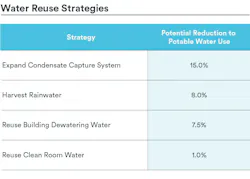
The Rice University study found that one existing building dewatering system could offset approximately 7.5% of annual campus water use, with a payback period of just over three years. This finding highlights the value of matching source characteristics to demand profiles rather than treating all water as interchangeable.
Planning for What Comes Next
With these strategies identified, the next challenge was understanding how the strategies would perform as the campus grows. For instance, expanding building square footage increases cooling demand. That increased cooling demand may also create opportunities for additional condensate capture, a water supply that is well suited to cooling tower makeup. Another strategy to consider is to plan for changes in landscape that affect irrigation demand to include design that creates new opportunities for rainwater storage.
Evaluating these relationships at a single point in time risks prioritizing solutions that work today but fail to scale. To address this, the team used scenario-based modeling to evaluate how future growth, climate conditions, and operational changes could affect both water demand and alternative supply availability over time.
This approach helped identify strategies with the greatest long-term impact, operational feasibility, and resilience value.
From Strategy to Action
The result is a roadmap that sets scalable performance targets and defines how to achieve them. That plan is already translating into action. Strategies such as expanded condensate capture, environmentally responsive irrigation systems, enhanced submetering and monitoring, and leak detection are being implemented across campus.
For Rice University, resilience does not mean using less water at all costs. It means recognizing water as an asset and aligning supply, demand, and system performance more effectively over time.
The same framework can help other campuses and large institutional facilities evaluate how alternative water sources and operational demands evolve alongside long-term growth.
Stewardship means delivering the right water, in the right place, at the right time.
About the Author
Rucker Simon, PE, is a Principal and Managing Director, Houston Civil Engineering Service at Walter P Moore. He can be reached at [email protected].
About the Author
Walter P Moore
Walter P Moore is an international company of engineers, innovators, and creative people who solve some of the world’s most complex structural and infrastructure challenges. Providing structural, diagnostics, civil, traffic, parking, transportation, enclosure, and construction engineering services, they design solutions that are cost- and resource-efficient, forward-thinking, and help support and shape communities worldwide. Founded in 1931, Walter P Moore's 800+ professionals work across 24 U.S. offices and six international locations. Follow Walter P Moore on Facebook, Instagram, LinkedIn, Twitter, and YouTube.