The future of water: Innovative approaches to water management in civil engineering
This blog post was authored by Rucker Simon, PE, Principal and Managing Director, Houston Civil Engineering Service, Walter P Moore.
Across the world, water appears in conditions of scarcity, sufficiency, and excess. Each reveals a different challenge, but all point to the same reality: water’s behavior is natural, while its consequences are shaped by how we choose to plan, build, and respond.
The future of water stewardship depends on more than reacting to site-specific problems. It requires recognizing pressures already here, and challenges still ahead in ways that are sustainable and resilient. It also requires education, transparency, and collaboration among engineers, policymakers, developers, utility providers, and the communities these systems serve.
4 Initiatives to Water Management in Civil Engineering
There is a long list of initiatives one could pursue in the name of “future water stewardship.” For this report, we chose to focus on four that sit at the intersection of high impact, real-world applicability, and where we can help drive meaningful progress: Measure, Reduce, Educate, and Advocate.
1. Measure More
Stewardship starts with measurement that reflects the full picture, not just the number at a meter. Operational water use is only part of the story. Water is embedded in construction materials, energy generation, hardware, and site preparation, and those impacts will increasingly shape what water responsibility looks like at the project and regional scale.
Data centers make this especially visible. As artificial intelligence and high-intensity computing grow, so do the water demands tied to building and operating the infrastructure that supports them. Cooling strategies carry tradeoffs in water use, energy demand, cost, and performance. Climate, seasonality, and local availability influence what is feasible and what is responsible.
For civil engineers, stewardship begins before a facility is built, identifying reuse opportunities through water-balance thinking, and context-sensitive siting that looks past water conservation measures to water positivity that can support surrounding infrastructure, nearby residents, and long-term community resilience.
2. Reduce Waste
In the near term, the most actionable progress comes from integrating existing practices, technologies, and strategies to better align demand with available resources. That means moving beyond isolated fixes and treating water management, water quality, reuse, and runoff as parts of an interconnected cycle that spans natural and built systems.
This shift is urgent because water challenges are not isolated. In some places, aquifers are under pressure and freshwater is limited. In others, larger rainfall events create more runoff, increased flood risk, and heavier pollutant loads. Scarcity and excess can occur simultaneously, shaped by geography, infrastructure, and growth patterns. Responding effectively requires evaluating water supply, storage, conveyance, treatment, and demand as a system over time, and defining “success” in context so project-level gains contribute meaningfully to the needs of a region, watershed, or basin.
3. Educate Through Design
A critical part of the future is making water systems visible and understandable, not hidden and abstract. Translating technical solutions into forms that are meaningful to the public reduces uncertainty, builds trust, and supports informed decision-making.
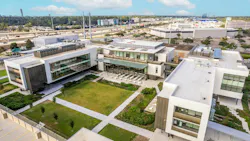
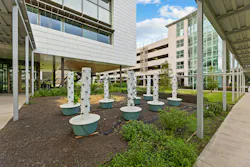
That is why education-ready projects matter. At The Awty International School in Houston, stormwater requirements and resiliency expectations increased significantly following Hurricane Harvey. Rather than treating those requirements as something purely utilitarian to hide underground, the project team leveraged the opportunity to put environmental systems on display. The campus design includes cisterns and rain gardens that capture, filter, and temporarily store rainwater, while also creating visible learning environments for students.
By making the systems visible and accessible, these spaces gives students an opportunity to learn about complex environmental systems, planting seeds for future engineers and designers who will inherit the next chapter of water stewardship.
4. Advocate for the Future
Long-term stewardship also requires shifting expectations, not just improving individual projects. Water stewardship cannot rely on incentive programs or isolated strategies alone. It must become part of baseline practice through codes, standards, planning, and development policy. Moving from reactive to proactive stewardship means establishing climate-responsive requirements for storage, reuse, adaptability, and long-term performance, so resilient water systems become standard practice rather than project-specific alternatives.
It also means designing for projected conditions, not only historical ones. Many practices still rely on recurrence-interval storms derived from past rainfall records, even as climate variability challenges those assumptions. The upcoming Atlas 15 rainfall projections reflects how storms are expected to change as temperatures rise, and points toward a future in which design storms grow more intense, and flood risk increases. Responding does not simply mean building larger pipes. It means creating more storage, greater flexibility, and better alignment between intermittent water sources and reliable demand over the life of infrastructure.
The future of water stewardship will depend on ingenuity at every scale, from individual sites to regional systems, and from today’s infrastructure decisions to tomorrow’s policy frameworks. It will be shaped by choices that can be implemented now, strengthened over time, and carried forward through real projects with clear community value.
About the Author
Rucker Simon, PE, is a Principal and Managing Director, Houston Civil Engineering Service at Walter P Moore. He can be reached at [email protected].
About the Author
Walter P Moore
Walter P Moore is an international company of engineers, innovators, and creative people who solve some of the world’s most complex structural and infrastructure challenges. Providing structural, diagnostics, civil, traffic, parking, transportation, enclosure, and construction engineering services, they design solutions that are cost- and resource-efficient, forward-thinking, and help support and shape communities worldwide. Founded in 1931, Walter P Moore's 800+ professionals work across 24 U.S. offices and six international locations. Follow Walter P Moore on Facebook, Instagram, LinkedIn, Twitter, and YouTube.