Boston’s oldest city-owned property transformed into all-electric, fossil fuel-free workplace
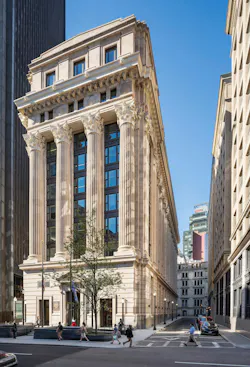
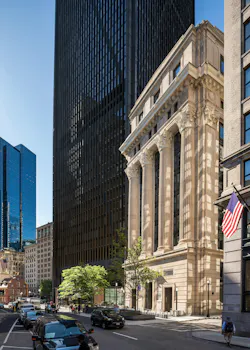
A renovation of 26 Court Street, on Boston’s oldest city-owned property, transformed the building into a modern, all-electric, fossil fuel-free workplace.
The five-year project preserved 89% of the historic 1912 structure and is a model for how cities can revitalize aging civic infrastructure while preserving architectural character and advancing ambitious climate goals, according to a news release from project architect CambridgeSeven.
26 Court Street is the oldest plot of land continuously owned by the City of Boston, with records dating back to 1635. The current building was constructed in 1912 as the City Hall Annex, serving that function until 1969, when it became the headquarters of the Boston School Department.
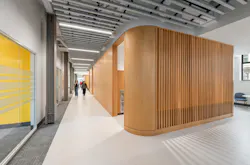
The building now provides workspaces for multiple city departments, including the Public Facilities Department, Mayor’s Office of Housing (MOH), Office of Economic Opportunity and Inclusion, Environment Energy and Open Space, Mayor’s Office of Art and Culture, Office of Food Justice, Office of Historic Preservation, Veteran’s Affairs and Human Resources.
The 175,000-sf building is composed of 11 stories of office and meeting space, three levels of below-grade basement space, a reimagined lobby, and a universally accessible plaza on Court Street that returns the main entrance to the original north façade. The project also widened surrounding sidewalks and added EV charging stations, bike racks, and flag poles.
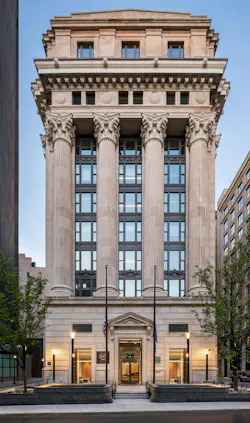
Targeting LEED Platinum certification, the fossil fuel-free building significantly improves energy performance through upgraded high-efficiency windows, enhanced insulation, and advanced mechanical systems.
The project also required installation of a new transformer vault within the existing building envelope—replacing infrastructure once used for coal-fired boilers—to support the building’s full electrification while minimizing impacts to the historic exterior.
By renovating and modernizing the existing structure rather than pursuing new construction, the project is estimated to have saved 50%–75% in carbon emissions compared to a new building while preserving an important piece of Boston’s civic and architectural history.
On the building team:
Owner and/or developer: City of Boston
Design architect: CambridgeSeven
Architect of record: CambridgeSeven
MEP engineer: RFS Engineering (M+E), VAV International (P)
Structural engineer: WSP
General contractor/construction manager: Shawmut Design and Construction