5 emerging design trends in university student housing
This blog post was authored by Brady Jobe, Senior Associate and Director of Collegiate Projects, Kirksey Architecture.
The dreary cinderblock dorm rooms that many of us remember as a rite of passage from our undergrad days would now be unfamiliar to most first-year students walking onto a college campus today. Student housing has leveled up in recent years as preferences for new living arrangements, sustainable materials, and building conservation are transforming student housing for the better.
5 Emerging Design Trends in University Student Housing
At Kirksey, we’ve designed over 20 student housing projects, totaling more than 9,000 beds at colleges across the country. Here are five trends we are beginning to see and incorporate when designing on-campus housing and valuable amenities for undergraduate students
1. Wellness Amenities
Wellness has become a major focus for residential life staffing at universities. Students’ mental health is at an all-time low, so wellness is a top priority in the design of university buildings. Features such as natural light, biophilic materials, patterns, and air quality all have proven benefits to mental health and humans’ relationship to nature. Increasingly, our clients are incorporating these elements in the design process.
Mass timber is becoming more popular in student housing. The natural material adds warmth to the structure of the building. While typically only about 30% of the wood remains exposed, it serves more as a powerful tool for introducing biophilic elements into the built environment than as a standalone wellness element.
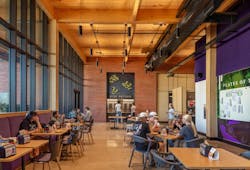
Biophilia, the interaction between humans and nature, positively impacts students’ mental health, helping with anxiety, depression, and the challenges many of the undergraduates feel when away from home. For this purpose, mass timber works well for repetitive applications, offering the added benefit of cost efficiency. Off-site prefabrication and faster, more predictable installation allow beds to come online sooner, significantly reducing construction schedules.
Not only do these elements support mental health, but they also enhance cognitive function and academic performance.
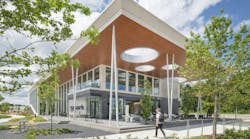 Photo courtesy Hanbury
2. Places that Foster Community
With so many students away from home for the first time, fostering community on campus is vital to supporting student mental health. Design can help foster these connections. “Pod-style” housing—once a curiosity—is now becoming the standard for universities seeking cost-effective first-year housing.
This arrangement, which features student rooms surrounding community spaces like restrooms, can encourage connection and social interaction while maintaining privacy.
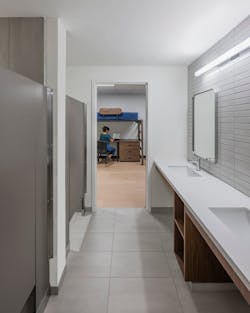
Pod-style housing has become an effective strategy for balancing privacy with community in first-year residence halls, and Kirksey has incorporated this approach on multiple projects, including the renovation of Collins Hall and Memorial & Alexander Halls at Baylor University. In these communities, student rooms are organized around shared social spaces, with restroom pods distributed throughout the floor rather than concentrated in traditional gang-style facilities.
Each restroom contains private, individual fixtures that offer greater comfort and dignity for students while still encouraging interaction in the surrounding lounge and circulation areas. By dispersing these facilities evenly across the community space, students no longer need to walk down long hallways late at night to find a restroom, which improves both convenience and privacy.
This arrangement also activates the surrounding lounge areas, naturally encouraging students to gather, study, and socialize near these shared amenities. Similar pod-based configurations have also informed recent housing programming efforts for the University of Houston and the University of North Texas, reflecting a broader shift toward residential layouts that foster connection while respecting students’ need for privacy.
3. Flexible Gaming Lounges that Support Esports Culture
Esports participation is a growing trend among college students. Designing spaces for community gaming can reduce some of the isolation and loneliness that universities cite as drawbacks to gaming. The goal of creating an esports community space is to help introverted gamers engage with the broader community in shared spaces.
While many gamers prefer to play independently, designers need to be strategic about where the gaming lounge is located. A gaming space near a community kitchen, restrooms, and laundry rooms encourages more interaction points between games.
While Kirksey has not yet designed a standalone esports arena, our team has begun incorporating flexible gaming lounges within residence halls that support both casual gaming and broader student engagement. At Baylor University’s Memorial and Alexander Halls, for example, a dedicated gaming lounge was designed as a multipurpose social space that can quickly transition between everyday lounge use and an active gaming environment.
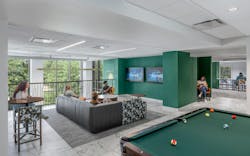
The space includes multiple televisions, easy plug-and-play connectivity for gaming consoles, and flexible furniture that can be rearranged for groups of players or spectators. Students might gather there to watch television, relax between classes, or quickly transform the room into a lively gaming area for a round of Mario Kart or other multiplayer games.
By integrating gaming within a shared lounge environment rather than isolating it, the design encourages students who might otherwise game alone to interact with peers and participate in the larger residential community. This approach reflects the growing recognition that gaming spaces, when thoughtfully located near other shared amenities, can become important social hubs within student housing.
4. Dining Halls-of-fame
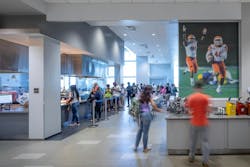
Depending on a university’s master plan, dining halls have quickly become a defining feature and a key amenity valued by students. As the Kirksey team often notes, when it comes to dining, “every seat should be a GREAT seat.”
A successful dining hall should offer a variety of culinary experiences and flexible seating options that cater to different needs, whether students want to spread out and study or gather with friends over a meal. It’s also an ideal opportunity to weave in student life and campus history, creating a space that embodies the spirit of the university and allows students to truly immerse themselves in their campus’ culture.
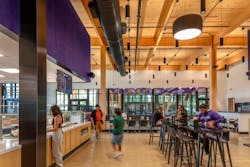
Some universities are taking this concept a step further by activating dining spaces beyond traditional meal hours. In some cases, food stations close in the evenings, allowing the space to transform into collaboration zones and provide 24/7 seating access for students.
5. Prioritizing Sustainability & Renovation
Renovation builds and rehabs, rather than new builds, are becoming an increasingly prominent trend in campus housing. With tariff impacts driving up construction costs, renovation often presents a more cost-effective and strategic solution. Unlike ground-up projects, existing campus housing already benefits from the most valuable amenity—its location.
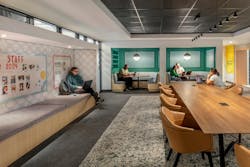
There is value in the historical significance and legacy of existing residence halls. Kirksey recently worked with JE Dunn on the renovation of the first-year women’s residence hall, Collins Hall, on the Baylor University campus in Waco. The goal was to create spaces that protect its rich community life and showcase its history while providing all the modern amenities students have come to expect.
The result is a blend of traditional details and fun feminine accents that create a welcoming, vibrant, and supportive community for first-year Baylor women.
By focusing on thoughtful renovations, universities can modernize and enhance their facilities while still preserving and making upgrades a smarter and more sustainable investment.
About the Author
Kirksey
At Kirksey, we greatly value each other, our clients, our community, and our earth. As architects, designers, and planners, we believe it is our responsibility to design high-performing, healthy buildings that positively impact the people, environment, and communities they serve. We do this by creating facilities that are resource-efficient, site and community enhancing, and provide a healthy and enjoyable experience for the people within them.