Student dining: Design strategies to nourish belonging
This blog post was authored by Greg Pinter, AIA, LEED AP, Principal, GBBN; and Zachary Zettler, AIA, LEED AP, Principal and Director of Higher Education, GBBN.
Connection to community and a sense of belonging have a direct impact on student satisfaction and retention. No place on campus is this truer than the dining hall. Creating dining halls that nourish a sense of belonging can also impact revenue as students seek it out, linger, and keep their dollars on campus.
Specific design strategies can help students—especially first-year students or introverted students—feel less exposed and vulnerable entering the dining space. These strategies include creating transitions, seating choices, and leveraging location.
Creating Transitions
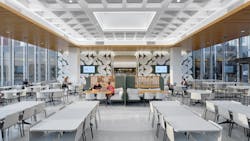
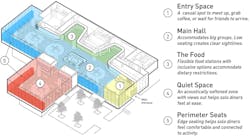
Research reveals that what seems like a simple act—choosing a seat in a crowded room—is actually a complex psychological process impacted by the qualities of the environment and the presence of other people. MarketPointe, at the University of Cincinnati (UC), serves primarily first-year students who are making these kinds of calculations as they arrive to eat.
To help them, MarketPointe incorporates a series of transition zones between the busy campus environment and the dining seat to give students a moment to consider their options before being thrust into the middle of the lunch rush.
Providing Seating Options, Especially When Dining Alone
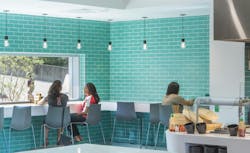
Diverse seating options empower students to feel at ease, particularly when dining alone, by reducing the feeling of being “on display.” This thoughtful approach fosters a more inclusive and comfortable environment.
We employed this strategy at the University of Cincinnati’s On the Green Dining Hall. The high-top counter seating offers a view of campus, making it an inviting spot for single diners.
Leveraging Location
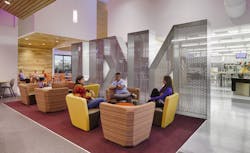
Northern Kentucky University (NKU) has historically been a commuter campus but is becoming less so. Its Norse Commons sits at a campus crossroads and houses a dining hall as well as student mailboxes and administrative offices.
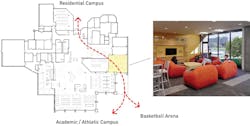
The design of the Norse Commons dining hall leverages its central location—between the residence halls, academic campus, and athletic campus—by incorporating lounge space that flexes between dining and after-hours use. This space invites conversation and a moment for students to touch down going to and from sporting events or build community at pre-game day gatherings, while watching the game or using it as their own gaming space.
Norse Commons’ dining hall features elements that can bring students together in other ways. At the time of Norse Commons’ renovation, NKU’s athletic program had just been elevated to Division 1 and their basketball team had become eligible to play in March Madness. A large sculpture was devised to act as a rallying point for school spirit, allowing students to make it their own by adding notes, posters, and other gear.
Dining options play a significant role in attracting and retaining students today. They are a crucial factor in choosing a school, so it’s essential to adapt the design and operation of these dining spaces. Traditional dining models are no longer sufficient for modern campuses. Attractive, flexible, and welcoming dining facilities meet students’ cravings for diverse seating options, are more equitable, and support positive student experiences. Designed correctly, these dining facilities can fulfill students’ need for connection, belonging, friendship, and networking.
About the Author
GBBN
We combine creative tenacity, technical mastery, and a global perspective to deliver design solutions that help our clients achieve their goals. Together, we shorten the distance between medical breakthroughs and patient bedsides, set students up for success, connect audiences and artists, and inspire employees to do their best work. At GBBN, we see architecture as mor than just buildings, because positively affecting people is the most important thing we do. Follow GBBN on Facebook, Instagram, LinkedIn, and Twitter.