A Swiss company uses gravity and 35-ton blocks to store energy
South Africa’s Mpumalanga province could get an innovative gravity-based energy storage system with a rated capacity of 25 megawatts and 100 megawatt-hours of storage.
South Africa’s public utility, Eskom, and the Swiss energy storage technology company Energy Vault have partnered to deploy the latter’s gravity-based tech, as reported by Energy Storage News.
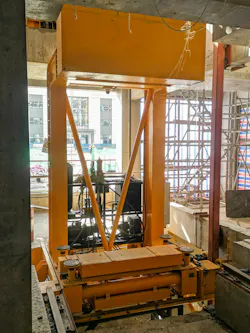
Energy Vault’s system leverages a simple concept: charging by pushing heavy blocks upward inside a tall tower, then discharging by pushing the blocks downward.
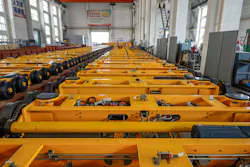
When renewable sources like wind or solar produce more electricity than the grid needs, the surplus energy powers motors that lift the heavy blocks upward. The 35-ton blocks comprise recycled materials such as waste concrete and industrial aggregate.
As the blocks hold their position, they also hold potential energy, similar to a boulder at the top of a hill, AutoNotion writes. The system thus converts electrical energy into gravitational potential energy, or the energy contained in a mass at a certain height—in effect, charging the battery by raising heavy masses.
When demand increases, the motors carefully lower the weights, converting the motion back into electricity that can go to the grid.
Founded in 2017 by Swiss researchers, Energy Vault is among the first companies to invest in large-scale gravitational energy storage.
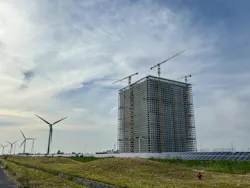
Energy Vault’s first commercial-scale project is located in Rudong, China. According to Domus, the 148-meter-tall concrete structure, almost 40 stories high, looks like a brutalist residential tower. Inside, it’s a giant mechanical battery, storing electricity generated by renewable sources and then releasing it back to the grid as demand rises.
The Rudong system has a storage capacity of 100 MWh and can deliver up to 25 MW of power, providing about four hours of electricity at full output.
Energy Vault is developing similar facilities in the U.S., Domus reports. Other gravity-based energy storage projects include UK-based Gravitricity’s 250-kilowatt system in Edinburgh.