Top 10 sustainable design projects for 2026
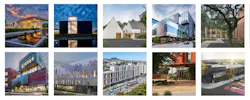
Now in its 29th year, the COTE Top Ten Award highlights projects that meet the AIA Framework for Design Excellence's rigorous sustainability criteria for social, economic, and ecological value.
The COTE Top Ten Award 2026 winners include the net-zero Reich Hall at Marlboro Music in Marlboro, Vt., multiple all-electric projects, including an affordable housing development in San Francisco and a fire station in Marion, Iowa, and the world's first net-positive energy botanical garden.
Entries to the COTE Top Ten Award are reviewed by two bodies in separate sequences: a technical proficiency review panel whose evaluations are shared with a jury for an additional standard assessment. Meet the jury and review panel below.
Here's a look at the 10 winners (text and images courtesy AIA):
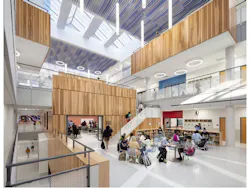
Benjamin Banneker Academic High School, Washington, D.C.
By Perkins Eastman DC (prime architect), Perkins Eastman Architects (associate architect—interiors, FF&E), Moody Nolan (associate architect—interiors), and Dan Curry Architects (associate architect)
Benjamin Banneker Academic High School embodies the determination and excellence of its students, who fought for its realization—securing a new building that reflects their determination and namesake’s legacy. The design centers on a central Learning Commons, a unifying, light-filled atrium ascending to "Skyplace," an open terrace with views of DC’s landmarks. Blending sustainability, community connection, and educational excellence, the Net Zero Energy building fosters collaboration and environmental stewardship. Art and design elements honor Banneker’s legacy while creating a collegiate environment that empowers students as learners, leaders, and global citizens.
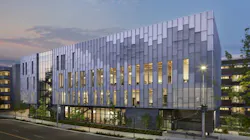
Health Sciences Education Building, University of Washington, Seattle
By The Miller Hull Partnership (architecture, interior design) and SLAM Collaborative (medical education architect)
The Health Sciences Education Building (HSEB) fosters future healthcare professionals by breaking down traditionally siloed healthcare education and embracing a multidisciplinary approach. The building promotes a “Culture of Care,” including mass timber hybrid structure to reduce carbon and occupant stress levels, a textural and reflective building skin designed at a human scale, lush and dappled light-filled outdoor moments to promote connection with nature, informal gathering spaces of various scales and character to create a sense of inclusion and belonging, and sustainable systems and finishes to ensure occupant health and wellness.
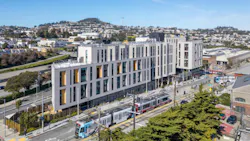
Kapuso at the Upper Yard, San Francisco
By Mithun
Kapuso—Tagalog for “one at heart”—demonstrates how affordable housing can advance equity, climate action and community connection. The project delivers 131 permanently affordable, all-electric homes at Balboa Park Station, one of San Francisco’s busiest transit hubs. Community-serving ground-floor spaces activate a terraced transit plaza with open sightlines, accessible pathways and protective planting, encouraging transit use, safety and social interaction. A sheltered “green heart” courtyard, flexible lounges and landscaped gathering spaces support resident health and daily connection. Low-carbon materials, efficient systems and transit-oriented design create a vibrant, resilient neighborhood that integrates housing, mobility, nature and community.
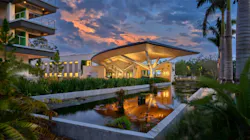
Marie Selby Botanical Gardens – Phase 1, Sarasota, Fla.
By Overland Partners, Inc. and Sweet Sparkman
Phase 1 of the Marie Selby Botanical Gardens Master Plan reimagines a historic site as a regenerative campus embodying the AIA Framework for Design Excellence. Integrating architecture, ecology, and community, the design achieves Net Positive Energy through a 1.2 MW photovoltaic array and Living Building Challenge performance targets. Rainwater systems safeguard the Hudson Bayou, while biophilic design immerses visitors in Florida’s native biodiversity. The Living Energy Access Facility, Welcome Center, and Plant Research Center demonstrate how cultural landscapes can advance climate action, resilience, and well-being creating an urban sanctuary where science, education, and community thrive together as one living system.
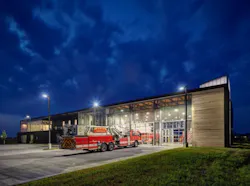
Marion Fire Station No. 1, Marion, Iowa
By OPN Architects
A two-level 21,200-sf fire station reduces emergency response time, establishes a strong civic presence, and uses biophilic design principles to support fire fighters' physical and mental wellness. The all-electric building is highly transparent with full-height glass doors on the north and south elevations of the apparatus bay that maximize daylight and establish a community connection. Glazing continues along the north elevation juxtaposed with shou sugi ban wood, which is charred and paradoxically fire-resistant. Living spaces access two trellis-covered terraces and a green roof. Inside, strategic sequencing of spaces between the bays and office and living areas mitigate exposure to carcinogens.
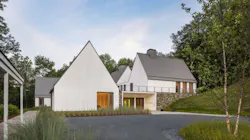
Marlboro Music Reich Hall, Marlboro, Vt.
By HGA
Reich Hall at Marlboro Music exemplifies sustainability, community, and artistry. Nestled in Vermont's Green Mountains, the building integrates seamlessly into its natural surroundings with a design inspired by Cape Cod cottages. Featuring geothermal heating, passive and active design strategies, and abundant natural light, it exceeds AIA 2030 standards while minimizing environmental impact. Tailored for musicians, its acoustically advanced rehearsal rooms support creativity, while a climate-controlled library preserves the world’s largest chamber music collection. Reich Hall reflects Marlboro’s ethos of connection—between nature, music, and people—providing a flexible, inclusive space for collaboration, creativity, and sustainability in a cherished cultural retreat.
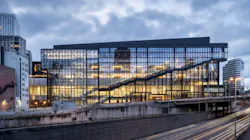
Seattle Convention Center Summit Building, Seattle
By LMN, Graham Baba Architects, Scharrer AD, Rolluda Architects, and Tiscareno Associates
At 1.5 million square feet, The Summit building is the second largest LEED Platinum building in the U.S. and largest LEED Platinum convention center. The world’s first high-rise convention center, program is stacked vertically instead of the typical sprawling horizontal convention center, offering a new model for the typology that centers on engaging community at all scales to connect people to the urban core. The building redefines convention centers, offers a shift in the events industry and seamlessly integrates with the adjacent city neighborhoods. The project emphasizes sustainability while promoting craft and art by local emerging and established artists.
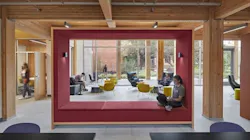
Trinity University Business & Humanities District, San Antonio, Texas
By Lake Flato Architects
The Business and Humanities District merges 11 departments within two renovated historic mid-century modern buildings and the new mass timber Dicke Hall, forming a vibrant interdisciplinary campus core. Outdated spaces became light-filled, active learning environments supported by passive design, systems innovation, and rooftop solar. Dicke Hall reduces embodied carbon by 52% and energy use by 90% compared to baseline, while capturing 100% of condensate to eliminate potable water use for toilets and landscape. The transformation expanded the district’s area by 42% with less than a 1% increase in total campus energy use.
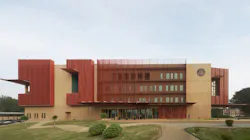
U.S. Embassy Niamey, Niger, Niamey, Niamey Urban Community, Niger
By The Miller Hull Partnership, LLP (design architect) and Page Southerland Page, Inc. (architect of record)
Situated on the existing 10-acre embassy site just north of the Niger River, the new U.S. embassy in Niamey, Niger, replaces existing buildings which no longer meet current standards for security, life safety, and efficiency, and expands others to meet the evolving needs of the diplomatic mission. The design of the embassy respects and incorporates elements of the Nigerien landscape and traditional architecture, where simple materials help to mitigate Niger’s sub-tropical climate. Great care was taken to develop building engineering systems and landscape, stormwater, and wastewater systems which reduce the potential burden of the facility on the local utility infrastructure.
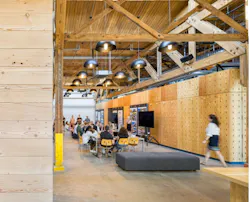
Volta Studio, Portland, Ore.
By Bora Architecture & Interiors
Celebrating the existing building’s industrial warehouse character while demonstrating that carbon and economy go hand in hand, design interventions were intentionally kept to a refined minimum. View windows were cut into the existing concrete wall so occupants can gaze downtown, while strategically reworked existing roof monitors bring in abundant daylight. A new accessible entrance invites visitors into a large central gathering space dubbed the Design Lab, where local community groups frequently host events to nurture human connection. Envisioned as an open workshop where ideas are born, Volta Studio offers a welcoming, healthy, and flexible environment for creative exploration and collaboration.
2026 COTE Top Ten Award Jury
Rand Ekman, FAIA, LEED AP BD+C, HKS (Chair)
Ismar Enriquez, AIA, LFA, LEED AP, Practice
Donald King, FAIA, UW College of Built Environments
Neeraja Pandav, Assoc. AIA, Richard L. Bowen & Associates
Karin Patriquin, AIA, CPHC, LEED AP, Fitwel Ambassador, Patriquin Architects
2026 COTE Top Ten Award Technical Review Panel
Erica D. Cochran Hameen, Assoc. AIA, Carnegie Mellon University
Matthew Conti, AIA, Evolve EA
Ian Cook, AIA, Evolve EA
Sara Curlee, AIA, Pope Design Group
Dustin Davis, AIA, LEEF Fellow and LEED AP BD+C, WDD Architects
Reva Derhammer, AIA, WELL AP, LEED Green Assoc., DELV Design
S. Brady Dietert, AIA, Dietert Design Studio, LLC
Tanya Eagle, Assoc. AIA, LEED AP BD+C, WELL AP, AICP, JLL--Jones Lang Lasalle
Simona Fischer, AIA, CPHC, MSR Design
Lee Fithian, AIA, University of Oklahoma, College of Architecture
Sarah Gudeman, PE, LEED Fellow, BCxP, WELL AP, Fitwel Ambassador, Branch Pattern, Inc.
Lauren Gunther, AIA, CPHC, LEED AP, CDT, DiMella Shaffer
Melanie Islam, AIA, Mason Architects
Katherine Lashley, AIA, Marlon Blackwell Architects
Arjun Mande, AIA, Goody Clancy & Associates, Inc.
Ankita Nalavade, Assoc. AIA, NYC DDC
Crystal Ng, AIA, Curtis+Ginsberg Architects
Caroline R. Perkins, AIA, McMillan Pazdan Smith Architecture
Daniel Piselli, AIA, FXCollaborative Architects LLP
Jefferson Poole, AIA, Goody Clancy & Associates, Inc.
Anna Pravinata, AIA, Alliance
Scott Rodwin, AIA, Rodwin Architecture
Zolna Russell, Floura Teeter
William Smarzewski, AIA, CPHC, LEED AP BD+C, Ewing Cole
Rick Van Diepen, AIA, GRN VISION Sustainability Consultants
Matthew Van Sweden, Assoc. AIA, LFA, LEED AP BD+C, WELL AP, Progressive Companies
Caleb Walder, AIA, LEED AP BD+C, Belmont University
Kertis Weatherby, AIA, LEED AP, Marlon Blackwell Architects
Erica Weeks, AIA, LEED Fellow, ASHRAE Certified Decarbonization Professional, SITES AP, WELL AP, FITWEL Amb, WEDG, ENVISION SP, Paladin, Inc.
Jonathan Weiss, AIA, LEED Fellow, WELL AP, Fitwel, Jacobs