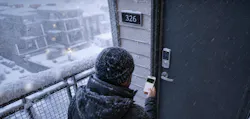
The digital transformation of multifamily access over the last decade has been remarkable. Walk through a modern Class A or B property today and many of its most important access points are likely to be electronic. The lobby, package room, fitness center, parking garage, and amenity deck may all respond to a card, fob, phone, or code. Operators can issue and revoke access centrally, while electronic access creates a record that mechanical keys simply can’t.
In high-rise and midrise buildings with interior corridors, the unit door was relatively easy to convert. But across a huge portion of the North American multifamily housing stock, one door never made the transition: the exterior-facing unit door.
Garden-style walk-ups, breezeway-access buildings, townhome rentals, casita communities, and ground-floor patio units all share it. Add student housing, workforce housing, military housing, and townhome-style stacked rentals, and exterior-facing unit doors number in the millions. For many owners, these doors aren’t exceptions in the portfolio. They are a substantial part of the door count.
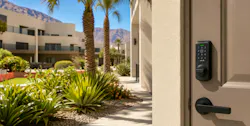
The Most Challenging Door in Multifamily
The reason is not a lack of demand. It is Mother Nature.
The electronics inside many residential smart locks were designed for indoor or sheltered conditions, and exterior service creates a very different operating environment. Cold affects batteries. Moisture and condensation can challenge electronics. Salt air accelerates corrosion in coastal markets, while prolonged UV exposure and high temperatures create their own demands in warmer climates.
Hardware designed for an interior or sheltered residential entrance doesn’t automatically translate to an exposed multifamily unit door.
More importantly, a lock designed around a single homeowner and a standalone app doesn’t necessarily translate to a multi-unit operating environment. Multifamily requires centralized credential management, predictable maintenance, auditability, and the ability to manage resident, staff, and vendor access at scale.
So the analog status quo persisted, along with its costs.
Consider a 150-unit garden-style community with 40 percent annual turnover. That’s 60 unit doors requiring a credential change every year. With mechanical locks, each turnover brings some combination of maintenance time, parts, key management, and travel across a spread-out site. Scale that across a 1,000-unit portfolio and the recurring labor becomes significant.
Add after-hours lockouts, master-key exposure, and the fact that the exterior unit door may remain one of the few access points without an electronic audit trail, and the carrying cost of staying mechanical becomes real and recurring.
Retrofit Ready
Same hole, no drilling. This is what makes the exterior unit door particularly well suited to a retrofit solution: most already use one of a small number of standard residential deadbolt preparations.
The cylinder cutout, latch bore, strike, backset, and common door-thickness ranges have been remarkably consistent across residential construction. Whoever hung the door and whenever they hung it, there is a good chance the opening already exists for the hardware that needs to replace it.
That standardization cuts both ways. It helped keep the mechanical cylindrical deadbolt in place for decades because any replacement had to fit the opening already in the door. But it also makes replacing that deadbolt relatively straightforward once electronic hardware exists that can use the same preparation and withstand exterior conditions.
Every compatible exterior unit door in the portfolio is carrying a quiet retrofit asset: the opening is already there.
The Salto DBolt Touch Outdoor was designed around that opportunity. It is an outdoor-rated smart deadbolt designed to retrofit standard residential deadbolt preparations without additional drilling, door replacement, or frame modification.
The backset adjusts to both common residential dimensions, 2-3/8 inches and 2-3/4 inches. The supported door-thickness range spans 1-3/8 inches to 3-11/32 inches, accommodating a broad range of residential exterior door constructions.
In practical terms, the DBolt Touch Outdoor is designed to replace an existing mechanical deadbolt on compatible standard residential door preparations. No carpenter, no replacement door, no special order.
For multifamily owners, that single fact reframes the project.
A smart access upgrade that requires door or frame work becomes a construction project, with the budgeting, scheduling, resident disruption, and trade coordination that construction implies. An upgrade that uses the existing preparation is a straightforward hardware swap, repeated door by door.
No wires at the door
The second half of the retrofit story is electrical—or rather, the absence of it.
One of the biggest constraints on access-control retrofits is not necessarily the cost of the hardware. It is the cost of getting power and connectivity to every opening.
Traditional hardwired commercial access can require power and cabling to the door, pathway work, wall penetrations, and coordination with electrical or low-voltage trades. At the scale of a garden-style portfolio with buildings and unit entrances distributed across a large site, those installation costs can fundamentally change the economics of an upgrade.
The DBolt Touch Outdoor is wire-free and runs on three AA batteries. Because the door requires no wired power or data connection, operators can avoid bringing electrical and communications infrastructure to each individual opening.
That changes the deployment model considerably.
Instead of treating each apartment entrance like a traditional hardwired access-control opening, the installation becomes much closer to replacing the mechanical hardware already on the door.
Operators who require online functionality can add wireless infrastructure according to the Salto system architecture selected, rather than wiring every unit door individually.
The economics are therefore different from a hardwired retrofit. The operator is largely comparing a defined hardware and deployment investment against recurring mechanical-key costs: rekeys, lockouts, cylinders and parts, key inventories, and staff time.
That makes the upgrade considerably easier to model at portfolio scale.

Engineered for Outdoors
None of the retrofit math matters if the hardware can’t withstand exterior conditions.
The Salto DBolt Touch Outdoor carries an IP55 ingress-protection rating on the exterior side and is rated AAA under ANSI/BHMA A156.40, the standard for residential deadbolts.
The distinction matters. This isn’t simply a question of putting electronic hardware on a residential door. It is about using hardware specifically engineered for weather-exposed residential entrances.
For multifamily owners operating garden-style, breezeway, townhome, and other exterior-access communities, that addresses one of the fundamental reasons the unit door remained mechanical while the rest of the property moved to electronic access.
Ultimate Flexibility
Turnover provides another advantage: a recurring installation window when access to the unit interior is already scheduled.
A retrofit during turnover creates relatively little incremental disruption because the door is already part of the make-ready workflow. Operators can choose to convert an entire property at once, sequence deployment building by building, or incorporate the upgrade into normal turns.
For owners managing large portfolios, that flexibility matters.
A project requiring hundreds of doors to be converted simultaneously has to compete for capital, contractors, maintenance resources, and management attention. A retrofit that can follow the property's existing operating rhythm offers another path.
Once installed, the exterior unit door can become part of the same broader access strategy used across the community.
The Salto DBolt Touch Outdoor is compatible with Salto Homelok, Salto KS, and Salto Space and supports mobile credentials, RFID cards and fobs, and PIN access through the touch keypad.
Instead of handing a resident an electronic credential for the parking garage, fitness center, pool, and package room—and then a mechanical key for the apartment—the operator can create a more consistent access experience from the property entrance to the resident’s unit.
There are operational advantages as well.
Rekeying can become credential reassignment. Lost credentials and lockouts can often be resolved digitally rather than through a mechanical rekey or locksmith visit. Vendor and staff permissions can be managed according to defined access policies and time windows. And electronic access can provide an audit trail at a door that historically generated none.
The exterior unit door stops operating as an exception to the property's access strategy.
The last door comes online
The demand for keyless access at the exterior unit door was never really the issue. The challenge was finding hardware that could withstand outdoor exposure without turning the retrofit into a construction project.
That equation has changed.
Outdoor-rated, wire-free smart deadbolts now give multifamily owners a practical path to bring exterior-facing unit doors into the same access strategy as the rest of the community—whether deployment happens at turnover, one building at a time, or across an entire property.
For garden-style and other exterior-access communities, the unit door no longer has to be the last mechanical lock in the portfolio.