Solving the Exterior Unit Door Problem
Key Highlights
- Garden-style and low-rise buildings account for roughly four in ten U.S. multifamily units
- Indoor-rated smart locks fail outdoors in predictable ways, from frozen keypads to corroded contacts
- Standardized deadbolt prep means the retrofit needs no drilling, door replacement, or frame work
- Wire-free operation eliminates electricians, trenching, and the installed cost that stalled past rollouts
- Rollouts can happen all at once or follow the turnover calendar, building by building
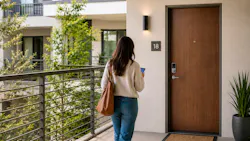

The digital transformation of multifamily access over the last 10 years has been remarkable. Walk through a modern Class A or B property today and many of its most important access points are likely to be electronic. The lobby, package room, fitness center, parking garage, and amenity deck may all respond to a card, fob, phone, or code. Operators can issue and revoke access centrally, and electronic access creates a record that mechanical keys simply can't.
In high-rise and midrise buildings with interior corridors, the unit door was easy to convert. But across a huge portion of the national apartment supply, one door never made the transition: the exterior-facing unit door. Garden-style walk-ups, breezeway-access buildings, townhome rentals, casita communities, and ground-floor patio units all share it, and garden-style and low-rise buildings alone account for roughly four in ten multifamily units in the United States. Add student housing, workforce housing, military housing, and townhome-style stacked rentals, and the count of exterior-facing unit doors in operator portfolios runs into the millions. For many owners, these doors are not exceptions or anomalies in the portfolio. They are the bulk of the door count.
The last holdout: Why this door resisted the upgrade
The reason is not a lack of demand. It is Mother Nature. The electronics inside a typical residential smart lock were specified for indoor conditions, and exterior service breaks them in predictable ways. Batteries discharge fast in the cold. Keypads freeze or fail in the wet. Condensation forms inside the housing when warm interior air meets a cold exterior surface, then refreezes overnight. Salt air corrodes contacts on coastal sites, and UV degrades housings in the Sun Belt.
The industry learned this the expensive way. Operators who bought consumer smart locks at retail and installed them across exterior units saw early failures, and more than a few properties quietly reverted to mechanical hardware after a bad winter. The warranty conversation was short, because the documentation had said indoor or sheltered use all along.
The failures were not only physical. A lock designed around a single homeowner and a standalone app does not translate to a multi-unit operating environment. Multifamily requires centralized credential management, predictable maintenance, auditability, and the ability to manage resident, staff, and vendor access at scale. Consumer hardware was never built to answer those questions, and a keypad that survives the weather but cannot prove a departed resident's code was erased has solved only half the problem.
What staying mechanical actually costs
Consider a 150-unit garden-style community with 40 percent annual turnover. That's 60 unit doors every year. With mechanical locks, each turnover brings some combination of maintenance time, parts, key management, and travel across a spread-out site. Scale that across a 1,000-unit portfolio and the recurring labor becomes significant. Add after-hours lockouts, master-key exposure, and the fact that the exterior unit door may remain one of the few access points in the community without an electronic audit trail, and the carrying cost of staying mechanical becomes real and recurring.
None of that is new. What is new is that the two things that made the exterior unit door so hard to convert, the door itself and the wiring, turn out to be the two things that make it unusually easy to retrofit once the right hardware exists.
Same hole: The retrofit asset hiding in plain sight
Virtually every exterior unit door in the country already has a standardized deadbolt prep. The cylinder cutout, the latch bore, the strike pocket, the screw spacing, and the door thickness range have been consistent across residential construction for decades. Whoever hung the door, whenever they hung it, the holes are in the same places.
That standardization cuts both ways. It is what kept the mechanical cylindrical deadbolt frozen in place for the better part of a century, because any replacement had to fit the hole that was already there. But it is also what makes replacing the deadbolt almost effortless once hardware exists that can fit the prep and survive the weather. Every exterior unit door in the portfolio is carrying a built-in asset: a pre-drilled, dimensionally standardized opening that is already the right size for a retrofit.
For multifamily owners, that single fact reframes the entire project. A smart access upgrade that requires door or frame work is a construction project, with the budgeting, scheduling, resident disruption, and trade coordination that construction implies. An upgrade that drops into the existing hole, with no drilling, no door replacement, and no frame modification, is a hardware swap, repeated door by door.
No wires: The constraint that stopped past rollouts
The second half of the story is electrical, or rather, the absence of it. The constraint on smart access rollouts has rarely been the cost of the hardware. It has been the cost of getting it installed. Hardwired commercial access hardware means electricians or low-voltage subcontractors at every opening, wall penetrations, coordination with residents for access to interior outlets, and a per-door installed cost that can dwarf the lock itself. At the scale of a garden-style portfolio with buildings scattered across a site, that math has stopped many upgrades before they started.
Battery-powered, wire-free smart deadbolts remove that constraint entirely. When the door requires no wired power or data connection, deployment involves no electricians, no trenching between buildings, and no scheduling around unit interiors beyond the swap itself. A single door takes roughly the same 15 to 20 minutes a rekey typically takes, with nothing more specialized than a screwdriver. Operators who want real-time online features add wireless gateways at the building level, a fraction of the cost and disruption of wiring individual doors.
That changes the shape of the financial decision. The per-door cost of the rollout reduces to the lock, a small amount of labor, credentials, and a platform license. That is a one-time spend. The cost of staying mechanical, the rekeys, the lockout calls, the key inventories, recurs for as long as the doors stay mechanical. One number gets paid once. The other never ends.
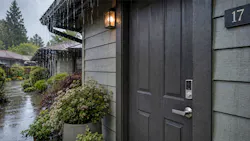
The Salto DBolt Touch Outdoor is built on exactly this profile. It installs into the standard residential deadbolt prep with an adjustable backset for both common dimensions, runs on three AA batteries rated for up to 85,000 operations, and connects to building-level wireless gateways when operators want online features. The installation guide includes one outdoor-specific step that differs from an indoor install: seating the exterior and interior gaskets correctly. That is the extent of the added complexity.
What to look for in outdoor-rated hardware
The category of purpose-built outdoor smart deadbolts is young, and not every product marketed for exterior use was engineered for it. A few criteria separate hardware that will still be working in its third winter from hardware that will not.
Look for an ingress-protection rating under IEC 60529, the international standard for dust and water resistance, with IP55 as a reasonable floor for a door that takes wind-driven rain. Look for an ANSI/BHMA A156.40 grade, the residential deadbolt standard that tests security, durability, and finish; Grade AAA is the highest the standard awards. Confirm a published operating temperature range that covers the property's actual climate, and confirm that the lock installs into the standard residential deadbolt prep with both common backsets. Ask whether the product was designed for outdoor service from the start or is an indoor lock with a gasket added later; the industry has tested the second approach for years, and it has not held up.
Finally, make sure the hardware belongs to a platform the property can actually operate. Salto's DBolt Touch Outdoor, an outdoor-rated version of its DBolt deadbolt line built for weather-exposed residential entrances, is one example of the category, and it illustrates the point: the value is not in the lock alone but in the exterior unit door joining the same credential model, audit trail, and access policies that already govern the rest of the community.
Deploy all at once, or at the pace of turnover
Because each installation is fast and self-contained, a rollout can follow whatever schedule an operator prefers. Some will convert an entire property in a single mobilization. Others will use turnover as a recurring installation window, when access to the unit interior is already scheduled and the door is already part of the make-ready workflow. Either way, sequencing by building rather than by scattered units lets each building switch to the new credentialing model in a single event instead of running two access models in parallel.
Once installed, the exterior unit door behaves like every other electronic door on the property, managed on the same platform, whether that is Salto Homelok, Salto KS, or Salto Space, with the same mobile, RFID, and PIN credentials. Rekeying becomes reassignment. Lockouts become a code or a remote unlock instead of a locksmith bill. The audit gap closes, and the same vendor windows and expiring credentials that govern the lobby now govern the unit door.
The last door comes online
The demand for keyless access at the exterior unit door was never really the issue. The challenge was finding hardware that could withstand outdoor exposure without turning the retrofit into a construction project.
That equation has changed. Outdoor-rated, wire-free smart deadbolts now give multifamily owners a practical path to bring exterior-facing unit doors into the same access strategy as the rest of the community, whether deployment happens at turnover, one building at a time, or across an entire property. For garden-style and other exterior-access communities, the unit door no longer has to be the last mechanical lock in the portfolio.