Why an integrated approach matters for MEP modular construction
This blog post was authored by Chad Salge, Division Leader, VP, Southland Industries.
Over the course of the past few years, the design and construction world has been dramatically impacted by the AI infrastructure race and growing demand for complex facilities across multiple market verticals. This transformation is accelerating demand for modular construction approaches that can help teams execute large scopes of work on compressed schedules with fewer available resources.
To deliver on these unprecedented timelines, architects, engineers, and contractors are having to tow the balance of executing efficiently without sacrificing expected quality. That tension has introduced a widely adopted approach to incorporating modular scopes and design for manufacturing and assembly very early in the design process.
MEP modular construction moves portions of mechanical, electrical, and plumbing system assembly from the jobsite into controlled manufacturing environments for later installation in the building. For mechanical, electrical, and plumbing (MEP) systems, this approach creates opportunities to relocate significant portions of work to controlled manufacturing environments, reduce field labor exposure, and provide greater certainty of outcome for owners.
However, the ability to manufacture modular components is only one part of the equation. Overall, this trend has brought to light how important it is to have an integrated lifecycle approach when designing and assembling modular MEP components.
Why an Integrated Lifecycle Matters for Modular MEP Solutions
An integrated lifecycle approach is a holistic delivery that considers all aspects of the design, installation, and operation of a facility. With the proper project or program framework, the project delivery team is set up well to execute this approach.
The components of the framework that allow for this approach to be collaborative and effective are:
- Incorporation of team members that understand design, manufacturability, constructability, and service from the conceptual phase of the project.
- Early delineation of site install and modular scopes.
- Contractual arrangement that aligns the team around a common goal.
- An owner that drives the execution of this integrated approach
The key aspect of creating a design that can materially deliver the vision of an integrated lifecycle approach is incorporating the right input at the right time.
In a design-build approach, where the team is comprised of architects, engineers, virtual design and construction (VDC) teams, installers, and service personnel, the design is enabled to take into account all aspects of the lifecycle of a product and building system.
In a modular MEP design, you have to consider the impact that the individual product, whether a module or skid, has on the overall system design. This includes how the product is going to be manufactured, tested and commissioned in the shop, installed in the field, filled and flushed, and maintained or serviced for the remainder of its useful life. Most importantly, the team must understand how the assembly, installation, and maintenance of the product will impact the safety of those who come into contact with it.
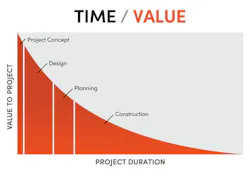
Although these considerations can add time to the front end of the schedule, they can save significant time, money, and a lot of heartache on the back end. The ability to positively influence the project when early, holistic decisions are made is depicted in the image below.
Defining Site Installation and Modular Scopes for MEP Systems
To provide clarity in this new frontier, it is essential to have clear delineation between site installation and modular scopes. When this approach is followed, the entire team is set up for a very efficient project delivery due to the clear demarcation of scope. This is particularly important for MEP systems, where individual modules must integrate with the broader building infrastructure.
The pragmatic ways to ensure that scope is clearly defined is to incorporate a RACI matrix for roles and responsibilities, create a map of an overall building plan that provides scope boundaries, lock “scope blocks” in place early that do not require much design effort and host design charettes that focus on areas that need more collaborative attention.
The final result of this design progression should be a set of drawings or a model that can delineate scope clearly enough for an estimate to be created that reflects the way that the project is going to be executed. From there, the owner can clearly see the cost and schedule impacts, determine if further adjustment to the approach needs to be incorporated and ultimately release the team to move towards the execution phase of the project.
Aligning the Team for Successful Execution
Proper contractual arrangement is a vital aspect of effectively executing the approach laid out above. If there is a lack of alignment between design, supplier, and construction contracts, it will not fully allow for the needed collaboration to occur.
Several project delivery methods can support this level of collaboration, including design-build, IFOA (Integrated Form of Agreement), and triple prime with a collaboration agreement. In a design-build approach, the designer and contractor are on board from the conceptual design phase of the project and are working to align on project schedule and cost. With the right team of experienced companies that are equipped to make well-informed decisions, design, manufacturing, and installation timelines can be greatly reduced when compared to traditional timelines.
A major component to driving modular project execution and efficiency is an owner that provides direction and defines expectations early that remain consistent throughout the project. The owner must fully trust the team selected to make decisions that will benefit the project, since there is no time to waste second-guessing decisions or revisiting items already decided on.
When there is an owner that has a clear project mission, is decisive, and enables the team to realize their full potential, the project is sure to be successful.
Scaling MEP Modular Solutions Across Markets
With large-scale projects required to be deployed at a rapid pace, particularly in the data center market, the need for an integrated modular approach continues to grow.
However, the value of this approach is not limited to data centers. Healthcare, advanced manufacturing, and other market verticals face similar challenges related to labor availability, construction schedules, quality, and building system performance.
As modular construction continues to evolve, the key to successful execution will be understanding how individual components fit into the overall building system and how the system will perform throughout its lifecycle.
Successful MEP modular construction is not simply about moving work offsite. It requires an integrated approach that connects design, modular solutions, installation, commissioning, and service early in the project lifecycle. When those disciplines work together, modular solutions can provide greater certainty around constructability, schedule, quality, and long-term building system performance.
About the Author
As Division Leader, VP, Chad Salge spearheads Southland Industries’ modular solutions strategy across mission-critical sectors including data centers, healthcare, and semiconductor manufacturing. With deep expertise in blending design-build capabilities with manufacturing operations, Chad drives Southland's geographic expansion and the development of dedicated manufacturing facilities near major metropolitan centers. His vision centers on advancing industry standards, fostering workforce development partnerships with major hyperscalers, and positioning modular solutions as the foundation for faster, more reliable project delivery. Chad is committed to elevating the construction trades and creating sustainable career pathways for skilled laborers and engineers.
About the Author
Southland Industries
As an MEP building systems expert, Southland Industries provides integrated, full lifecycle solutions that optimize the design, construction, operation, and efficiency of buildings. Through collaborative client partnerships and our collective expertise, we create premier built environments. Follow us on LinkedIn, Instagram, and Facebook.