Mass timber is evolving: Best practices for managing risk, schedule, and performance

Mass timber has moved beyond novelty. Today, the conversation is less about whether to use it and more about how to deliver it successfully, at scale, and across more building types.
Across project teams, designers, manufacturers, and trades, the same themes surface again and again around risk, execution, and early decision-making.
These are the practices that consistently separate successful mass timber projects from the ones that struggle.
Moisture management on mass timber projects
Moisture mitigation has emerged as the single biggest execution and budget risk on mass timber projects, and for good reason. Exposure affects everything: appearance, schedule certainty, rework, warranty risk, and owner confidence in the building.
The mistake teams make is treating moisture as a construction phase issue. In reality, moisture management spans the entire lifecycle, including fabrication, transport, storage, installation, enclosure, and turnover.
Successful teams establish a formal moisture management plan early and then revise it as the project evolves. Temporary and permanent protection strategies are aligned.
Sequencing is designed to “get dry fast,” with façade timing, crane picks, ventilation, laydown space, and temporary drainage all working together. And weather risk, especially in winter, is carried honestly, not buried in a footnote.
When moisture is managed proactively, mass timber performs its best.
Protection plans must balance aesthetics, fire performance, and constructability
Clients rightfully care deeply about the final appearance of exposed timber. And while construction teams must account for the client’s vision, they must also prioritize durability, fire performance, constructability, maintenance, and cost. Therefore, it’s important to align priorities to ensure project success.
The key is early clarity. Teams need to decide upfront what exposed timber must look like at turnover and how it will be maintained over time. Coatings and finishes must be coordinated with fire testing and warranty requirements. Where appearance is critical, practices like full sanding and multiple finish coats need to be planned well in advance.
UV exposure also matters as exposure can affect appearance if teams aren’t prepared. Protection planning must account for real site conditions, not ideal ones.
Early trade partner engagement sets mass timber projects up for success
The most successful mass timber projects share a common denominator: effective coordination that starts early. Because the structure is highly integrated, mass timber rewards teams that plan ahead. MEP coordination, connection strategies, and sequencing decisions all benefit from early clarity and alignment.
Engaging manufacturers and installers early, committing to buyout sooner and investing heavily in VDC coordination contributes to success. Standardizing connections where possible, locking in partners, and coordinating penetrations early help teams move through construction with confidence and less rework.
Prefabrication amplifies these advantages. When teams do the work early, mass timber delivers what it promises most consistently: speed, precision, and quality.
Sequencing and logistics are inseparable from quality
In mass timber construction, sequencing, logistics, moisture control, and quality are part of the same system.

Laydown constraints, delivery timing, crane utilization, enclosure milestones, and façade sequencing all influence how quickly a building can be protected. Shaft openings and temporary drainage require intentional planning. Deck loading assumptions need to be clearly defined before enclosure begins.
Projects that treat logistics as a late exercise give risk room to grow. Projects that plan holistically protect both the structure and the schedule.
Species and supply chain decisions are becoming major cost drivers
As adoption grows, teams are recognizing that species selection is no longer just an aesthetic choice. It affects cost, availability, transportation, installation sequencing, and risk exposure.
Early alignment between designers, clients, and the supply chain is essential. Manufacturing capacity, lead times, transportation limitations, and storage conditions should be treated as first-order design inputs
The growth of mass timber also depends on a healthy supply base. Responsible forest management, local economies, and long-term material availability are part of the equation. Execution excellence and sustainability are deeply connected.
Hybrid structures can be the answer to constructability
Hybrid structural systems are evolving rapidly, and for many projects, they offer the best of both worlds.
Pairing mass timber with other materials, such as steel or concrete, can improve speed, manage cost, and simplify complex conditions. But those benefits only materialize when connection strategies and spline systems are decided early.
Structure, envelope, and moisture protection must work together, not fight each other. Hybrid solutions reward clarity and early decisions.
The next proving grounds are technology, industrial, affordable housing, and healthcare
Mass timber demand is expanding into the technology, industrial, affordable housing, and healthcare sectors. In fact, the technology industry now accounts for 15% of the overall mass timber supply chain.
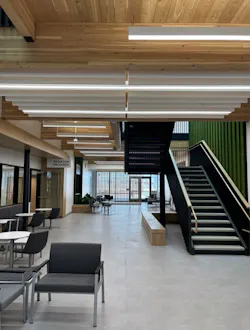
Each brings unique code requirements, fire rating challenges, durability expectations, and operational realities that must be addressed upfront. Success starts with understanding building-type limitations early, identifying where mass timber creates real value, and developing roadmaps for where the system works today, and what needs to evolve next.
The bottom line
Mass timber is no longer emerging. It’s maturing.
What happens next will be defined by teams that plan earlier and execute deliberately. When delivered well, mass timber doesn’t just meet expectations. It raises them.
The industry’s opportunity isn’t just to build differently. It’s to build better and prove that mass timber belongs in the mainstream.