6 lessons from turning a pass-through plaza into a civic destination
This blog post was authored by 40 Under 40 Class of 2025 alumni Garrett Herbst, AIA, NCARB, Director of Emerging Technologies, Little Diversified Architectural Consulting.
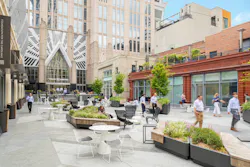
When the Truist Center Plaza project in uptown Charlotte was first presented to Little, it sounded straightforward. The plaza primarily served as a public connector between Tryon Street (a major city thoroughfare) and the Truist Center lobby for employees and visitors. Its amenities had become dated and uninviting, and the scope was framed as necessary maintenance. Yet, even within that limited charge, it was clear the space held far greater potential. This was one of Charlotte’s most visible urban thresholds, positioned to do more than simply move people through it.
The base of a 47-story tower carries significance beyond its structure. It shapes first impressions and signals whether a building engages its community or turns inward from it. As we studied the plaza, we recognized an opportunity to strengthen the relationship between the financial headquarters and the city around it. In alignment with Charlotte’s 2040 Vision Plan, the space could evolve from a pass-through zone into a catalyst for community engagement.
What complicates this story is what lies beneath. The plaza is not simply a ground plane, but a roof. Below is an active electrical vault containing critical infrastructure that powers the tower and portions of the surrounding block. That hidden condition introduced technical complexity that shaped every decision the project team made.
6 Key Lessons from Reimagining Truist Center Plaza
The six lessons that follow emerged from navigating those constraints while transforming a utilitarian surface into the civic asset it is today.
Lesson 1: Let Constraints Drive Innovation
The active electrical vault below the plaza established nonnegotiable parameters. There was zero tolerance for water intrusion or service disruption. Every design decision had to begin with protection of the infrastructure below.
Structural load limits governed soil depths, weights, and anchoring strategies. The proposed planters required close coordination with structural engineers to verify capacity and distribution. Lightweight planting media balanced landscape ambition with structural reality. Integrated slot drains and subsurface systems were carefully detailed within the granite paving to manage water without compromising clarity of design.
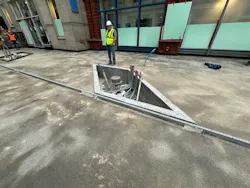
Drainage became an architectural exercise. Integrated slot drains and subsurface systems were woven into the granite paving assembly, allowing water to move efficiently without disrupting the visual clarity of the plaza. Early alignment between structural, civil, MEP, waterproofing consultants, and the architectural team ensured the limitations would not reduce creativity but elevate and shape it.
Lesson 2: Treat the Ground Plane as Public Infrastructure
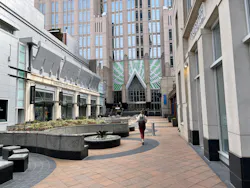
Located between Tryon Street, College Street, and the Overstreet Mall network (a skywalk system that connects office buildings, restaurants, shops, hotels and parking garages), the plaza functions as connective tissue in Uptown. It is not leftover space, but urban infrastructure.
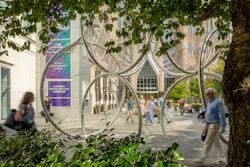
The redesign supports daily pedestrian flow while accommodating large civic events. Integrated AV infrastructure allows flexibility without temporary interventions. A catenary lighting system establishes presence after dark, and a public art installation marks the space as a gateway.
By treating the ground plane as a facilitator of public engagement, the project reinforces both the tower and the public realm it inhabits.
Lesson 3: Build Great Design with Great Builders
Complex projects require a contractor who understands both craft and collaboration. From the outset, our partnership with Shelco was essential. Their field leadership, deep familiarity with the tower, and established relationship with the facilities team ensured that critical infrastructure remained protected while design intent was executed with precision.
Stone coordination with Lomax Tile achieved tight tolerances across a plaza defined by multiple elevation changes. Custom furnishings fabricated by Studio 431 and metal integrations by Southeastern Architectural Systems were refined through iterative detailing and mockups to ensure alignment between concept and construction.
The success of the plaza is inseparable from the quality of its execution. Ongoing collaboration among contractor, engineers, fabricators, and the design team translated complex technical requirements into cohesive, built outcomes.
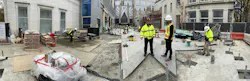
Lesson 4: Lead Collaboration Through Active Communication
Nearly 30 contributors shaped the project. Aligning that group required clarity, consistency, and leadership.
Ownership representation through Truist and CBRE ensured strategic alignment. Partnership with Charlotte Center City Partners connected the project to broader civic priorities. Workshops focused on wayfinding and environmental graphics refined the user experience. Coordination between the artist, engineers, lighting consultants, and contractor ensured that aesthetic intent remained grounded in technical feasibility.
Structural and waterproofing constraints were communicated clearly and repeatedly across all disciplines. By making limitations transparent, the team could design within them confidently rather than discovering conflicts late in the process.
Collaboration was not passive coordination. It was active leadership within every discipline.
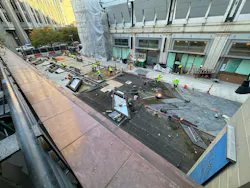
Lesson 5: Design for Sustainability Through Resilience
Sustainability began with adaptive reuse. By preserving the existing structural deck of the plaza, the project reduced embodied carbon and extended the lifecycle of a significant urban asset.
Structural limitations required lightweight Rooflite planting media, demonstrating how technical constraints can support environmental performance. A drought tolerant, no irrigation plant palette reduces long term water demand while maintaining seasonal variation. Pollinator supportive species contribute to urban biodiversity, and a strengthened tree canopy mitigates heat island effect within the dense urban core.
Durable, regionally quarried granite was selected for lifecycle performance and contextual continuity. Resilience here is not a single feature. It is the cumulative result of material choices, planting strategy, and long-term adaptability.
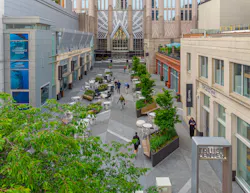
Lesson 6: Reuse to Reimagine
Today, the space supports programming well beyond daily circulation. Beyond the grand opening that reintroduced the plaza to the city, it has been a destination for local festivals and music events, transforming the ground plane into a venue for performance, gathering, and community connection. The redesign improves accessibility and clarity while integrating art, landscape, lighting, and architecture into a unified experience.
Aligned with Charlotte’s 2040 Vision Plan, the renewed plaza demonstrates that strategic reuse can do more than preserve what exists. It can unlock new energy, extend relevance, and recalibrate how a landmark participates in the life of the city.
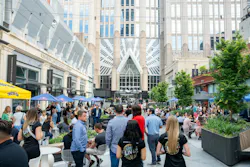
Beneath the new granite, the vault continues providing power to sustain the tower and surrounding infrastructure. Above it, the plaza has been transformed from a pass-through space into a platform for daily movement, civic gathering, and urban identity.
What began as a targeted repair became a broader reconsideration of potential. By embracing constraints, aligning a diverse team, and designing for long term resilience, the project illustrates how technical challenges can catalyze meaningful transformation at the heart of the city.