Designing collegiate athletics facilities as an institutional brand anchor
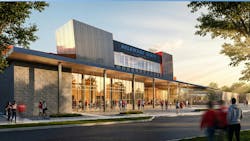
This blog post was authored by 40 Under 40 Class of 2025 alumni Jenn Rittler, AIA, Associate Principal and Project Architect, Moody Nolan.
Everyone is blinded by the flashy lights of billion-dollar venues. While those cathedrals of sport are impressive, they offer little utility to the leaders of fast growing D1 programs at mid-sized institutions. Our design approach marries great intentions and maximum flexibility in a climate of fluctuating enrollment and fixed state budgets.
On the heels of a historic football season and a bold launch into a new era, Moody Nolan’s work on the Delaware State University (DSU) Athletics Facility enforces a new reality: Modern athletic infrastructure must be an Institutional Brand Anchor. As one of the nation’s leading HBCUs, DSU required a design that didn’t just house athletes, but anchored a 135-year cultural legacy within a high-performance, modern framework.
3 Design Strategies for Modern Division I College Athletics Facilities
To succeed in this growth model, we utilized several strategies to transform DSU’s capital investment into a Legacy Interface. Here’s what we are learning.
1. Nobody Funds a Cost Center Forever. Design a Revenue Driver
There is a difficult conversation happening at every state-funded institution right now. Enrollment is shifting, budgets are tightening and every square foot is under the microscope.
We have to shift our design thinking from a spend mindset to a growth mindset. Instead of asking “How do we design great suites for donors on game day?” we ask “How do we design spaces that a corporate retreat coordinator, a career fair director, and a gala planner would all fight over on a Tuesday in February?”
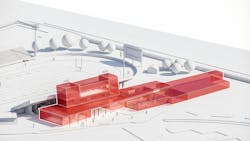
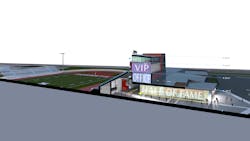
The answer is hospitality forward. At DSU this looks like a VIP space with floor-to-ceiling views of the football field and flexible infrastructure for a 200-person reception. It looks like a President’s space that impresses a major donor and doubles as a board meeting room. We aren’t just designing for the six home game days; we are designing for the 359 days in between.
The Design Insight: In early design, view the athletic spaces through a hospitality lens. Broaden the conversation and highlight non-athletic use cases that support University fiscal initiatives.
2. Heritage Isn’t a Hallway: Layering Tradition into High Performance Design
One of our unique design challenges was honoring the deep legacy of an HBCU while delivering a high-tech, glass-and-steel recruiting tool. We believe in integrating heritage and legacy into the architecture itself.
Through the building’s siting strategy—which connects it to the greater campus—and the sightlines framed from the inside out, we create a Legacy Interface; connecting past, present, and future.
We also focused on empowered choice in circulation. A student-athlete can choose to arrive through a grand public lobby, feeling the energy of the fan base, or via a dedicated, private athletics entry. Similarly, staff can choose to engage with the public or bypass straight to their offices. This spatial intelligence respects the different modes of campus life while keeping the institution's story at the forefront. When a prospective student-athlete or staff arrives on campus and sees their culture reflected in the transparency and materiality of the architecture—that’s a winning recipe.
The Design Insight: For any institution with deep cultural identity the design process must include alumni and valued partners as co-creators, not just as final approvers.
3. Operational Elasticity: Future-Proofing for Growth
A common mistake in AEC is over-specifying for the now. At DSU, we prioritized future
flexibility for revenue-generating opportunities that haven’t even been dreamt of yet.
We designed the seating bowl to be adaptable. It can accommodate a variety of seating types—ranging from standard benches to premium, buckets seats—allowing DSU the room to "scale up" their ticket tiers as demand grows. This allows for operational growth and bidding flexibility—designed for market competition. We are designing for where DSU is going, not just where it sits on the map today.
The Design Insight: Before entering Design Development, sit down with the client and map a 10-year growth scenario. Ensure the "Day 1" architecture doesn't become a "Day 2,000" bottleneck.
What serves today may not serve tomorrow.
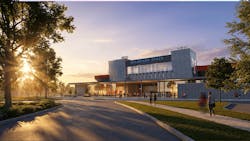
The Bigger Picture: Why Modern College Athletics Facilities Must Anchor Institutional Identity
The DSU project reminded me that the best architecture doesn’t just serve a program—it becomes a program. It elevates a team. It opens a front door to an entire institution. It says to every student-athlete, every community member: You belong here.
That’s not a sports complex. That’s a legacy.
About the Author
Moody Nolan
At Moody Nolan, we use the built environment to catalyze social change. Our integrated design and delivery approach combines architecture, interior, and experiential design—creating places that ignite culture and improve lives. With more than 300 employees in 12 locations around the country, we leverage the power of diverse backgrounds to drive design innovation. Named by Fast Company as one of the world’s most innovative architecture firms, our work garners national attention from industry-leading organizations, including the AIA Architecture Firm Award.