Designing for empathy: Integrating biophilic patterns at Hope Plaza
This blog post was authored by Ruju Rathod, LEED AP BD+C, WELL AP, Global Sustainable Design Leader, CO Architects.
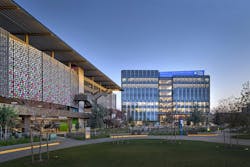
Hope Plaza is a new eight-story, 350,000-GSF outpatient center that offers patients access to leading cancer treatment in a tranquil and inviting environment. The building embodies City of Hope’s patient-centered model of care by creating a place of healing that nurtures both groundbreaking science and the human spirit.
Decades of evidence show that access to nature, art and natural light reduces stress, improves cognitive function, creativity, well-being and expedites healing. A driving factor in the design of Hope Plaza was to create a place that fosters a zest for life and provides hope for cancer patients—two important markers of well-being for those undergoing treatment.
To achieve this, the design team of CO Architects, in association with EwingCole, prioritized designing for empathy at all scales. These scales include the campus, building, interior and room level and prioritize connection to nature, non-rhythmic sensory stimuli, air flow, water and the dynamic use of natural light and art. Biophilic patterns are integrated at all levels to create spaces that empower patients by restoring choice and agency wherever possible.
Empathy at the Campus Scale
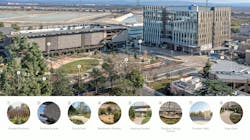
The campus includes a 1.65-acre Ted Schwartz Family Hope & Healing Park that caters to all scales of interactions. It is designed with large, shared spaces, gathering spots and intimate refuge areas that provide varied experiences for users based on their mood for the day.
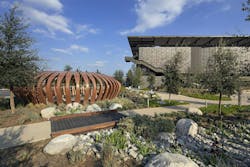
Patients who come to City of Hope are typically living with diabetes or an advanced stage of cancer, visiting multiple times in a year, and sometimes even staying in a hotel on the campus. To best support the long-term community, the park features a range of amenities, including a large outdoor event space and sculpture gardens to walk through, meditation gardens, shade structures, outdoor pavilions, an outdoor dining terrace, and a calming yoga deck.
There are different landscape styles, including rose gardens and Japanese tea gardens, that promote biodiversity, color and fragrance to the landscape. Water detention arroyos across these amenities both create a sense of tranquility and serve as a sustainable design strategy. Connection across natural systems and the use of water features unite the campus while emphasizing biophilic design strategies.
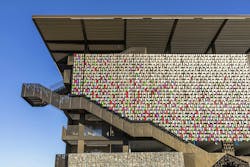
Visitors experience the healing park and parking structure upon arrival on campus. Their journey is overlaid with moments of empathy along the way. City of Hope has a unique tradition of the “Wishing Trees”, where one can tie a note to the trees with a wish for a family member or friend. The design of the parking structure incorporates this tradition beautifully by creating a facade of notes made of metal panels, almost like an art installation. The panels flutter with the wind, creating an unexpected pattern that incorporates the biophilic principle of non-rhythmic sensory stimuli. The panels also offer thermal and airflow variability, offering comfort to those inside the garage.
Empathy at the Building Scale
Located at the foothills of the San Gabriel Mountains, the design of Hope Plaza was inspired by the natural flow of water from the mountains.
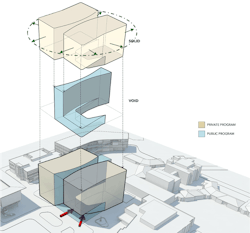
The facility was conceptualized as a “boulder in a stream” with water eroding its way through the site, represented by an arroyo and detention ponds, and then moving into the building, where it carves out the public space and lobby on the ground floor.
The urban river wash, nearby mountains and the building's responsive design to the movement of the sun highlight the project's connection to the natural environment.
The exterior is conceived as a hard shell on three sides that protects the building from the harsh Duarte sun on the south, east and west facades, while the north facade is transparent, allowing more daylight to enter the building and offer direct views of the San Gabriel Mountains. This serves as a passive design strategy for energy efficiency as well as wayfinding, as visitors are naturally inclined to move towards the transparent area.
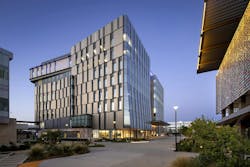
The hard shell is made of anodized metal panels that change their tonality from shiny to matte throughout the day based on the sun exposure. The ground floor facade is conceptualized from the idea of boulders left over due to the stream eroding the site. The base uses stone referencing the region's alluvial plains and gravel quarries. Here, elements of biophilic design are thoughtfully integrated into the exterior via biomorphic forms and patterns.
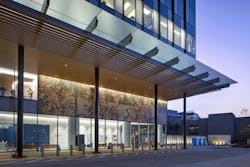
Art is integrated throughout Hope Plaza—from the entry park pavilions, the colorful parking structure, and custom murals, sculptures and paintings inside and outside the building. At the entrance, a large-scale tile art mural called “Blossom” mimics the Silk Floss Trees nearby in the park that are embellished with pink flowers. The artwork also establishes a dialogue with the parking structure tags while introducing the biophilic design elements of complexity and order.
Additionally, a sculpture called “Iris of Hope” that utilizes metal panels shaped in the form of petals of an Iris will soon be placed at the front of the fountain, creating a pavilion that can be experienced from inside and outside by allowing pedestrians to walk through the piece.
Empathy at the Patient Level
Daylight was thoughtfully prioritized for those who need it most on each floor. Hope Plaza’s room design reflects a thoughtful and cohesive approach that connects the exterior and interior through consistent materials and architectural expressions, particularly the theme of erosion that carries seamlessly indoors.
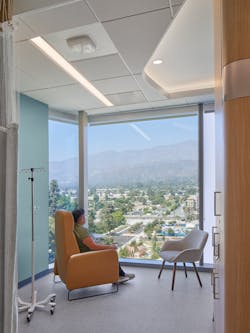
The interiors feature clutter-free millwork and well-integrated compartments, enhancing functionality and cleanliness. Art is thoughtfully incorporated throughout—from waiting areas to individual rooms and even blood draw spaces—creating a warm, human-centered environment.
Expansive views from lobbies, patient rooms and collaborative workspaces foster a sense of openness and connection to the outdoors. The design promotes an efficient and intuitive patient experience by streamlining spatial sequences into a “one-stop shop” model. Clear transparency and intuitive wayfinding further support ease of navigation. Additionally, computationally optimized shade structures not only enhance thermal comfort but also cast beautiful, perforated patterns that animate the floors with dynamic, shifting shadows throughout the day. This dynamic and diffused light infuses biophilic design principles to the patient spaces, creating a tranquil space designed around empathy.
About the Author
CO Architects
Los Angeles-based CO Architects is nationally recognized for architectural planning, programming, and design in the healthcare, science and technology, and higher education sectors, and works with leading institutions from coast to coast. CO Architects’ specialized expertise includes transformative schools of medicine and health professions, advanced research and teaching laboratories, and innovative clinical facilities on higher education, healthcare, and urban campuses. The firm has been nationally and internationally recognized with more than 200 awards for innovative design and project delivery, including the American Institute of Architects California’s Architecture Firm of the Year Award. Follow CO Architects on Facebook, Instagram, LinkedIn, and Twitter. View more thought leadership content from CO Architects.