Trauma-informed healthcare design: From reducing harm to creating health

This blog post was authored by Rachel DeSanto, WELL AP, CLGB, Senior Consultant, Blue Cottage of CannonDesign; and Swapna Sathyan, MBA, Principal and Consulting Director, Blue Cottage of CannonDesign.
The National Council for Behavioral Health estimates 70% of adults in the U.S. have experienced some type of traumatic event at least once in their lives.
Trauma can come from military service, abuse, systemic inequities, medical experiences, homelessness, grief or chronic illness, among countless other life events, and research shows a direct correlation between trauma and physical health conditions like diabetes, heart disease and high blood pressure. The majority of those who seek care are carrying the weight of experiences that may not be immediately visible.
Post-Traumatic Stress Disorder, or PTSD, offers one lens through which we can understand trauma, but the broader lesson for designers is that trauma is often present whether it is disclosed or not. Healthcare environments, and really all environments, should be designed with the assumption that trauma may influence how patients, families, caregivers and staff perceive and interact with the built environment.
Before a patient can interpret a sign, understand a process or meet a caregiver, their body is already responding to the space around them. For individuals who have experienced trauma, that response may register as danger before it becomes conscious thought. Hospital spaces that feel confusing, noisy, unpredictable, overly institutional or lacking in personal control can unintentionally reinforce feelings of anxiety, vulnerability and hypervigilance. Conversely, environments that foster safety, clarity, dignity and choice can support emotional regulation and healing.
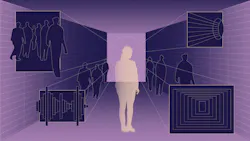
Eli's journey
To understand the relationship between trauma and physical space, consider Eli, a patient living with PTSD.
Eli arrives at a hospital for a planned procedure that requires an overnight stay. Clinically, her visit may appear routine. She will check in, move through pre-op, undergo a procedure, recover and eventually be discharged. But for Eli, the experience is not routine. She enters the hospital carrying memories and experiences that shape how she interprets her surroundings. Her PTSD is deeply connected to a past loss of control, and the hospital environment can quickly intensify that feeling. Long corridors with no visible exit, crowded waiting rooms, unfamiliar noises, overhead announcements, medical terminology and constant movement through the system can make her feel disoriented and powerless. Instead of focusing on her recovery, Eli finds herself scanning her surroundings for information, reassurance and control.
What may appear efficient from an operational standpoint can feel profoundly different to someone experiencing hypervigilance, which is a state of extreme alertness, or heightened sensory awareness. The challenge for designers is not to predict every individual trigger or create a separate environment for every person. That would be impossible, and it could unintentionally place the burden on patients to disclose or explain their needs. Instead, the opportunity is to design healthcare environments that support a wide range of emotional, sensory and cognitive experiences from the start.
A trauma-informed environment starts with recognizing that stress isn't only emotional. It's also spatial, sensory, physiological and operational.
For Eli, the hospital experience becomes less threatening when the environment restores a sense of agency and coherence. Design elements that support this include:
- Clear sightlines and intuitive wayfinding so she understands where she is and where she is going.
- Visible destinations and identifiable exits that make the path forward, and the way out, easy to read.
- Predictable transitions between spaces that reduce uncertainty about what happens next.
- Layered waiting areas, quiet alcoves and smaller zones within larger public spaces that offer choice without requiring her to explain why she needs it.
Design can also help regulate the body. Features that reduce sensory load and support emotional regulation include:
- Glare-free lighting, acoustic control and access to daylight.
- Views of nature and calming materials throughout the space.
- Low-stimulation retreat areas for when she needs to step away.
- Personal control over room lighting, privacy, temperature and audiovisual settings, giving Eli the ability to shape her immediate environment during a moment when much of her care may feel outside of her control.
Trauma-informed design need not stop at reducing triggers, though. This is where it intersects with salutogenic design. Originally developed by medical sociologist Aaron Antonovsky, salutogenesis focuses on the factors that support human health and well-being rather than the factors that cause disease. At its core is the concept of sense of coherence, helping people feel that their environment is understandable, manageable and meaningful. Where trauma-informed design helps us understand how environments can reduce fear, confusion, loss of control or heightened stress responses, salutogenic design expands the conversation by asking how environments can actively create the conditions for health, resilience and well-being. Rather than focusing exclusively on minimizing harm, salutogenic design asks how environments can help people feel safer, and more capable, connected and supported in their own healing.
For Eli, this distinction matters. A trauma-informed approach may help reduce stress and anxiety during her healthcare journey. A salutogenic approach actively supports her sense of safety, agency, connection, confidence and hope throughout the experience. Instead of simply helping her avoid harm, the environment becomes part of the healing process itself.
Real-time transparency into the process and timeline, a family zone offering on-demand communication with loved ones, culturally resonant art, warm materials and non-institutional details can help the environment feel less like a system acting upon Eli and more like a place designed to support her as a whole person.
Sensory boundaries, nested layers and identity anchors
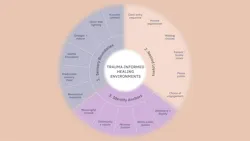
Recent trauma-informed design research offers a useful framework for translating these aspirations into tangible design strategies through three design principles: sensory boundaries, nested layers and identity anchors. Together, these principles move the conversation beyond simply removing stressors and toward creating environments that support healing.
Sensory boundaries
Sensory boundaries acknowledge that many individuals who have experienced trauma also experience heightened sensory awareness. In stressful environments, otherwise ordinary stimuli can become overwhelming: footsteps in a corridor, equipment alarms, harsh lighting, strong smells, visual clutter or the feeling of being exposed. The goal is not to eliminate sensory input altogether, but to thoughtfully modulate it.
Sensory boundaries could prevent Eli from being overwhelmed:
- Acoustic materials soften disruptive noise.
- Glare-free lighting reduces visual stress.
- Views to nature and access to daylight help orient to time and place.
- Gentle transitions between public, semi-private and private areas reduce the abruptness of moving through the system.
- Materials, color, texture, sound and light work together to create an environment that feels more regulated, restorative and human-centered.
Sensory boundaries are about giving people a more predictable relationship with their surroundings.
Nested layers
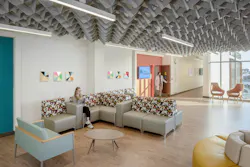
Nested layers recognize that people’s needs change over time. A person may seek privacy in one moment and connection in the next. They may want to observe before participating, pause before entering a clinical zone, or remain near loved ones without feeling surrounded by activity. Environments that provide gradients of social, sensory and physical engagement allow people to determine how they participate in space.
For Eli, nested layers might begin at arrival:
- A clear entry sequence helps her intuitively understand where to go
- Registration occurs in a private alcove, without feeling hidden
- The waiting area offers multiple options: a more social seating zone, a quieter alcove, a place for family, clear sightlines to staff and exits
- Corridors include moments of pause rather than feeling like a forced path from one destination to the next
- In the patient room, zones for care, rest, belongings and family help organize the experience and reduce the feeling of being overtaken by the clinical environment
Nested layers are about empowering people to choose how much to engage rather than being forced into full visibility or full isolation at any given moment.
Identity anchors
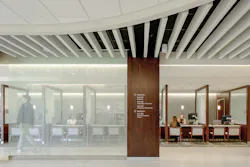
Identity anchors help people see themselves reflected in the environment. Trauma can disrupt a person’s connection to self, community, place and belonging. Healthcare environments can unintentionally reinforce this disconnection when they feel institutional or indifferent to the people moving through them. Identity anchors help restore dignity and meaning.
For Eli, identity anchors help transform the hospital from a place she must endure into a place where she is recognized as a whole person. That recognition comes through:
- Meaningful artwork and culturally responsive spaces.
- Authentic connections to the local community.
- Biophilic design strategies that mirror patterns and scenes found in nature.
- Opportunities for personalization.
- Family support areas.
- A patient room that allows patients to control privacy, keep personal belongings secure, display something meaningful or maintain connection with loved ones.
- Public spaces that feel warm and legible.
Identity anchors are design cues that help people see themselves in a space instead of feeling processed by it.
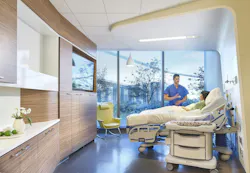
Taken together, sensory boundaries, nested layers and identity anchors move beyond removing stressors toward designing spaces that actively support healing.
A note on technology
Technology also has a role to play, but only when it supports human needs and enhances the user’s experience. Real-time updates, customizable room settings, digital communication tools for caregivers and accessible information systems can provide clarity and reassurance when they are intuitive and optional.
For Eli, technology is helpful when it increases transparency and control. A digital update that lets her loved ones know where she is in the care process may reduce anxiety for her family. A simple interface that allows her to adjust lighting or privacy may help her feel more in control of her room. Clear information about next steps may reduce the uncertainty that often amplifies stress.
The objective should never be to automate comfort but rather to increase agency and legibility.
Designing for the entire journey
For patients, healing begins long before treatment occurs. It begins in the parking lot when the arrival feels intuitive. It continues at registration when they clearly understand what comes next. It is reinforced in waiting areas with choice around where and how they engage. It is supported during care with curated control over aspects of the environment. It is strengthened when family members can remain informed and connected throughout the process. And it remains present through discharge when they leave feeling informed, respected and empowered rather than processed through a system. In an environment that is trauma-informed and salutogenic, every step of the journey contributes to a person's sense of coherence, helping them understand where they are, what is happening and how they can participate in their own care.
It is important to acknowledge that the built environment represents only one component of a truly trauma-informed approach. Successful trauma-informed design emerges from the intersection of the physical environment, the design process, and the policies and operations that ultimately shape how space is experienced. Co-design with patients, families, caregivers and staff helps ensure that lived experience informs design decisions, while operational leaders and trauma-informed care practitioners help align the environment with care models, policies and organizational culture that support healing. A trauma-informed building can only fulfill its intended purpose when all three elements work together.
Ultimately, this is not about designing for a single patient or diagnosis. It is about recognizing that trauma is common, often invisible and deeply connected to how people experience the physical environment. Trauma-informed design helps us understand how environments can reduce harm, while salutogenic design pushes us to create environments that actively contribute to health. Together, they remind us that hospitals are more than places where care is delivered. They're environments that communicate safety, dignity, control and possibility, and when thoughtfully designed, they can help people do more than recover — they can help people heal.
About the Author
CannonDesign
CannonDesign’s Insights is a place for the global design firm to share thoughts and news related to their current efforts to help transform businesses, educational models and health paradigms. The firm engages diverse perspectives and expertise to deliver proven, innovative solutions to our most important partners, our clients. Our global network of more than a thousand professionals enable us to create design solutions to the greatest challenges facing our clients and society. Follow us on Facebook, Instagram, LinkedIn, and Twitter.