How higher education spaces can better serve student veterans
This blog post was authored by Alyson Mandeville, Planner and Designer, Gresham Smith.
A campus can celebrate veterans with banners, ceremonies, and branded messaging. It can highlight a dedicated office, lounge, or resource center as support. But for student veterans transitioning from military service to higher education, the real test is personal: Does this place feel designed with me in mind?
For many veterans, service members and others in the military-connected campus community, college is not just an academic step, but a profound transition involving shifts in identity, routine, social connection, language, and purpose. They often balance coursework with work, family responsibilities, and the complexity of benefits and enrollment. Many are older than classmates, commute, or return after years. In this context, the built environment shapes whether support feels accessible, belonging possible, and campus life navigable.
Institutions serious about veteran success must move beyond symbolic recognition and administrative accommodation to ask: How can space itself support transition?
At Gresham Smith, our work for the Office of Veteran Success at the University of South Florida, on both Tampa and St. Petersburg campuses, highlights this. Designing for military-connected students means creating environments that support autonomy, privacy, peer connection, identity, and dignity. It means designing not just for occupancy, but for experience.
Beyond the Administrative Model
For many institutions, a veteran’s journey starts with an administrative office for questions, benefits, and staff connections. While essential, limiting the space to an administrative hub misses a bigger opportunity. An Office of Veteran Success can be a gateway, refuge, study area, social anchor, and transition zone that addresses both practical student needs and the deeper cultural shift veterans face.
For those from structured military environments, this transition is profound. Military life has its own language, routines, and embedded resources that create order and predictability. Leaving this can feel disorienting—a separation from not just a job, but a way of life, language, and community that once made daily life clear.
On campus, veterans aren’t just learning new subjects; they’re navigating a new culture, systems, language, and routines. While design can’t solve everything, it can help ease this complex adjustment and complement the services, resources, and engagement opportunities the university provides to support students through their academic journey.
Designing for Choice Rather Than Assumption
One key reality is that there is no single veteran student profile. Some veterans seek camaraderie and active engagement; others prefer privacy and independence. Some need a place to work between classes, while others seek counseling, peer support, or simply comfort in an unfamiliar environment. Thus, the most effective veteran spaces offer choice.
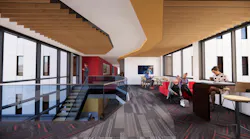
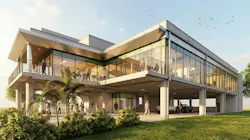
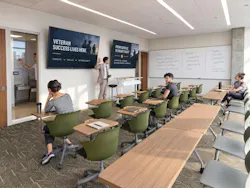
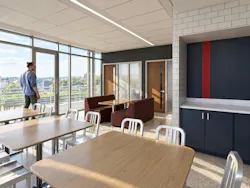
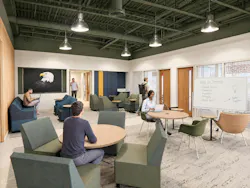
At USF, the Office of Veteran Success on both campuses were designed as a layered environment with a variety of spatial experiences. Public and private zones let students engage on their own terms. Front porches provide informal spaces supporting connections without pressure. Lounge and social areas encourage community, while small and group study rooms support quiet focus and collaboration. Flexible multipurpose rooms adapt to evolving needs and dedicated areas for veteran student workers foster peer mentorship, while counseling rooms support private, sensitive conversations.
Together, these elements do more than check boxes; they create a design framework based on agency. Instead of prescribing how to use a space, the environment allows veterans to choose how to interact with the space.
This flexibility matters in transition. Leaving a highly structured military life, the ability to make choices within a supportive space helps veterans establish new routines, rituals, and a sense of control in civilian and academic settings.
Belonging Without Isolation
Dedicated veteran spaces can provide recognition and comfort, but they also introduce an important tension: how do colleges create spaces of affinity without unintentionally separating veterans from the larger campus community?
This is where thoughtful planning matters. Veteran success spaces should not be hidden or treated as peripheral. They should feel distinct, but not detached, supportive, but not segregated. Their role is not to pull veterans out of campus life, but to create an anchor point from which they can connect to it more confidently.
For students who may already feel different from the traditional campus demographic, this distinction is significant. A well-designed veteran success space can affirm belonging without demanding assimilation. It can provide a place where military experience is understood and respected, while still functioning as a bridge to academic and social life beyond the office itself.
That bridge matters because student veterans are often translating constantly, between military and civilian language, between established habits and unfamiliar expectations, between a past identity rooted in service and a future identity still taking shape. Space can support that translation by offering both familiarity and openness.
Supporting Psychological Ease Through Design
The most effective veteran centered spaces often reflect a deep sensitivity to how environments are experienced, not just how they appear. Small decisions can carry outsized importance.
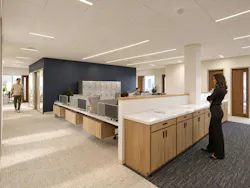
In the USF projects, for example, furniture arrangements were intentionally designed so that seating did not place occupants with their backs toward doors. This may seem like a subtle move, but it reflects a broader commitment to psychological comfort, situational awareness, and personal control. Similarly, the availability of both open and enclosed settings allows students to regulate their exposure, choosing when to engage socially and when to retreat for privacy or focus.
These decisions are not decorative. They are functional expressions of empathy. They signal that the environment has been shaped by listening, observation, and by an understanding that comfort is often rooted in detail.
They also acknowledge another reality of transition: military life is built on ritual and predictability. When veterans leave that world, they do not simply lose their jobs. They often lose daily habits, spatial cues, social rhythms, and shared understandings that once organized their lives. A thoughtfully designed space can help restore a sense of orientation. It can provide consistency, legibility, and choice, all of which support the process of building new routines.
As higher education increasingly embraces conversations around student wellbeing, neuro-inclusion, and trauma informed practice, veteran centered design offers a compelling model for how those values can become spatially legible.
Honoring Service in Meaningful Ways
Veteran success spaces should acknowledge identity and service history in ways that are respectful, authentic, and layered. At USF, the design incorporates nods to military heritage through references to different uniforms across time and representation of all service branches. These elements help create recognition and reinforce that veterans are seen as a valued part of the campus community.
Just as importantly, the design extends beyond symbolism alone. Materiality, furnishings, and naming create subtle moments of familiarity and nostalgia throughout the space. The Marine uniform’s blood stripe, for example, is translated into the design through the use of blue and red. The collaborative café features the iconic Navy Chair, while rugs introduce an almost camouflage-like quality through their patterns and textures. Terrazzo-inspired flooring recalls the material often found in government buildings, and vintage marine light-fixture pendants add another layer of reference. The lounge area, aptly named The Hangar, further reinforces the space’s sense of identity and place.
These gestures are not meant to create a themed environment. They are intended to create recognition without overstatement. For student veterans, nostalgia in design can do more than recall the past. It can provide familiarity amid transition and help bridge the distance between military culture and academic life.
But the most meaningful tribute is still not symbolic alone. It is functional. Military references, branch representation, and heritage cues can enrich the environment, but they are most effective when paired with spaces that genuinely support daily student needs. A graphic or display may communicate appreciation; but a well-designed counseling room, flexible study area, or thoughtfully arranged lounge environment communicates care.
Higher education has an opportunity to move beyond performative support and toward environments where recognition is embedded in how spaces work, not only in what it displays.
A Broader Lesson for Higher Education Design
Designing spaces for student veterans ultimately reveals a larger truth: campuses work best when they accommodate a wider range of life experiences than the traditional student model assumes.
The environments that benefit veterans often benefit many others as well, including adult learners, transfer students, commuters, first generation students, and students balancing education with work or family responsibilities. Spaces that offer privacy, flexibility, dignity, and multiple modes of engagement are not specialized in the narrow sense. They are simply more responsive to the reality of today’s student population.
For that reason, veteran centered design should not be seen as a niche intervention. It is a lens through which institutions can assess how inclusive, adaptable, and humane their campuses truly are.
Designing for the Transition
The most important role of a veteran success space may be to acknowledge transition itself. Moving from military service into higher education is not a single moment but an ongoing process of adjustment, translation, and redefinition.
That process deserves more than administrative efficiency. It deserves spaces that understand complexity, support community without pressure, privacy without isolation, and identity without stereotypes. It deserves environments that don’t ask veterans to conform to a preexisting campus model but meet them where they are and help carry them forward.
As colleges invest in veteran programming, the design conversation should rise to that challenge. The question is no longer whether an institution has an Office of Veteran Success, but whether that office and campus are truly designed to support transition.
This is the difference between making space available and making space matter. At Gresham Smith, our work with the University of South Florida in Tampa and St. Petersburg reinforces this: when veteran success is approached through intentional design, space becomes more than a backdrop for services. It becomes part of the support system itself.
In higher education, the next frontier may be not just designing places for veterans to go but designing places that help them build a new way forward.
About the Author
Alyson Mandeville is a planner and designer focused on creating campus environments that support student success, belonging, and long-term institutional resilience. As Gresham Smith’s Education & Research practice leader, her work explores how design can remove barriers, amplify strengths, and shape more equitable experiences across higher education.
About the Author
Gresham Smith
The Gresham Smith blog is about starting discussions. We want to get people thinking about issues and trends that are impacting the design services industry and the market sectors Gresham Smith architects, engineers, interior designers, planners, consultants and environmental scientists serve. Great ideas are typically enhanced through conversation and often stifled by singular views and opinion. We hope you'll join in this conversation and help us to create a meaningful dialogue. Follow us on Facebook, Instagram, LinkedIn, Twitter, Vimeo, and YouTube.