Building the collegiate classroom of the future
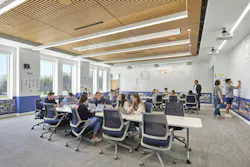
The average college student is no longer so average. Data from higher education institutions indicates cohorts that are more gender and racially diverse, older, and increasingly first-generation college attendees. This comes as students make different calculations when it comes to the “value” of higher education, particularly with the shifting landscape of cost and student loans, the career-readiness of certain degrees, and the merits of non-traditional workforce training programs.
So colleges and universities must meet these students at this precarious and ever-shifting moment, but how? This reflection is welcome: a strategic, supportive, and engaging student experience will help develop strong creators and critical thinkers. Creating a student-ready campus may also be simply required for self-preservation, as campuses compete to attract enrollees from this dynamic and ever-changing pool of new learners and garner public funding that increasingly prizes student retention and performance.
No matter the demographics of its new student bodies, it is vital that a campus supports educational and personal growth, including mental and physical wellness, financial literacy, relationship-building, equity, and identity. We refer to this holistic environment as supporting the Whole Student. Fostering a Whole Student environment on-campus experience contributes to students’ success, particularly first and second-year students.
To support this, we believe that “place”—the literal ground students stand on and the feeling of belonging it hopefully foments—is one of the biggest differentiators between competing higher education institutions. Indeed, we know that students report better engagement and belonging when meeting together physically.
While much thought has been given to the interconnected fabric of student support spaces across campuses in recent years, attention to the formal learning environment—where foundational campus experiences are born—remains just as important. The core of this environment is the classroom, which has been a mainstay of instructional space but in an uncertain future gains new importance.
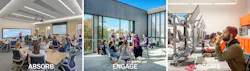
Flexible classrooms are the workhorses of teaching efficiency and play a vital role in a campus' learning ecosystem by providing a place for easy-to-access, curated learning with healthy student engagement. Also consider that the classroom is prevalent in K-12 learning environments and offers comfort in familiarity to first-year college students that need to land on their feet in a completely new university setting. Bridging the student’s transition from high school to college, the classroom remains ideally positioned to provide identity, community, and security to younger learners.
Classrooms need to leverage three fundamental pedagogical actions—absorbing, engaging, and creating—to expand teaching styles, engage students equitably, and foster well-rounded intellectual growth. When designed with intention, the classroom can facilitate all three actions, resulting in spaces that are invigorating, equitably welcoming, and efficient.
We design general classrooms with two strategies: a robust infrastructure and planned flexibility. Designs that champion both will serve a broad range of subjects and teaching styles and help personalize instruction to the student. Here is a deeper look at the thinking behind these strategies:
Planning for Flexibility
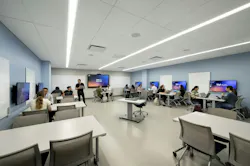
Higher education classrooms require flexibility to accommodate varying subjects, teaching styles, and participation. Flexible classrooms also make for savings on space and cost, with the rooms able to adapt to curriculum changes. This flexibility can be obtained in these design strategies:
Room for change
Making sure that the classroom can house different seating layouts, provide proper sightlines, and accessible routes is crucial to its success in delivering instruction and engaging a broad range of students. For example, rooms that do not have enough space will feel cramped and uncomfortable and schedulers may place smaller courses in these rooms based on instructor and student feedback, potentially well below the max room capacity.
Furniture selection
Learning is tangibly impacted by the usability and comfort of the furniture inside the classroom. To facilitate absorbing, engaging and creating, the furniture must be able to be re-arranged; in groups, towards separate displays, for communal visibility, or other configurations. The worksurface should be large enough to support a range of work and if there is project-based instruction, storage must also be considered.
Modular and adaptable
Spaces that can be more easily combined or divided into spaces of another type better allow for future changes. When planning classrooms in new buildings, we target a universal structural grid that allows for one full structural bay to represent one general medium-sized classroom that can be divided or duplicated to achieve the desired mixture of instructional space.
Infrastructure
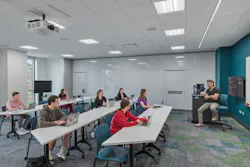
Classrooms must empower students to make connections and provide unhindered access to resources and tools. The infrastructure that supports this and the mandate for flexibility needs to be robust and convenient to use, always ready but not cumbersome. These infrastructure features are necessary to consider in classroom design:
Instructional Technology (IT), Power, and Connectivity
Classrooms require a backbone of computing power to share content, allow for interactive instruction, and more. However, the classroom needs to welcome users of varying tech comfort levels to instruct, share, create, and engage. Classroom technology must be simple and easy to use, with a user’s chosen device. Connections must be made to campus-wide networks to facilitate easy retrieval of information, with adequate power and wireless connections.
Technology Environment
Students and instructors function better when friction across campus is reduced. Integrating instructional technology with scheduling, amenities, and scholarly services streamlines the experience of arriving to class, accessing coursework, and connecting with remote students. This not only improves learning outcomes, it provides equitable knowledge access and ready platforms for sharing.
Campus Infrastructure
Classrooms draw heavily on computing resources in the building and elsewhere on campus. Exposing and positioning data centers or campus technology pathways as hands-on laboratories can be a unique opportunity for workforce training and research. Resource-sharing across campuses or institutional entities, particularly with the computing needs of artificial intelligence, expands computing capabilities while modeling collaborative responsibility to the public good.
Classroom Location
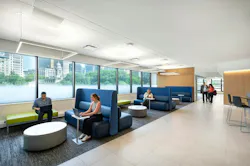
Classrooms are just one piece of the learning landscape on campus. Their location and proximity to informal learning spaces and experiential learning centers facilitate varied student-led learning and academic pursuits. Learning spaces intended to work together in this way cannot be remote nor duplicative.
Future of Classrooms
As we work with campuses conducting planning studies currently, the academic future remains foggy. While it is difficult to predict what the higher education landscape will look like in coming years, reconsidering and investing in the formal learning environment is a good strategy.
When designed with flexibility and robust infrastructure, classrooms can help campuses remain resilient in an uncertain future. The adaptation, ability to flex for various uses, and a simplified technology interface positions the classroom as a stalwart part of a future-ready higher education campus. These are key goals we are keeping in mind during our current planning and design conversations:
Value to Students
Classrooms should allow for student support, engagement, and a variety of learning styles. Spaces designed both intentionally and with the ability to flex to each student’s needs are likely to contribute to academic success.
Prioritizing Efficiency
Higher education institutions are currently prioritizing the creation of spaces that can serve multiple users rather than highly specialized spaces. This practice better prepares institutions to ride any waves of change: spend money wisely on spaces that achieve high utilization, to right-size investment for optimal impact. New programs or functions may be tested in a flexible shared classroom or class laboratory before investing in a single-use or specialized space.
Leveraging Physical Connection
As AI replaces tasks and accelerates learning, employers still value social and professional skills in addition to technology familiarity. Research and surveys show that, though the flexibility of remote learning is convenient, incorporating in-person engagement encourages critical thinking and drives home the subject material.
Conclusion
The classroom has been the primary space for education for a long time and will remain a crucial part of campuses while institutions are greeted by new challenges. Student bodies and what they are studying are changing, both spurred on by technological innovation. Physical, emotional, and mental growth necessary for attracting and retaining students takes place outside of traditional spaces. Workforce training and career-readiness take on increased importance for new enrollees and public funding sources.
These new hurdles demand a democratized and de-siloed view of space on campus, a vision where spaces serve many purposes and holistically support the campus community. Applying new focus to classroom flexibility and infrastructure will allow forward-thinking institutions to accommodate academic evolution with strategic investment.
About the Author
CannonDesign
CannonDesign’s Insights is a place for the global design firm to share thoughts and news related to their current efforts to help transform businesses, educational models and health paradigms. The firm engages diverse perspectives and expertise to deliver proven, innovative solutions to our most important partners, our clients. Our global network of more than a thousand professionals enable us to create design solutions to the greatest challenges facing our clients and society. Follow us on Facebook, Instagram, LinkedIn, and Twitter.