5 design strategies for creating collaborative makerspaces
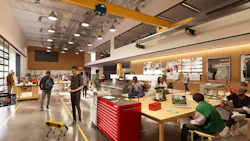
At Hanbury, we design makerspaces as places where people connect, ideas take shape, and learning becomes visible. Our work explores how architecture can support the full creative process, from the first experiment to the story shared beyond campus.
5 Makerspace Design Strategies for Making, Learning, and Sharing
Successful makerspaces bring together equipment, people, and opportunity. Across our academic work, we look at how space can encourage participation, reveal the making process, and help students communicate what they learn.
Process documentation adds another layer to that work. Lighting, acoustics, places to observe, and simple recording tools help students reflect on their process and their decisions. These spaces become a place to tell your story.

1. Build community
A place to make is a place to belong. Informal gathering areas, shared worktables, and spaces for discussion help students learn from one another.
Designing for collaboration begins with giving people room to connect.
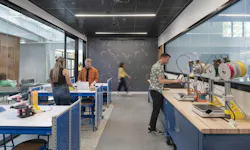
2. Make the work visible
Transparent partitions, observation areas, and project displays bring making into everyday campus life. Seeing others experiment can help a first-time visitor imagine taking part.
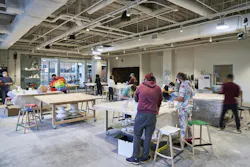
3. Create room for reflection
Recording design decisions, tests, and failures helps students explain how their ideas change. Flexible review areas and simple documentation stations can make reflection and growth a part of the everyday workflow.
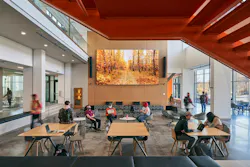
4. Share beyond the workshop
Project presentations and digital storytelling connect student work with audiences beyond campus. Spaces for exhibition and communication can celebrate the people, the questions, and the discoveries behind a finished project.
5. Design for growth
Ideas evolve. Spaces should be designed as a living framework for making, evolving alongside the ideas, technologies, and communities it supports.
About the Author
Hanbury
Hanbury's Knowledge Cafe is features the latest intelligence about architecture and planning for universities and colleges. Accessible articles are authored by Hanbury leaders and address key industry issues and trends--the topics that university and college administrators and facility leaders are tackling as they plan, build, renovate, and maintain the campuses that serve the 21st-century students, faculty, and staff. Follow us on Facebook, Instagram, LinkedIn, and Twitter.