Built for every mind: 5 principles that define neuroinclusive design
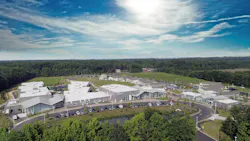
When a school is designed with genuine empathy for the full range of ways students think, sense, and engage with the world, it becomes a catalyst for growth, confidence, and belonging. These are the main ideas behind neuroinclusive design that are transforming how learning environments are designed.
According to The Neurodiversity Alliance, between 15% and 20% of the U.S. population is neurodivergent, encompassing individuals with autism, intellectual disabilities, ADHD, and other conditions. For these individuals, the built environment actively shapes how they can learn, connect, and thrive.
The Bancroft campus in Mount Laurel, N.J., is one of the most instructive examples of what intentional, purpose-built design can achieve for this population. The new campus was designed from the ground up on 80 acres to support a then 120-year-old organization that had outgrown their facilities. The Mount Laurel campus serves as both proof of concept and a replicable framework.
The Case for Purpose-Built Environments
Bancroft served individuals with autism, intellectual disabilities, and neurological challenges for more than a century before relocating from its original Haddonfield campus to Mount Laurel. Leadership recognized that the population they were serving had evolved significantly since the school’s founding in 1883, and that a purpose-built environment could unlock far greater outcomes than any renovation of existing structures could deliver.
Toni Pergolin, Bancroft's CEO who led the campus relocation, describes how that recognition shaped the decision to seek out a design partner with deep expertise in the field.
"The population we served became more acute," says Pergolin. "Many more students were non-verbal, with much more complex needs. We had great ideas internally, and our staff could tell us what worked and what didn't. But we also knew we needed a partner who understood what others in the autism field were doing, what was working elsewhere, and what we could incorporate."
The willingness to take the risk to reach for purpose-built facilities that multiply impact is part of what makes Bancroft's story unique. Many mission-driven organizations have such limited resources they never dare to imagine something bigger or better for themselves.
Bancroft took the leap and paid off immensely, positioning themselves for financial sustainability for the next generation of learners.
5 Principles of Neuroinclusive Design
1. Sensory Regulation is the Starting Point, Not the Afterthought
Sensory regulation is the foundation of every neuroinclusive environment.
Neurodivergent individuals are more vulnerable to sensory overload and experience attention fatigue more quickly than neurotypical individuals. The sensory quality of a space can support and restore capacity to focus and self-regulate, the foundation of an enabling learning environment.
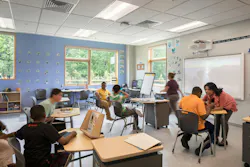
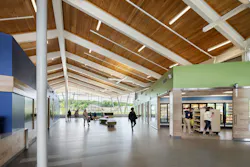
At Bancroft, every major design decision was filtered through the question: What does this space feel like to a student in a dysregulated state? It means layered lighting with dimming capability in every classroom, acoustic panels integrated into corridors and common areas, and a careful palette that uses color strategically rather than decoratively.
It also means a firm commitment to natural light and views, with generous glazing oriented toward a tree-lined campus landscape.
"Eight years in, the thing that still strikes me most is how the natural environment shapes the experience of the campus every single day,” said Pergolin. “For students who process the world differently, the constant calming presence of the light, trees and views makes an enormous difference."
2. Program Wide, Then Design Deep
Do not use your current space program as a baseline. The way an organization operates should not be a product of its constraints, but a map of what is possible.
At Bancroft, KSS interviewed approximately 200 people across the campus before making a single design decision. Together, KSS and Bancroft walked through every building, asked staff what worked and what did not, and toured comparable institutions.
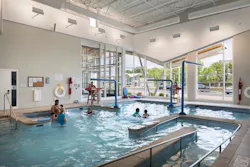
An iterative design process asked stakeholders not to describe their current environment but to reimagine it entirely. That open-minded process surfaced the need for an on-site activity pool. An on-campus pool transformed swim instruction from a logistical hurdle into a reliable, embedded part of the curriculum. It is a decision that would never have emerged from a space program built on the status quo.
3. Navigate from Private to Public, Deliberately
The Bancroft master plan is organized around a fundamental spatial argument: The built environment itself should support the arc of learning. Moving from private to public, from protected to exposed, mirrors the developmental journey of its students.
For a residential campus serving children with complex behavioral needs, that sequencing also answers a harder question: How do you create spaces that feel genuinely like home while still meeting the safety and clinical demands the population requires? At Bancroft, the answer became a defining differentiator.
Residential buildings are clustered in quiet, protected settings. Group homes, seven in total, are designed with the intimacy of real households: Shared kitchens, staff spaces separate from student spaces, and a family garden where parents can spend time with their children without navigating a clinical facility.
Transitional housing is organized around a central campus green with uninterrupted sightlines to the Activity Center and the Vocational opportunities, providing a visual connection to the next stage of life before students take steps to get there.
The Activity Center sits at the center, a 24/7 facility housing the gymnasium, clinic, art and music spaces, the pool, and the Vocational opportunities. Its programming is designed around nodes of interaction: The shared meal, the greeting in a corridor, the moment when a student at the checkout counter of the mock store makes eye contact with a peer and completes a transaction.
These moments of true connection are the curriculum.
4. Raising the Bar: Design for the Most Vulnerable
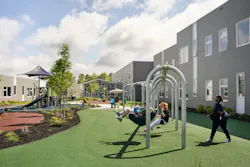
What is essential for the most vulnerable users turns out to be beneficial for everyone. Generous corridor widths make buildings more comfortable for every student and staff member. Acoustic treatment improves learning regardless of diagnosis. Biophilic design strategies that provide connection to nature reduce stress and are restorative for teachers who spend eight hours a day in these buildings just as much as for the students they serve.
A building with poor acoustics is tiring for every occupant. A building with no natural daylight or views disrupts our circadian cycle, throwing us out of balance. A building with confusing circulation creates anxiety for everyone who moves through it. Neurodiverse students cannot mask or compensate their way through those conditions, and neurotypical students pay an invisible cost too. Designing from the needs of the most vulnerable elevates a project, rather than constraining it.
5. Design for the Long Arc, Not Just the Current Program
The Bancroft campus opened in 2017 and reached full enrollment within two years, half the timeline the organization projected. "It was everything we hoped for, times ten," Pergolin says. "We thought it would take five years to fill. It took two. The impact on the individuals and the families was so much more than we anticipated."
Now, less than a decade later, a new early education school is in design on the same campus: 56,000 sf, serving 140 students ages three to 11, and expanding Bancroft's continuum of care from early childhood through transition to adulthood.
The new school carries forward the architectural vocabulary of the original campus while thoughtfully evolving it for a younger population. Classroom configurations are being refined based on eight years of post-occupancy learning. Therapy rooms are being repositioned along corridor edges to provide greater flexibility. Color palettes are being adjusted to feel more playful and age-appropriate without sacrificing the sensory discipline that defined the original design.
Building on What Works
The willingness to think big and to trust the design process, alongside the opportunity to iterate, to take what was learned from lived use and apply it to the next building, is how a specialized institution becomes a replicable model rather than a singular accomplishment.
When the built environment is designed with genuine intention for the full range of ways people think, sense, and move through the world, it stops being a backdrop and starts being a tool. For students whose daily experience depends on whether a space supports or undermines their ability to engage, that distinction is everything.
About the Author
Mayva Donnon, AIA, NCARB, LEED AP is a Partner at KSS Architects with more than two decades of experience designing learning environments for neurodiverse populations. She led the design of the Bancroft Campus in Mount Laurel, N.J., an 80-acre, purpose-built campus for individuals with autism, intellectual disabilities, and neurological challenges that have become a recognized model in the field. Her work continues to expand across the continuum of care, including Bancroft's Early Education Program currently in design, a new K-12 school for Elwyn, the Postsecondary Education Rehabilitation Transition Program at the Woodrow Wilson Rehabilitation Center, and the Rutgers Center for Adult Autism Services. KSS's neuroinclusive design practice is grounded in deep stakeholder programming, post-occupancy research, and cross-institutional benchmarking. Mayva is a frequent speaker and writer on the intersection of architecture, neuroscience, and human development.