Building data centers beyond the first term lease
This blog post was authored by 40 Under 40 Class of 2025 alumni Trevor Walker, PE, SE, Vice President at JLL's Technical Investment Advisory Services group.
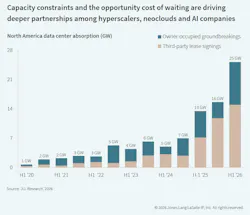
The capital flowing into data center infrastructure right now is real and it is significant. According to JLL's North America Data Center Report: Midyear 2026, North America recorded 25 GW of net new demand in the first half of this year, double a year ago, five times that of two years prior.
More than 66 GW is currently under construction, 95% of it precommitted. Vacancy is below 1% for the third consecutive year. Rents have grown 9% annually since 2020.
The investment thesis, on paper, is straightforward. The harder question is whether the buildings being built today will support it ten years from now.
Technology cycle outpacing construction cycle
GPU generations turn over every 18 to 24 months. Cooling requirements are shifting from air-based systems to direct-to-chip liquid cooling. Power density requirements are on a trajectory to double or triple within a single lease term. A facility designed to current specifications can be operationally outpaced before the certificate of occupancy is issued.
This is not hypothetical. It is already happening on projects under construction today.
Hyperscalers who account for 59% of current absorption are committing $750 billion in capital expenditures to build and lease capacity for AI at a scale that did not exist three years ago. OpenAI and Anthropic alone are linked to roughly 11 GW of capacity under construction or online. The demand is real. What is less certain is whether the physical infrastructure being delivered to support that demand is being built with adequate flexibility to remain relevant when the technology it houses evolves.
The design decisions that matter
For building design and construction professionals, this creates a specific set of decisions that are easier to get right in the basis of design phase than to correct later.
Structural capacity is first. Buildings designed to accommodate higher power densities and alternative cooling infrastructure (even if not initially deployed) are measurably less expensive to upgrade than those locked into a fixed operational model. Raised-floor air-cooling configurations optimized for today's hardware can become a liability when liquid cooling becomes the standard at scale, which current trajectories suggest is when, not if.
Power and utility headroom are second. With 66 GW under construction representing an electricity requirement larger than Germany's entire grid, site selection and utility positioning decisions made today will define operational flexibility for years. Substations with excess capacity and grid interconnection designed for future energy sources (including on-site generation and battery storage) will hold value through multiple technology generations in ways that undersized infrastructure simply will not.
Modular build-out is third. Deferring commitment to fixed interior configurations wherever possible allows owners and operators to respond to evolving tenant requirements without full renovation. This is particularly relevant as enterprise users (managing hybrid portfolios with requirements of 500 kW to 3 MW) increasingly struggle to secure capacity alongside hyperscale demand.
The community and site question
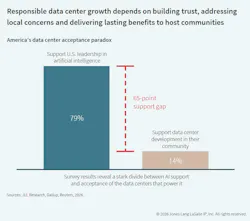
JLL's research surfaces a figure worth noting: 79% of Americans support U.S. leadership in artificial intelligence, but only 14% support having a data center built in their community. That 65-point gap is not going to close on its own, and it has direct implications for entitlement timelines, project schedules, and long-term operating relationships.
Buildings that treat the community boundary as part of the design brief (through architectural quality, noise mitigation, water transparency, and genuine local economic benefit) are consistently better positioned through the entitlement process.
This is not a soft consideration. It affects schedule and cost in ways that show up in the budget.
The ten-year question
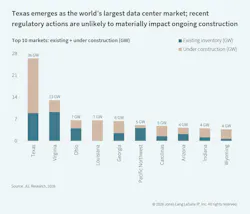
The assets being built today, particularly the 77% of new capacity rising in frontier markets like West Texas, Ohio, Louisiana, and the Carolinas, will need to serve purposes that are not fully defined yet. That argues for designing in optionality now: structural capacity for higher-density hardware, utility headroom for alternative energy sources, spatial flexibility to accommodate configurations that do not yet exist.
The capital is committed. The projects are moving. The question for the design and construction community is whether the buildings being delivered are built for the asset's useful life, or just for the first lease term.