The airport sector seeks longevity, optimization over novelty
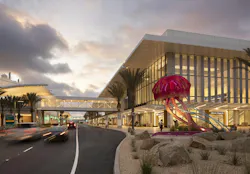
Global air travel has rebounded, but the airport construction boom taking shape in 2026 looks different from past cycles. Rather than racing to build the next iconic mega-terminal, owners are prioritizing modernization, operational resilience, and measurable performance gains. Funding pressures, evolving passenger expectations, and new delivery models are reshaping how and where dollars are spent. Here’s where airport terminal construction is headed next.
The global airport construction market is projected to be about $1.25 trillion in 2026—a $40 billion increase from 2025. Firms like Arora Engineers attribute terminal work to be approximately 30% to 40% of this spend, while WSP sees the remaining 40% going towards terminal expansion and 20% to renovations and upgrades.
Many firms are seeing a shift in spending from “expansion-first” to “optimization-first.”
“Over the next 12 to 24 months, airport terminal investment will be driven less by headline-grabbing, single-phase new terminals and more by targeted modernization, reconfiguration, and system upgrades that unlock capacity, extend asset life, and improve operational resilience,” says Julie Wienberg, Managing Principal, Aviation Practice Leader, Perkins&Will.
The State of Airport Construction Spending
Swinerton VP and National Director of Aviation, Carrie Shaeffer, sees construction spending in 2026 being driven by rising passenger volumes, the need for greater efficiency, and increasing expectations around the passenger experience.
This is especially true for mid-sized and regional airports, as multiple firms note especially strong activity at these airports. Large airports still lead in construction activity, however, with terminal projects accounting for the majority of spending, cites Mark Crosby, Vice President, Aviation, McCarthy Building Companies.
“On average, the top 10 airports in the U.S. are each investing about $1 billion annually over the next five to 10 years,” says Crosby.
Some of these increased airport efficiency initiatives include modernizing baggage handling systems, improving passenger flow, and upgrading parking.
Looking into 2026 as the Airport Terminal Program (ATP) ends, funding will shift toward smaller-scale improvements through traditional sources. This includes the Airport Improvement Program, Airport Infrastructure Grant Program, Airport Funding Reallocation, and Passenger Facility Charges—according to Indhira Figuereo Blaney, Senior Vice President and National Aviation Market Leader, WSP.
Overall, it appears that construction in 2026 will be focused on modernization rather than expansion. According to Dodge Construction Network data, about 75% of terminal projects slated to begin this year involve alterations or renovations, while 15% are additions and just 10% are entirely new terminal builds.
Public Funding Updates for Airport Terminal Construction
“For 2026, the public funding picture for U.S. terminal work is still anchored in two buckets: baseline Federal Aviation Administration (FAA) airport grants, and terminal dollars from the final year of the Infrastructure Investment and Jobs Act (IIJA),” says Sergiu Pelau, PE, LEED AP, Principal and Practice Area Director for Aviation, Syska Hennessy Group.

Most airport projects still begin with FAA Airport Improvement Program grants. Experts from firms like Page, now Stantec, continue to see FAA grant funding play a meaningful role in airport terminal construction and renovation.
“That funding remains an important component of how many airport authorities advance capital improvements,” says Jeff Mechlem, AIA, Principal and Managing Director, Page, now Stantec.
This public funding remains stable and “largely consistent” across administrations, says Chris Harrison, General Manager of Aviation, The Weitz Company. While the funding structure hasn’t changed, one thing has: the urgency. Federal and state dollars are increasingly use-it-or-lose-it, which puts pressure on airports to deliver projects faster or risk losing funding.
Use-it-or-lose-it financing pushes owners toward delivery models that reduce schedule risk and accelerate speed to market, such as progressive design-build and Construction Management at Risk (CMAR).
Some airports are even getting creative in order to fund projects. Hensel Phelps is seeing the expansion of luxury concessions and tech-integrated retail, airline funded investments, and airports playing with their local control of CFCs (Customer Facility Charges).
“While funding constraints remain, the outlook is stable and forward-moving,” says Shaeffer. “Federal dollars are being allocated, grant processes are active, and airports are translating funding into real projects”
Airport Design Trends for 2026
In recent months, airport design trends and innovations seem to be focused on three key areas: technology, passenger experience, and sustainability. With major hubs like Atlanta, Chicago, and Los Angeles leading the way—according to STV’s Technical Director of Architecture, Buildings, Bing Zeng, AIA, LEED AP, CSI—the latest trends are not centered on what’s new, but rather longevity.
Technology Improvements
For tech, firms like Arora Engineers see enhanced usage of multi-sensor cameras, LiDAR, and direct-view LED for EVIDS banks and displays. There’s also been an uptick in biometric processing—multiple firms including Gensler cite a “complete biometric journey” integrating its way into both TSA and U.S. Customs and Border Protection.
Hensel Phelps’ Corporate Director of Project Development, Brian Skipper, DBIA, LEED BD+C, CRM+P, sees improved efficiency in biometric boarding, digital twins, smart building systems, and touchless infrastructure. National architecture, engineering, interior design, and planning firm PGAL has found that through touchless, biometric, and data-driven systems, many airports have realized reductions in queues and staffing impacts of 20 to 40 percent.
In California, the Hollywood Burbank Airport’s new state-of-the-art terminal will be fully electric—only the second airport in the U.S. to do so. Designed by Corgan, in association with CannonDesign and Syska Hennessy Group on the MEP side, the terminal will pursue LEED Gold certification, incorporating solar technology to supplement power generation, maintain thermal comfort, and reduce energy dependency.
The new terminal is “inspired by old Hollywood glamour,” says Brent Kelley, Managing Principal and Aviation Sector Leader at Corgan. “The facility will feature dramatic, sweeping lines with hints of art deco and Mid-Century design.”
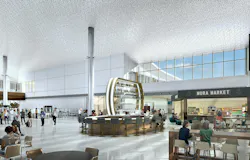
With 14 new replacement gates, the terminal will offer localized amenities/retail, centralized check-in and security checkpoint, streamlined baggage and curbside flows, a new airline support facility, and a new six-level parking garage.
Many of these AEC firms’ clients, especially at larger hubs, are pursuing Airport Carbon Accreditation or LEED standards, according to Wilson Rayfield, AIA, LEED AP, Executive Vice President of Aviation at Gresham Smith. Multiple firms note on-site renewable energy as a key development, as well as increasing the use of sustainable materials.
Sustainability
Sustainability is a key driver of design innovation in aviation infrastructure. Green infrastructure is being embedded into design to reduce energy use, improve resilience, and lower long‑term operating costs, according to Balram “B” Bheodari, National Practice - Lead Aviation at Michael Baker International.
Materials like mass timber are a “strong fit for aviation facilities,” says Shaeffer. “Its warm, biophilic qualities enhance large terminals and concourses while supporting sustainability goals.”
In fact, Swinerton (contractor) and ZGF (architect)’s Portland International Airport has delivered measurable performance outcomes, including a 53% reduction in energy use, a 90% decrease in fossil fuel heating, a 70% reduction in embodied carbon, and elimination of fossil fuels at the central plant, according to Swinerton.
In addition to rating systems such as LEED, airports are increasingly referencing frameworks like Envision, Airport Carbon Accreditation, and the Living Building Challenge, notes Perkins&Will’s Wienberg.
A trend that seems to be popping up more is “fresh air” environments as a core part of terminal experience design. In recent projects, Syska has noticed this trend being driven by its architectural partners.
According to Syska, this trend also has real MEP implications: maintaining the terminal’s positive pressure, exterior comfort strategies, access control/security overlays, and the operational choices that come with opening a secure outdoor space.
Spaces like these—ones with ample natural lighting, unobstructed views, outdoor sightlines—are “paramount” to the passenger experience, says Brian Rush, Vice President, Preconstruction, W.E. O’Neil Construction.
Passenger Experience
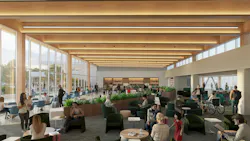
The passenger experience is the core of the airport experience. Today’s airport terminals draw from hospitality design, offering elevated luxury and comfort. Rows of tandem seating are now balanced by lounge seating, workstations, and acoustic pods, notes Kashyap Bhimjiani, Airports Practice Leader, Skidmore, Owings & Merrill (SOM).
Gensler finds that lounges are now becoming the expectations for all passengers, although this leads to a reduction in shopping revenue. This is especially true as “bleisure”—business trips that are extended for leisure purposes—becomes commonplace, notes Kimley-Horn. This trend is fueling demand for airport lounges, co‑working spaces, enhanced technology, and family‑friendly amenities.
“Other amenities such as kids play areas, pet relief areas, mother’s rooms, and spaces for passengers with reduced mobility are making terminals more inclusive spaces,” says Bhimjiani.
“Accessibility For All” is a mantra from HDR that invites sensory-friendly spaces, ASL technology and specialized communication tools, service animal relief areas, lactation suites, and family/gender-neutral restrooms.
In fact, restrooms are “one of the clearest indicators of quality” for airport design, says Kirsten Fordyce-Wheeler, Practice Leader, Aviation Interiors, HOK. Lighting, soft acoustics, touchless fixtures, and layouts that accommodate travelers and their luggage all signal care and competence.

Overall, the passenger experience benefits from greater access to local concessions, a wider variety of seating options that support different traveler needs, and the incorporation of biophilic design elements to improve comfort and well-being, cites Sharron van der Meulen, Managing Partner, ZGF Architects.
Project Delivery Trends for Today’s Airports
It seems nearly unanimous among firms that the traditional design-bid-build approach to airport projects is being replaced by more collaborative delivery models like progressive design-build or Construction Management at Risk (CMAR).
“CMAR is not new, but it's the new flavor of doing design and construction for many airports,” says Chris Gubeno, PE, Civil Practice Lead, Burns Engineering.
Ty Osbaugh, Cities Sector and Aviation Practice Leader, Gensler, finds that clients are split between delivery methodology, while Allen Hill, General Superintendent for PCL Construction, sees progressive design-build becoming the preferred model among clients.
Offsite/Modular Construction
Also playing a larger role is prefabrication, modular, and offsite construction. This is especially relevant for structural, mechanical, electrical, and restroom assemblies, cites Hill.
With offsite construction, airport terminals can remain active for longer periods of time. The benefit here is not completely eliminating disruptions, but significantly reducing its duration. Modular typically provides three main benefits for airports, according to Frank McIllwain, PE, Director of Aviation for Garver: Accelerated construction, minimized operational disruption, and improved sequencing and consistency of construction by building trades.
For one Corgan project, using modular for the ATL $1.4 billion concourse modernization project helped keep gates open for 320+ daily flights, according Jonathan Massey, Managing Principal and Aviation Sector Leader at Corgan.
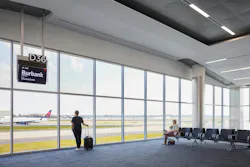
By using modular construction—prefabricating giant steel modules offsite, transporting them by high-tech equipment, and installing them overnight—ATL reduced gate downtime by 20% while increasing the size of Concourse D by 60 percent, cites Massey.
Modular is “one of the most powerful tools for delivering these projects,” says Mary Williams, Associate Principal, Thornton Tomasetti.
However, even with offsite assembly, teams still need to “carefully plan how passengers move, how staff continue their work, and how airport operations remain fully functional,” says Stephen Turner, PE, LEED AP, VP of Operations, Salas O’Brien.
Executive Airport Terminal Trends and Innovations
One “strong growth area” for airports—according to Harrison of The Weitz Company—are executive airport terminals. This is especially true around metro regions, notes Shaeffer of Swinerton.
These private terminals are designed as premium experiences, often emphasizing speed, privacy, technology integration, and operational efficiency, according to Harrison.
Airlines are doubling down on premium experiences—introducing private suites, dedicated lounges, and Delta One–style products, according to Bheodari—while major airports are expanding exclusive areas with separate screening processes to serve luxury and business travelers more discreetly and efficiently.
These spaces focus on customer experience and world-class workplace settings. Benefits include spa services, outdoor courtyards, and ultra-private security and boarding experiences, finds Skipper of Hensel Phelps.
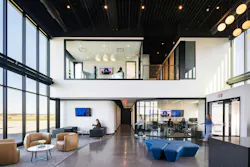
While tech may be a shiny, captivating amenity, some of these terminals are seeing a renewed appreciation for real, human-centered service.
“After years of pushing toward fully self-serve, app-based, and device-dependent experiences, many premium environments are reintroducing staffed reception, concierge-style assistance, and visible hospitality teams,” says Wienberg of Perkins&Will.
Modernization, Resilience, and the Next Era of Airport Design and Construction
We clearly see that construction spending for the airport sector isn’t going anywhere. Although this is the final year of the IIJA, public funding is still stable despite use-it-or-lose-it incentives putting pressure on airports to deliver fast.
For 2026, it appears that the next wave of airport investment will focus less on splashy new terminals and more on unlocking capacity, resilience, and performance from existing assets.
The passenger experience is still paramount, with hospitality-inspired design, inclusive amenities, and lounge-centric environments no longer being simply perks—they’re competitive necessities.
Technology leads the way as biometrics and smart systems are being deployed not for spectacle, but for measurable gains in efficiency. Sustainability falls not too far behind as mass timber and “fresh air” environments grow in adoption nation-wide.
The throughline this year is this: longevity. Across funding, design, and delivery, 2026 airport construction is defined less by novelty and more by durability, flexibility, and return on investment.
About the Author
 Quinn Purcell
Quinn Purcell
Quinn Purcell is the Managing Editor for Building Design+Construction. Covering the building industry for over four years, he has contributed to several award-winning industry reports, physical/digital magazines, and online news coverage. Quinn delivers content ranging from multifamily housing, technology, sustainability, and more.
For BD+C, Quinn runs the brand's 40 Under 40 program, covers product updates monthly, manages a blog partnership with over 50 AEC firms, and writes daily analytic-driven content for the website.