The challenges and benefits of using VR for biophilic design

This blog post was authored by Alireza Sedghikhanshir, PhD, LEED GA, Post Doctoral Researcher HBI, Page; and Raffaella Montelli, PhD, Associate AIA, Principal, Director of Research & Innovation, Page.
Immersive technologies are no longer just nice-to-have visualization tools; they are catalysts for a new era of experimental and human-centered design innovation. Virtual reality (VR), in particular, gives designers, clients, and stakeholders an opportunity to explore architectural ideas before anything is built.
In early design stages, VR helps users experience space, scale, light, and materials in a way that bridges the gap between designs and lived experience. This is especially important when designing restorative, biophilic environments—spaces that draw from the logic and aesthetics of nature through organic forms, natural materials, and multisensory cues such as light, texture, and water, all working together to promote health and well-being.
While the benefits of biophilic design are well known, implementing these features in real buildings is often challenging. Costs, space constraints, and maintenance requirements can all pose obstacles.
This is where VR can play a critical role by allowing teams to test, refine, and optimize biophilic design strategies before making real-world investments. It also enables cost–benefit analysis and helps identify the most human-centered, effective, and impactful solutions.
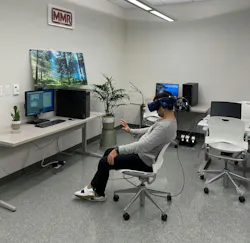
But here is the challenge: VR does not always work as needed. Simulating the complexity of nature and how people truly respond to it is far harder than it looks. Some studies show that human responses in virtual environments do not align with what happens in real spaces.
For example, in one study comparing the impact of green walls in real and virtual environments, only the real one led to measurable stress recovery.
The virtual version of the same-sized green wall, even though it looked nearly identical, had no significant effect.
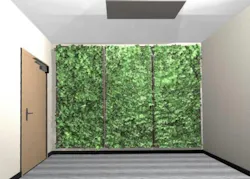
This serves as a research-backed reminder that using VR to test designs demands careful calibration and validation to ensure its outcomes reliably reflect real-world responses. Without validation, using VR for design decisions could lead to spaces that fail to effectively support the people who use them, especially in critical environments like healthcare facilities, where design can directly affect well-being.
VR integration with additional data streams, such as physiological, psychological, and behavioral measures, provides robust cross-validation between virtual and real-world outcomes. This capability strengthens the credibility of findings, ensuring that biophilic and restorative design strategies are both evidence-based and effective in practice.
Recent developments in immersive technologies and spatial computing
VR technologies have advanced rapidly, evolving from simple visualization tools into powerful media that can simulate complex spatial and sensory experiences. These developments have paved the way for the broader paradigm of spatial computing, which now enables dynamic, multi-sensory, and interactive digital environments. This technological progression has revealed emerging applications in healthcare, where immersive systems are used to support mental health therapy, enhance patient rehabilitation, and enable new forms of medical training and remote care.
The newest generation of immersive platforms available on the market, such as Apple Vision Pro, Samsung Galaxy XR, and Meta Quest, are an example of how technology has revolutionized the virtual experience of nature, with ongoing commercial and academic research continuing to push those limits, e.g., MIT MediaLab, UC Berkeley XRLab.
These systems combine high-fidelity rendering, low-latency head and hand tracking, and advanced eye-tracking with spatial audio and scene understanding, allowing users to experience spatial relationships and environmental qualities with increasing realism. Advances such as foveated rendering, gesture-based control, and gaze-responsive interfaces have enhanced user interactivity, while spatial audio pipelines simulate the directionality and distance of environmental sounds.
Collaborative virtual environments now enable multiple users to annotate and manipulate shared 3D scenes in real time, supporting collective design exploration.
Complementary tools like spatial styluses, wearable haptic gloves, and embedded physiological sensors that monitor heart rate variability, muscle tension, or temperature extend immersion beyond just the visual and auditory domains.
These innovations begin to bridge the challenges in using VR for biophilic design:
- The multisensory gap, by introducing tactile, auditory, and ambient cues
- The interaction gap, through more embodied engagement and gesture-based manipulation
- The exposure gap, as improved ergonomics and display quality allow longer, more stable sessions
These developments mark significant technical progress. Yet from a design research perspective, progress in simulation does not automatically translate into equivalence with real experience. The risk lies in mistaking sensory representation for sensory authenticity, a misunderstanding that can interrupt the relationship between design intention and user response. Within biophilic design, the intention is often to elicit restorative responses through interaction with natural stimuli. However, immersive simulations of these stimuli may not replicate the same physiological and psychological outcomes.
For example, while visual fidelity and spatial realism can be technically convincing, they may fail to trigger multisensory coherence to evoke restoration and stress recovery.
This gap highlights the need to critically examine how virtual interventions mediate user experience, not just how they represent natural stimuli. This underscores the importance of experimental examinations of design to understand its potential in evoking a restorative effect rather than just focusing on technological presentations. Without empirical grounding in user-centered evaluation, such simulations risk reinforcing surface-level aesthetics of “digital nature” rather than fostering the deep psychological and physiological connections required for restorative outcomes. Consequently, it is imperative to address how immersive tools translate intention into impact, ensuring that spatial computing is employed as a tool to test and refine biophilic hypotheses.
Multisensory integration: Progress and remaining frontiers
The ongoing evolution of immersive technologies has expanded the possibilities for designing multisensory experiences that emulate the richness of natural environments. Yet virtual nature remains an approximation rather than a full equivalent of real experience. This is not simply a technological limitation but a design challenge that requires translating the complex, restorative principles of nature into spatial and sensory interventions that can meaningfully enhance human well-being. The central task, therefore, is not only to identify which aspects of nature to represent but to determine how design can intentionally manipulate sensory, spatial, and symbolic cues to achieve measurable restorative outcomes.
From this perspective, technology functions as a tool of design inquiry rather than an end in and of itself. The latest immersive systems, integrating spatial audio, haptic feedback, and early olfactory diffusion, offer powerful tools for exploring how multisensory stimuli shape perception and emotion. However, these tools are still developing in their capacity to synchronize sensory channels and emulate the dynamic interplay that occurs in natural settings. In real environments, cues such as touch, temperature, scent, sound, and proprioception interact fluidly, producing restorative effects through feedback loops between perception, physiology, and affect.
Current platforms can reproduce these modalities individually, but not yet with the interdependent variability found in nature. Haptic interfaces convey vibration or pressure but lack the material richness of natural textures, and olfactory systems, while promising, remain limited in range and consistency.
Addressing this gap calls for a multidisciplinary approach, integrating design research with advances in cognitive science, environmental psychology, and computing. Rather than viewing simulation fidelity as the ultimate goal, the focus should be on developing a deeper understanding of how humans perceive, interpret, and respond to multisensory environmental cues, and how these insights can inform the design of restorative experiences across both physical and virtual settings. As multisensory design research develops, the refinement of immersive technologies will increasingly serve the broader aim of design, which is to create coherent, embodied, and affective experiences that capture the restorative potential of nature within the built and digital environments.
Human and contextual factors
Beyond the sensory domain, individual and contextual factors continue to shape the effectiveness of VR-based biophilic experiences. User variability, including differences in age, sensory sensitivity, and familiarity with immersive technology, can influence comfort and engagement levels.
For instance, older adults or first-time users may find navigation interfaces or visual feedback less intuitive, which can lead to lower immersion and increased disorientation. Cybersickness, caused by latency, mismatched vestibular cues, or a narrow field-of-view, still affects a substantial portion of users and can manifest as nausea, fatigue, or cognitive strain. Such physiological disruptions directly contradict the calming and restorative goals of biophilic design.
Moreover, environmental transitions in VR can differ sharply from real-world spatial experiences. In actual environments, the shift from built to natural spaces, such as a hallway opening into a garden, occurs gradually, allowing psychological and sensory adjustment. In VR, transitions are often instantaneous, transporting users abruptly between distinct contexts. This lack of perceptual continuity may disrupt a sense of realism or reduce the restorative effect, particularly when simulating stress-to-calm sequences like entering a healing space.
Finally, practical limitations persist. Multisensory peripherals such as haptic gloves, spatial styluses, and scent diffusers remain expensive and technically complex. High-quality systems demand calibration, maintenance, and specialized knowledge, constraining their use in design and healthcare applications. Consequently, while immersive technology continues to advance, the application of VR as a reliable proxy for real-world restorative environments must remain cautious and evidence-based.
Toward evidence-based research: Page, now Stantec’s approach
Recognizing these limitations, Page, now Stantec approaches VR not as a replacement for lived experience, but as a research instrument for understanding how people perceive and respond to simulated environments. Partnerships under development with leaders in this space enable Page to test and refine immersive methodologies, not to equate them with reality, but to identify when and how they diverge. Building on this approach, Page, design research seeks to explore how emerging methods such as wearable sensors, eye-tracking, and data-driven pre-post occupancy evaluations could be applied to connect virtual experience with measurable outcomes in real environments. This direction reflects an interest in developing a validation framework that helps determine where VR insights are reliable and where they risk distortion.
Rather than positioning VR as an end in itself, this approach situates immersive technology within a broader, evidence-based design process, emphasizing empirical testing, human variability, and multisensory realism. The goal is not to eliminate VR’s limitations, but to understand and contextualize their implications, ensuring that virtual simulations inform design decisions responsibly, without overstating their predictive value. Incorporating artificial intelligence into this trajectory could further advance the field by enabling the analysis of multimodal data, identifying patterns of restorative response, and informing adaptive, user-centered design strategies. Through such multidisciplinary collaboration, VR can evolve from a representational convenience into a scientifically grounded framework for investigating rather than assuming the restorative potential of biophilic design.
About the Author
Page
With roots extending back to 1898, Page provides architecture, interiors, planning, consulting, and engineering services throughout the United States and around the world. The firm’s diverse, international portfolio encompasses academic, advanced manufacturing, aviation, and civic/community/culture sectors as well as government, healthcare, hospitality, mission critical, multifamily residential, office, retail/mixed-use, science/technology and workplace projects. Page Southerland Page, Inc. has 1,300 employees across multiple offices in every region in the United States as well as abroad.
Learn more about the firm at pagethink.com. Follow Page on Facebook, Instagram, LinkedIn,