How Daytona State College uses adaptive reuse to expand workforce training
Colleges and universities continue to navigate enrollment uncertainty, funding cuts, and increasing scrutiny over capital and operational expenditures; this challenges them to creatively stretch their resources to continue providing a high level of service and support to their campus communities.
Higher education has become fiercely competitive, demanding innovation, reinvention of identity, and celebration of purpose. Thriving institutions are demonstrating an elevated commitment to delivering relevant, holistic, and personalized education and developing opportunities for students. Daytona State College (DSC) provides an example of success, meeting the challenges of today by creating the opportunities of tomorrow.
Adaptive Reuse Supports the Future of Daytona State College
DSC’s continued prominence within the region and beyond can be attributed to the many intentional decisions and focused plans deployed over several years, under a strong and committed leadership team. One of the approaches that has yielded consistently positive results has grown out of the most recent master plan developed for the college and the themes and vision that evolved from that process.
While not a new concept, DSC embraced a mindset of exploring adaptive reuse and the maximization of existing resources before consideration of new construction.
Operating seven campuses located across two counties, the college serves a diverse population with highly varied economic and industry profiles. In response to the needs of the communities that they ardently serve and support, DSC has ambitiously and successfully leveraged adaptive reuse as a strategic solution to support growing workforce training needs.
This has given the college greater latitude in executing much-needed improvements without waiting on unreliable funding for increasingly costly new construction. After recently completing the campus master plan, the college executed a series of projects that transformed underutilized and vacated campus spaces into high-demand learning environments.
Nursing classrooms became a welding lab, an early childhood facility became law enforcement training space, and academic areas were revitalized to expand EMS education through advanced simulation and hands-on training.
A Microcosm of Higher Education's Challenges
DSC is experiencing a microcosm of the issues facing higher education. Enrollment is declining, student demographics are evolving, the value of college education is being questioned, and financial concerns mean that institutions are being asked to accomplish more with the same or reduced level of resources. The need to take advantage of underutilized spaces and increase efficiency has become paramount.
While experiencing these pressures in their own way, DSC remained optimistic and found real opportunities. There was an elevated focus placed on already successful workforce and allied health programs, and the persistent pursuit of funding and the establishment of meaningful community partnerships helped grow these programs. In addition to expanding certificate and degree program offerings, shifting demographics also brought an increase in enrollment.
As the strategic vision of the college grew, the question that clearly stood out was: How would DSC provide these growing programs the space needed to deliver the curriculum that was sought?
A Master Plan Sets the Stage
In 2023, Spiezle partnered with DSC to prepare a Campus Master Plan for five of its campuses across Flagler and Volusia Counties, including the main Daytona Beach Campus. Using an immersive master planning process and a range of analytic tools, Spiezle developed a master plan that serves as the vehicle for the college to achieve greater efficiency in its existing buildings and holistically plan for strategic capital improvements.
Allen Masters, Associate Vice President for Facilities Services at DSC, recognized the value right away: “I recognized an immediate alignment between the newly developed Master Plan and several high-priority projects that required fast-tracked execution. We prioritized projects that directly addressed urgent program expansions, workforce needs, and critical facility upgrades across our campuses.”
Why Consider Adaptive Reuse?
As Masters puts it, “Renovating existing space rather than building new structures offers significant strategic and financial advantages when site conditions allow.”
Two main advantages stand out: accelerated timelines and fiscal responsibility. Renovation of existing spaces can drastically reduce design and construction lead times, allowing the college to bring critical workforce programs online much faster. Adaptive reuse maximizes the return on investment by creatively repurposing underused spaces with inherent strategic value and stretching budget dollars.
Together, they achieve the core goal: delivering high-quality learning environments for students.
Adaptive Reuse in Action
Three projects that Spiezle has supported at the college show how the approach works in practice. In Building 1 at the DeLand Campus, significantly underutilized and partially vacated academic facilities were reconfigured into state-of-the-art technology-rich EMS training and simulation labs. On the same campus, Building 8, which used to be an early childcare center, was modernized and repurposed into law enforcement training spaces, including a new tactical defense lab.
The completion of these two projects is a core component of the new home for the distinguished Charles M. Curb School of Emergency Services. The relocation of the functions to the DeLand Campus provides significantly improved and functional spaces and frees up valuable space at the Advanced Technology College campus to facilitate the growth and expansion of other trade programs and fields of study.
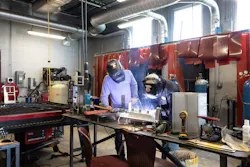
The third project of note responded to a specific demand to expand the highly successful welding program at the Daytona Beach main campus. An existing nursing lab space was selected for conversion based on its geographic location, existing infrastructure, and size. Through adaptive reuse of the space, the college was able to rapidly bring online a new lab that doubled the size of the welding program and helps respond to growing demand.
Lessons Learned
Complex adaptive reuse projects require significant coordination and planning. Communication is essential. Engaging users consistently from design through construction ensures the completed spaces meet their operational needs and reduces late-stage change orders.
Departmental stakeholders and end-users should actively participate in programming and preliminary design, and remain close to the projects as they advance in order to provide valuable current input and direction that is responsive to the ever-changing pedagogical and technological needs of the modern workforce, public service, allied health, and trade programs.
Adaptive reuse requires rigorous planning for hidden building conditions. Renovating legacy structures always reveals surprises. Teams that build robust physical and financial contingencies into renovation projects can maintain the agility to solve problems quickly.
Start with the Mission, Not the Building
DSC's experience shows that adaptive reuse is a practical and fiscally responsible strategy in design and facility management. The place to begin is the mission, not the building. Once an architect understands institutional goals and campus culture, they can conduct planning and programming studies to uncover underutilized, oversized, or misallocated rooms. A collaborative team can prioritize flexibility, engage stakeholders, and plan for challenges to ensure success.
Adaptive reuse works best when it is driven by strategic needs, backed by accurate facility data, and designed for long-term flexibility. For institutions facing tightening budgets and shifting enrollment, the question to ask is, “How can this existing facility best support our future mission?”
Starting with this approach, an institution can often discover that the space required to meet students' needs may already exist as a strong candidate for reuse.