Hello iGo! Modernizing Visitor Access in Multifamily
Key Highlights
- Visitors scan a QR code or tap an NFC plate to open a searchable directory and place a video call without installing an app.
- Residents can view visitors, choose whether to answer with video, and release the door from the app.
- Geofencing can restrict calls to visitors physically near the entrance, while access events are logged through Salto’s platform.
- The unpowered, network-free plate can reduce installation complexity and make it easier to add coverage at secondary entrances.
- Operators can manage residents and intercom access alongside credentials in Salto Homelok or Salto KS.

Walk into a multifamily building finished in the last five years and almost everything is connected. Package lockers, app-controlled thermostats, keyless unit entry, a leasing office that runs in the cloud. Then there is the intercom at the front door. It may have a camera and it may call a resident's phone, but it is still a panel: powered, networked, mounted, and serviced like any other piece of building equipment.
A new generation of intercom systems does away with the panel entirely. Everything, from the directory to a video call to the door release, moves to the phones that visitors and residents already carry.
The panel is the problem
Today's intercom market is not stuck in the past. Most recent systems have cameras and can ring a resident's mobile phone. The problem is what they still require to do it.
Hardware at every entrance. A modern video intercom is a touchscreen or camera panel that needs power, a network connection, a weatherproof enclosure, and a mounting detail. It is a vandalism target and a service item. Every additional entrance, from a garage gate to an amenity door, means another panel and another conduit run. Owners routinely limit coverage to the main lobby because the second and third entrances do not pencil.
A separate system from access control. Most intercoms are bought, installed, and managed on their own, apart from the system that handles key fobs, mobile credentials, and door schedules. Residents live in one database and the intercom directory in another. When someone moves out, both have to be updated. Property managers end up running two systems for one door.
A thin security record. A system that calls a phone still has to decide who can ring and from where. Many cannot confirm the caller is physically at the entrance, and the door release is logged, if at all, separately from the building's access events.
What hardware-free looks like
The alternative uses the smartphones everyone already carries. Salto XS4 Com is a good illustration. At the entrance is the XS4 Com iGO: a vandal-resistant polycarbonate plate, about 4 by 6 inches, carrying a unique QR code and an NFC tag. Sticker versions exist for metal surfaces and for mounting behind glass. The plate needs no power and no network connection. It includes braille and ships in a growing set of languages.
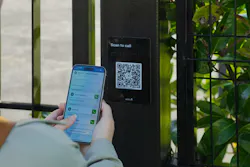
Behind it is a cloud platform that holds the building's entrances, floors, units, and residents, plus a native app residents install on iOS or Android. Visitors install nothing.
At the door, the sequence takes about as long as pressing a buzzer:
- The visitor scans the QR code or taps the plate. A web page opens with a directory searchable by unit, name, floor, or company.
- They tap the resident's name, which places a video call to the resident's app.
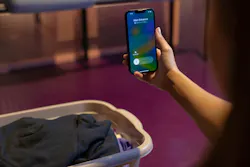
- The resident sees live video before answering, takes the call with or without their own camera on, or declines it.
- They release the door from the app, with or without talking. The command runs through the building's Salto access control platform, so it is logged like any other access event.
When enabled, geofencing means a visitor can only place a call when they are physically near the entrance, and the installer sets the radius per entrance. Someone who photographed the code last week cannot ring a resident from across town.
What it means for owners and operators
Lower first cost, especially at the margin. Removing the panel removes everything that supports it: the power circuit, the data drop, the enclosure, the blocking, and the commissioning visit. Once a building has one entrance on the system, adding a garage gate, a courtyard door, or a package room costs a plate and a lock.
An opportunity for properties without intercoms. Because nothing at the door needs power or data, an existing building can add visitor access without opening walls or trenching to a gate. Mount the plate, connect the door to the access control platform, and invite residents to the app.
One platform for the door. XS4 Com runs on Salto Homelok for multifamily communities or Salto KS for mixed-use properties. The administrator who issues credentials also manages the intercom directory. Move-ins and move-outs are a user record, not a printed directory insert. For a developer, the intercom becomes a feature of the access control spec rather than a separate Division 28 line.
An amenity residents use daily. Most smart building features are nice to have. The intercom gets used every time a friend visits or a package arrives, which is the kind of feature that shows up in reviews and renewal conversations.
Security questions, answered up front
The resident sees the visitor on video before the door opens, and geofencing means that call could only have been placed from the entrance. Calls run over WebRTC with end-to-end encryption, and as with any modern video call, residents decide whether their own camera is on. Every access granted is logged with the time, the access point, and the user who authorized it.
It is never too late to ditch the panel
Every operator knows the math. The old panel still works, mostly. Replacing it means a new panel, an electrician, possibly a new conduit run, and a week of residents calling the office because the directory is down. So, the replacement waits, and then it waits some more.
The replacement no longer has to be another panel. Because nothing at the door needs power or data, an existing entrance can move to XS4 Com without opening a wall or cutting a slab. The plate mounts beside the door with adhesive. The entrance gets a Salto lock or access point on KS or Homelok, which many Salto buildings already have. Residents get an invitation to the app. The old panel can come down the same afternoon or sit there until someone gets around to it.
It also works one entrance at a time. Start with the gate that never had an intercom, or the side door that takes the most delivery traffic, and let the lobby panel run until its service contract expires. Nothing about the system requires a building to convert all at once.
For owners who have deferred this decision for years, that is the real news. The upgrade finally fits inside a normal capital budget, and inside a normal week.
The front door, caught up
For decades, intercom modernization meant replacing one panel with a newer panel. The smartphone-based model breaks that cycle. The device everyone carries becomes the intercom, the intelligence lives in the same cloud platform that runs the doors, and the hardware at the entrance is a plate an installer can mount before lunch.
Learn more about Salto XS4 Com and how it works with Salto's cloud access control platforms.