Q2 Construction Cost Trends Shaping Project Budgets
Key Highlights
- Rising fuel costs are impacting all materials, especially those with energy-intensive production processes.
- Structural steel costs have been on the rise all year and are likely to continue rising into Q3.
- Copper wire and lumber costs are likely to stabilize as demand holds firm.


It might be too early for Merriam-Webster to crown their word of the year, but if the construction industry gets a say, the word for 2026 would be “uncertainty.” The current cost environment is extraordinarily volatile, and the industry is feeling the pain. Gordian’s Historical Cost Index, a longitudinal measurement of the overall change in construction costs including materials, labor and installation, skyrocketed 2% from the first quarter of the year to the second, the largest quarter-to-quarter jump since 2022. There’s no guarantee we’re anywhere close to the end of these colossal cost escalations, as they largely depend on how world events unfold.
So, yes, the construction industry is facing uncertain times.
However, looking at costs in RSMeans™ Data, we can say for sure that some sectors are feeling the impacts of volatility more than others. Let’s look at those disparate impacts and examine which costs are rising and which costs are stabilizing.
Fuel and Energy: The Obvious Cost Drivers
Sticker shock used to only happen at the car dealership; these days it’s happening at the gas pump. The massive spike in fuel and energy costs has downstream implications for material transportation costs, but that’s not the only area where they have an outsized impact.
Consider metal production, specifically anything hot-rolled, such as I-beams, H-beams and hot-rolled plates. The process of making these products is incredibly energy-intensive and, at least at present, incredibly expensive.
While rising fuel and energy costs touch every product, some cases are more painful than others. Next, let’s analyze the upward price movements of two core construction materials.
Rising Material Costs
Structural Steel – Following two straight sluggish quarters, structural steel costs have roared back in the second quarter, up 7.5% since the beginning of the year. Between exploding transportation and production costs, it is likely that structural steel costs will continue to climb In Q3 of 2026.
Fiberglass Insulation – Despite modest recent gains, fiberglass insulation costs have grown almost 18.5% since Q2 of 2025. Expect costs to continue rising as we enter the summer months, when consumer demand tends to ramp up.
Expect structural steel and fiberglass insulation to drive up costs in the near future. These next two materials are likely to behave more predictably.
Copper Wire – Copper wire costs are on a long-term upward trajectory, up over 18% since the quarter of 2025. Between Q1 and Q2 of 2026, prices jumped 5.3%. Here’s the good news for U.S. firm: To date, demand and production are leveling off, so current costs may hold for several months.
Framing Lumber – A brief concession: Lumber costs leapt over 5% since Q1 and year-over-year prices are up 4.21%, so if you read the words “framing lumber” with some level of skepticism, I understand. However, looking forward, any increases are likely to stay in the single digits, as demand should hold.
The Latest on Labor
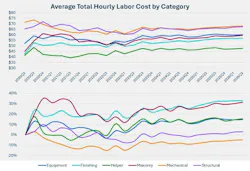
There has been too much reporting and analysis on the construction industry’s long-time labor shortage to rehash here. While the labor shortage wages on and finding skilled trade workers is persistently difficult, something interesting is happening in the labor market. We are seeing a lower-than-normal rate of layoffs and laborers exiting the workforce. This combination may be indicative of an employment holding pattern. It suggests companies are keeping more employees than in previous years, and that those employees are not leaving presumably for more lucrative opportunities.
Assuming those are the market conditions, we may be looking at labor as a steady, predictable aspect of construction estimating and project costs.
Summer of Uncertainty
Here’s the unfortunate fact: We have no control over the events driving cost volatility. The construction industry is entirely dependent on outside actors responding to their own set of motives. In times like these, reliable cost data is an invaluable resource. Check it regularly, and use it to make informed decisions about materials, project timing and procurement practices.
In the summer of uncertainty, leveraging data is how you exercise any measure of control.