Identity Is the New Access Credential
Key Highlights
- Modern hybrid work is rendering traditional RFID badge-based building security obsolete
- Biometric verification closes the gap between credentials and actual building occupants
- Identity lifecycle management automates access from onboarding through departure
- Converging physical and IT security delivers zero-trust architecture for buildings
- Occupancy intelligence from identity systems informs space planning and lease decisions
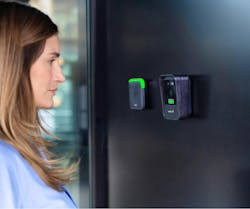

For decades, building security operated on a straightforward premise: control the boundary. Walls, doors, turnstiles, and a staffed lobby formed the perimeter. If you regulated what came through the entrance, the building was considered secure. That model worked because the population behind those walls was predictable—the same employees, at the same desks, five days a week.
That world no longer exists. Hybrid schedules mean occupancy can swing from 40 percent on Monday to near capacity on Wednesday. Contractors rotate through on project timelines. Flexible corporate workspaces bring unfamiliar tenants into shared corridors. Return-to-office mandates are reintroducing thousands of workers into facilities designed for a fundamentally different era of use. For architects, engineers, and building owners, the implications run deeper than security: they reshape how buildings are designed, operated, and optimized over their lifecycle.
The Credential Gap
An RFID badge or prox card answers exactly one question: is this credential valid? It cannot answer the question that actually matters: is the person holding it the authorized user?
Badge sharing, credential cloning, and tailgating all exploit this single-factor weakness. The IT security industry solved the equivalent problem years ago by layering identity verification on top of access tokens. Physical security has been slower to make this leap, but the technology has matured to the point where there is no longer a reason to wait.
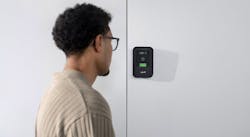
Face recognition solutions, like Salto XS4 Face, have emerged as the most practical bridge. Unlike a card or smartphone, a face cannot be lost, forgotten, shared, or cloned. Modern systems use dual cameras and AI-powered liveness detection to verify the actual person at the door, not a photograph, not a mask, not a proxy. Verification happens in a fraction of a second, with biometric data encrypted as code rather than stored as images. Enrollment is built around explicit consent and privacy compliance, addressing the concerns that have historically slowed enterprise adoption.
For architects, developers and designers, this matters because it redefines what the entry point of a building needs to be. The entry point is no longer a cumbersome checkpoint. It becomes an intelligent verification node. This is something building teams should be designing around, not bolting on later.
From Access Control to Identity Governance
Even the most sophisticated reader at the door is only as effective as the system behind it. Who decided this person should have access to this floor, this lab, this mechanical room? When does that access expire? What happens when they change roles, complete a contract, or leave the organization?
Traditional systems treat provisioning as a point-in-time event. A badge is issued. Permissions are assigned. If someone departs, an admin or facility manager (eventually) deactivates the credential. Role changes, project completions, and compliance lapses fall through the cracks, not because of negligence, but because the system was never designed to manage identity as a living lifecycle.
Physical Identity and Access Management, or PIAM, changes this from event-based to lifecycle-based. Identity management platforms, like Salto IDM, centralize governance across the entire organization, automating processes that legacy systems leave to manual work. Employees are provisioned the moment HR completes onboarding. When a contractor’s project ends, access revokes automatically. Visitors register through self-service portals and receive temporary digital credentials that expire according to policy.
It is important to note that these platforms integrate with the systems building owners already rely on, like HR platforms, IT directories, and space-booking systems. Access management inherits the logic of the organization itself. For those managing multi-tenant or flexible-use properties, this is not a nice-to-have. It is the only scalable way to maintain an accurate picture of who should be where.
Zero Trust Comes to the Built Environment
The convergence of IT and physical security has been discussed at security conferences for years. What has changed is that the operational architecture finally exists to deliver on the promise.
Zero trust in the cyber domain is built on a clear principle: never trust, always verify. Applied to physical access, the implications are transformative. The door does not trust the credential—it verifies the person, in real time, with face recognition. It confirms authorization in the sub-second window between user approach and lock engagement. When biometric verification at the edge is paired with a modern, identity-based access management solution, the result is the physical equivalent of a zero-trust architecture.
The Intelligence Dividend for Building Teams
Identity-first access produces a benefit that extends well beyond security—and this is where the value proposition resonates most strongly for building developers, owners, and managers. When you know with certainty who is in a building at any given moment, that data becomes an operational asset.
Space utilization patterns, peak occupancy windows, contractor compliance rates, visitor throughput, and after-hours activity all become visible. This intelligence supports facilities management, helps corporate real estate teams right-size leases, and provides the granular data that emergency mustering and code compliance require. For architects designing the next generation of flexible commercial buildings, understanding actual occupancy behavior (not assumptions) should be informing design decisions from the earliest phases.

Designing for Identity, Not Just Entry
The modern building will continue to evolve in ways that are difficult to predict. What will not change is the requirement that security systems verify people, not proxies. The badge was a useful instrument in an era of stable, predictable occupancy. That era is over.
Identity-first access, anchored by biometric verification at the door and governed by intelligent lifecycle management at the platform level, provides a foundation that does not depend on how the workplace evolves next. It scales across flexible and multi-tenant work environments. It delivers the convergence of physical and IT security the industry has been working toward. And it gives architects, engineers, and owners the occupancy intelligence they need to design, build, and operate smarter buildings.
Every generation of access control technology has removed a layer between the security system and the user. We have now reached a point where the credential is the user. The perimeter is identity.