Two-Way Radio Solutions for Large Construction Sites
Key Highlights
1. Concrete, steel, underground areas and distance can create communication dead zones across large construction projects.
2. Reliable radio coverage starts with understanding where crews work, where signals struggle and which teams need to connect.
3. Two way radios and repeaters can work together as a scalable communication solution for large and structurally complex jobsites.
Two-Way Radio Solutions for Large Construction Sites
A modern construction project rarely operates in one place.
A crane operator may be hundreds of feet above the ground. Material teams may move between loading zones and structures. Crews may work underground, behind reinforced concrete or across multiple floors. Supervisors, subcontractors and safety personnel may all need to communicate at the same time.
Giving every worker a radio does not automatically solve that problem.
The more important question is:
Can the connection reach everywhere the work happens?
Why Large Construction Sites Create Radio Dead Zones
Large construction projects present several challenges for radio communication.
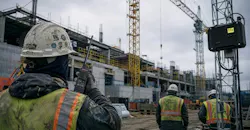
Reinforced concrete and dense steel can weaken signals between different parts of a structure. Underground levels can isolate crews from workers above ground. High-rise construction adds vertical distance, while large horizontal sites may spread teams between buildings, staging areas, material yards and equipment zones.
RETEVIS identifies structural signal obstruction as one of the major communication barriers on construction sites, alongside noise, durability requirements and operational coordination gaps.
These challenges explain why selecting a construction communication system based only on an advertised range figure can be misleading.
How Far Do Two-Way Radios Work on Construction Sites?
There is no single range number that accurately describes every construction project.
Real-world radio coverage depends on factors including:
● concrete and steel structures;
● elevation;
● underground areas;
● site layout;
● interference;
● antenna position;
● terrain; and
● the radio system being used.
An open outdoor area and a reinforced concrete high-rise can therefore produce very different results using similar equipment.
For project teams, the better question is not: “How many miles does this radio reach?”
It is: “Where does my team need reliable communication, and what stands between them?”
That shifts communication planning from product selection to site planning.
Start by Mapping the Construction Site
Before choosing a two way radio system, contractors can identify four things.
1. Where people work
Map ground crews, upper floors, cranes, basements, loading areas, temporary offices and other active work zones.
2. Who needs to communicate
A crane operator and spotter have different communication requirements from a project manager coordinating multiple subcontractors.
Understanding communication groups helps determine how the system should be organized.
3. Where coverage is likely to fail
Basements, structural cores, enclosed concrete areas and distant sections of a project deserve particular attention.
4. Which communications are critical
Some conversations are routine. Others—such as equipment coordination or urgent site communication—need to reach the right people immediately.
Only after understanding these requirements should a project determine which radios and supporting equipment it needs.
When Handheld Radios Alone Aren’t Enough
For many projects, rugged handheld two-way radios provide an effective foundation.
RETEVIS offers construction-oriented radios designed around jobsite requirements including durability, noise reduction, extended operation and different communication ranges.
But larger sites can expose the limits of direct radio-to-radio communication.
When crews are separated by significant distance or structural barriers, simply increasing radio power does not necessarily solve every coverage problem.
That is where a two-way radio repeater(RETEVIS RT97 series) can become part of the solution.
How Repeaters Extend Coverage Across Large Jobsites
A repeater receives a radio transmission and retransmits it from a strategically useful location.
Instead of relying entirely on one handheld radio to reach another through distance and structural obstacles, the repeater helps extend the communication path.
RETEVIS specifically recommends considering a repeater when a construction site is large and workers are spread over a wide area where direct two-way radio communication may lose signal.
This creates a more scalable architecture: Worker Radio → Repeater → Worker Radio
For contractors, that means communication equipment can be planned as a system rather than as a collection of individual devices.
Building a Construction Site Communication System
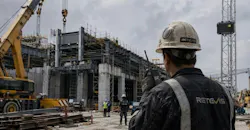
RETEVIS’s current Construction Radio Solutions approach combines rugged handheld radios, repeaters and related equipment around the conditions of the project.
Its construction portfolio addresses several common requirements: long-range communication, ruggedness, IP67 protection on applicable products, noise reduction, group communication and extended coverage.
A large construction project might therefore use rugged handhelds for frontline teams while adding repeater coverage where distance or structures create communication gaps.
The objective is not to deploy the greatest number of radios.
It is to create a communication system in which the people who need to reach each other can do so reliably.
Explore RETEVIS Construction Radio Solutions
Reliability Means Reaching the Other Side
For construction leaders, communication reliability has several dimensions.
Equipment needs to withstand the environment.
Workers need to hear messages clearly.
Teams need appropriate coverage.
And the communication system needs to fit the way the project actually operates.
Ultimately, however, reliability comes down to one result:
Did the message reach the person who needed it?
In 2026, RETEVIS is marking 16 Years of Reliable Connections—16 years of learning how communication requirements change across different users, environments and operating conditions.
Large construction sites make that idea particularly clear. One project may span basements, rooftops, cranes, concrete structures and open yards. Each creates a different communication environment.
But the expectation never changes.
Different World. Same Connection. Always Reliable.
