As companies continue to refine their hybrid work strategies, the role of workplace design has become more important than ever. Today's offices can no longer simply house employees. Instead, they must present as an engaging space where workers want to spend time.
According to Kent Clauson, vice president of marketing operations at Patcraft, many organizations are approaching tenant improvement projects with a renewed focus on quality, flexibility, and long-term performance.
We’re seeing experience-driven design replace purely functional offices,” Clauson said. “As companies establish more structured in-office attendance policies, workplace design has to justify the office commute through in-person experience and collaboration. It’s about intentional presence versus daily attendance.”
That shift is influencing everything from workplace layouts to flooring solutions, particularly as organizations reevaluate how they use space.
Smaller footprints, higher expectations
While many corporate tenants are downsizing overall square footage, investment within those spaces is increasing. Clauson said companies are prioritizing quality over quantity, especially within Class A and Trophy office environments.
“Overall square footage may be shrinking, but quality per square foot is increasing,” he said. “Organizations are investing more intentionally in spaces where design impact is visible, durable, and aligned with employee expectations.”
“Spec suites and full-floor renovations are on the rise, as speed-to-market is more critical than ground-up builds,” Clauson continued. “Renovation and TI [tenant improvement] work is far outpacing new construction, with landlords refreshing vacant spaces to compete for tenants.
As a result, designers and facility teams are increasingly looking for solutions that support compressed timelines without sacrificing aesthetics or performance.
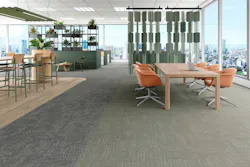
“We recently launched our Modular Form collection to meet the market need for a well-priced, well-designed go-to collection that is easy to use and coordinate throughout a range of spaces,” said Clauson. “The nine-style carpet tile collection provides design flexibility for the whole space with a variety of patterns, scales, and colors to mix and match for a seamless transition from one space to the next. It is also available in two quick-ship styles that deliver in 10 business days, meeting project timelines in a cost-effective solution.”
Designing spaces that reflect culture and identity
As companies rethink the role of the office, workplace design is also becoming a tool for reinforcing brand identity.
“We’re seeing organizations express brand and culture through materiality, texture, color, and layout,” Clauson said. “Design is focused on workspaces with fewer desks, incorporating more shared, amenity-driven spaces and investment in collaboration zones and social hubs.”
“Many organizations are also drawing inspiration from hospitality and residential design to create workplace environments that feel more welcoming, comfortable, and connected,” Clauson added.
That shift is also influencing flooring selections. “Flooring plays a major role in shaping how a space feels and functions,” Clauson said. “Every choice, from pattern and color to material and texture, can be used to create and define space.”
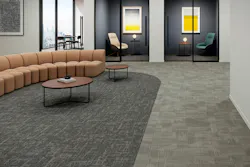
“One of our recent carpet tile collections, Modern Finds, uses textural, elevated patterns to evoke a sense of comfort and connectivity throughout workspaces,” he added. “The patterns incorporate familiar textures and rich fibers that celebrate handcrafted design, using multiple constructions to enhance detail and depth. The collection builds scale through texture to create a seamless effect throughout warm, inviting spaces that offer a more residential and hospitality-inspired feel within the workplace.”
Flooring performance meets operational needs.
While aesthetics support the identity and culture of an office, performance and operational efficiency continue to drive many commercial flooring decisions, particularly for facility managers and property teams responsible for long-term maintenance and lifecycle value.
“There is growing demand for installation-ready, low-risk solutions that simplify the specification process and reduce downtime,” Clauson said. “Teams are thinking beyond initial cost and placing more value on longevity, appearance retention, and lifecycle performance.”
Material preferences are also evolving based on how spaces are being used. Clauson said hard surface flooring is continuing to gain traction throughout circulation paths and amenity areas because of its durability and ease of maintenance. However, soft surface flooring remains an important part of workplace design.
“Hard surface is gaining share, but it is not replacing soft surface,” Clauson said. “The product mix is becoming increasingly space-specific.”
Luxury vinyl tile continues to grow in popularity across workplace environments, while carpet tile remains essential for supporting acoustics, comfort, and workplace wellness. Broadloom is still being used selectively in spaces where a more elevated or hospitality-inspired aesthetic is desired.
For many organizations, flooring decisions are also being evaluated through the lens of employee experience and workplace functionality.
“Design that aligns space and experience can directly impact how people feel, focus, and function within a workplace,” Clauson said. “Every design choice, from material and texture to pattern and color, contributes to how employees move, meet, collaborate, and navigate a space.”
Clauson said Patcraft approaches flooring as part of a broader workplace strategy rather than simply a finish selection.
“We’re thinking through the impact of our products on design and how they support the way people move, meet, focus, and navigate a space,” he said. “Our impact extends beyond the floor, creating long-term value through solutions that support budgets, timelines, and smarter lifecycle decisions.”
Conclusion
As workplace expectations continue evolving, organizations are placing greater emphasis on spaces that support flexibility, collaboration, and employee wellbeing while also delivering long-term operational value.
For designers, facility managers, and property teams, flooring is increasingly being viewed as more than a finish selection. It is becoming part of a broader workplace strategy that supports brand identity, enhances functionality, and helps organizations create environments where employees want to work, connect, and engage. That shift is continuing to influence how tenant improvement projects are planned, specified, and delivered across the commercial workplace sector.
Sponsored by: