How Integrated Metal Systems Are Redefining Building Envelopes
Key Highlights
- Fragmented development sourcing creates coordination gaps, rework, and hidden costs that erode budgets.
- Integrated single-source systems often reduce trades on site, eliminate field welding, and shorten timelines.
- Early coordination during design phases prevents costly field changes and reactive value engineering.

The Hidden Cost of Fragmented Specification
Fewer trades on site, shorter installation times, and one accountability chain from fabrication to final inspection. These are the outcomes that define a well-coordinated building envelope. They’re increasingly difficult to achieve when guardrails, rainscreens, sunshades, and canopies are sourced from separate vendors.
For general contractors and developers, fragmented specification of metal envelope components is one of the most persistent sources of hidden costs in commercial and multifamily construction. The cost overruns that derail building envelope budgets rarely announce themselves. They accumulate quietly, in between the guardrail vendor’s lead time and an Architectural Metal supplier’s delivery schedule, in the rework, field labor, and coordination failures that no single party owns.
BŌK Modern’s systems are designed to resolve that problem before it reaches the job site. Structural integrity is often built into the panels themselves, so they arrive site-ready: often no field welding, no secondary substructure, no additional coordination between trades. The coordination complexity that typically lives in the gap between vendors is eliminated at the source.
The difference is tangible. A BŌK Modern sales representative in Southern California, meeting with general contractors in Los Angeles, heard it directly: they had never seen a material supplier with this kind of collaborative relationship with builders; BŌK Modern functions less like a vendor and more like an extension of the project team. In construction, which is often defined by labor shortages and scheduling pressure, that kind of accountability has real value. Fewer trades, shorter installation sequences, and no secondary substructures translate directly into lower time and labor costs.
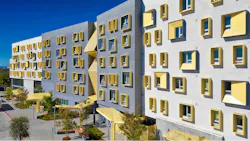
The Lillian Murphy Housing Complex in San Francisco illustrates what single-source coordination looks like at scale. Five product types were used across four building wings, installed by two trades, and under one vendor.

Early Coordination as Standard Practice
Most material suppliers enter a project at the specification stage, once key decisions about structure, waterproofing, and envelope sequencing have been made. At that point, change is costly, value engineering becomes reactive, and the general contractor absorbs the consequences.
BŌK’s approach is to get into the room earlier. The company is made up of a team of architects and designers–rather than purely technical specialists–who engage during the schematic or design development phases. They work alongside the architects, landscape architects, and contractors to identify coordination issues before they become field problems. The model is grounded in the understanding that early coordination consistently produces better outcomes and minimizes on-site labor inefficiencies.
At Albany Housing in Albany, California, BŌK was engaged early alongside the landscape architect, allowing the team to coordinate across the building envelope and the trellis under a single vendor, extending the scope from the façade to the ground plane. What might have been two procurement tracks, two sets of submittals, and two separate installation sequences became one. That kind of integration happens when the conversation starts early enough to shape the design. Integrated systems don’t just look better, they build better too.
Where a typical supplier hands off specifications and steps back, BŌK continues involvement through design development, pre-construction, and installation. For general contractors navigating complex envelope assemblies, that continuity reduces the unknowns and leads to fewer surprises in the field.
The Single-Source Model in Practice
Three projects illustrate how the integrated model performs across different delivery methods and levels of complexity.
Tahanan Supportive Housing — Cahill Contractors, San Francisco, CA
Tahanan Supportive Housing presented a complex coordination challenge: modular housing units were fabricated offsite by FactoryOS, paired with three-dimensional façade screens by BŌK, which cover all elevations of the building. Two prefabrication systems, two production schedules, and one building envelope. Without traditional framing or a secondary substructure, the result is a façade that reads as a single architectural gesture; an outcome that would be considerably harder to achieve across multiple vendors.
2060 Folsom (Casa Adelante) — James E Roberts-Obayashi Corporation, San Francisco, CA
2060 Folsom is an AIA award-winning mixed-use affordable housing development designed by Mithun featuring a nine-story walking bridge clad with BŌK’s guardrails and wallscreens. During the design review process, climbability became a concern, and after installation, the architect and owner decided to fill additional openings as a precautionary safety measure. BOK Modern developed a cover plate detail to close the gap between panels and the structural backup, preventing children from dropping objects through the system. A metal system that can be modified and adapted after installation, rather than requiring full replacement, has real long-term value for owners.
Sunnydale Block 3A – Nibbi Brothers, San Francisco, CA
Sunnydale Block 3A is part of one of San Francisco’s largest public housing redevelopments. BŌK Modern supplied a comprehensive suite of integrated metal systems—including rainscreen cladding, balcony guardrails, blade post fencing, and nail-on sunshades—unified by a custom perforated pattern designed by David Baker Architects. Each system is precision-fabricated from durable aluminum panels and pre-engineered to streamline installation and ensure long-term performance. Through close collaboration with the design team, BŌK Modern’s systems help realize the architectural vision—delivering both efficiency and visual harmony across the project’s varied façades and outdoor spaces.
When a single provider consolidates multiple envelope systems, the benefits compound: no secondary structure, fewer coordination gaps, no field welding, and a single accountability chain from fabrication through installation. When it comes to building envelopes, the best strategy isn’t the most complicated one; it’s the one that removes unnecessary complexity from the job site and from the systems themselves.