Recreation and wellness are bedfellows in new campus student centers
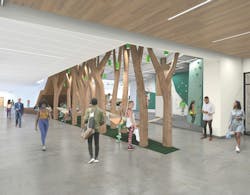
Student demands for amenities and services that address their emotional and mental wellbeing are impacting new development on college campuses that has led to recreation centers with wellness portfolios.
These hybrid buildings, whether the result of new construction or renovation and addition, are being positioned as centerpieces for their school’s master planning, with terms like “front porch” and “anchor” used to describe them.
As often as not, higher education institutions and their development, design, and building teams solicit feedback about these projects, pre- and post-occupancy, from students and other stakeholders, to ensure that the building and its programming are working as intended.
“Our strategic plan calls for a focus on health and wellbeing as a component of student success,” says Brian Mullen, PMP, CEFP, Capital Project Delivery Manager for Michigan State University’s Infrastructure Planning and Facilities Department. “This investment by our students, and their request, supports their ability to care for themselves as they work toward graduation.”
What he’s referring to specifically is MSU’s 293,000-sf, $200 million Student Recreation & Wellness Center, which is scheduled for completion in February 2026, replacing the campus’ Intramural Recreative Sports West Building. Its new features include a 50-meter Olympic-sized pool, rock climbing wall, Outdoor Adventure Center, sports simulation machines, two classrooms, and gender-inclusive lockers and bathrooms. The facility’s focus on overall student health and wellness is in alignment with the university’s 2030 strategic theme of sustainable health.
MSU already had an arboretum on campus, and the new facility includes a hammock grove located across from the climbing wall, says Troy Sherrard, FAIA, Partner and Practice Leader–Sports and Recreation for Moody Nolan, which designed the Rec & Wellness Center. He notes, too, that during the design phase, students pushed hard for letting in more natural light, so the building is brightened via a 10,000-sf ETFE roof skylight system at its center core, which Sherrard says is a first for rec buildings.
Another Moody Nolan-designed project is the Campus Recreation and Wellness Center, a nine-story, 276,000-sf, $250 million building on the campus of the University of Pittsburgh that is scheduled to open during the second quarter of 2025. This is Pitt’s largest rec or wellness facility to date, and the first to adopt a holistic approach to supporting overall student health and wellness, said Mary Beth McGrew, Associate Vice Chancellor in Pitt’s Office of Planning, Design, and Real Estate, in an article posted on Pitt’s website in November 2021.
That same article quoted Chancellor Patrick Gallagher, who stated, “This project began with listening to students, and their voices were loud and clear.” Two years earlier, the university’s Office of Facilities Management established an advisory committee that included Vice Provost for Student Affairs Kenyon Bonner. Student voices were invaluable to moving the project forward, said Anastasia Dubnicay, that Office’s project manager.
Sherrard adds, in an interview with BD+C, that the new facility can be viewed as the students’ “living room” where they experience various programs and services at their own pace, and without fear of recrimination.
Giving students reasons to stay on campuses
Concerns about students’ wellbeing are not novel for colleges; the University of Miami opened a wellness center on its Coral Gables, Fla., campus in 1996, one of the first colleges to do so, according to Dr. Patricia Whitely, the school’s Vice President of Student Affairs.
In recent years, health and wellness have become goals for new building projects on campus, be they residence halls, dining rooms, or athletic facilities. There are many reasons for this, including the widely reported insurgence of loneliness among Americans that is noticeably prevalent among 18 to 25 year olds, and has been exacerbated by the recent spread and persistence of the coronavirus. “There’s been a post-Covid crisis of students not connecting with campuses,” observes Peter ven den Kieboom, AIA, Principal and Director of Design for Workshop Architects in Milwaukee, Wis. Colleges have been trying to lure students back onto campus with amenities and services that cater to their educational, physical, and mental needs.
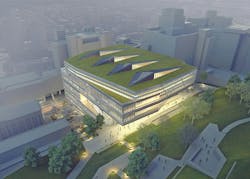
Workshop and HOK are the lead designers on the $80 million overhaul of Marquette University’s Helfaer Tennis Stadium + Recreation Center, which was first built in 1974. This project includes the addition of a 130,000-sf wellness center—bookended by the existing rec-athletic facility whose 65,000 sf are being modernized—that will offer a medical clinic, a counseling center, an alcohol and drug recovery program, a sexual violence prevention program, and other multipurpose spaces. (J.H. Findorff is the GC on this project.)
Lora Strigens, Marquette’s Vice President of Planning and Facilities, says that the new wellness building will bring the school’s various health programs under one roof. She also hopes that the building, when it opens next February, removes any “stigma” of using its services, and makes them easier to navigate.
Strigens goes on to say that buildings like these “amplify the student experience.” And while she attributes this project’s realization to the vision of Marquette’s President, Dr. Michael Lovell, Strigens acknowledges that students laid the groundwork when, in 2015-16, the student government commissioned a study about upgrading Helfaer, which led to a fee referendum to help pay for it.
Marquette’s master plan originally called for a teardown and replacement of Helfaer’s entire complex. However, that plan was deemed too big and expensive. The reno-and-addition route taken was more sustainable and financially reasonable, explains Stirgens.
Student centers: A centerpiece for growth on higher education campuses
This fall, North Carolina-based Elon University will begin construction on its Health EU Center, a three-story, 125,000-sf building that will be the second largest on Elon’s campus. The Health EU Center will support students’ emotional, physical, financial, purpose, community, and social needs, says Brad Moore, AIA, NCARB, LEED AP, Associate Vice President and Chief Facilities Manager.
Aside from the requisite exercise components—gym, fitness center, indoor-outdoor fitness center, aquatic center, and physical therapy services—Health EU Center will feature an expanded counseling center and a demonstration kitchen for nutrition instruction. Moore says that Health EU brings together programming that was scattered across Elon’s campus, including some in an 80-year-old building.
Moore speaks about the need for campuses to assuage their students’ “generational stress,” and how Elon’s health-related programs needed a central location. Indeed, Elon University’s latest master plan calls for the Health EU Center—which is scheduled to open in the summer of 2026—to anchor an Innovation Quad complex that includes existing structures such as the Moseley Hall Student Center, Inman Admissions Welcome Center, and Belk Library; as well as new buildings for its physics and engineering programs, and at least three other academic buildings that might include a dining hall. The complex is scheduled for completion in 2030, says Moore.
Health EU will be built on 12 acres where an elementary school once stood. Elon offered to build a new school on 18 acres off campus to make way for the health facility, which Moore says will “double the size of the campus core.”
A two-story, 40,000-sf, 600-seat dining hall with a variety of food options is serving two new residence towers with 881 beds that opened on the University of Miami’s campus August 12. These buildings represent the first two phases of Centennial Village, a four-phase, five-building, 522,000-sf development with a $335 million price tag, that should be completed by August 2026, says Whitely, Miami’s VP–Student Affairs.
Sherrard of Moody Nolan notes that projects like Centennial Village—which was designed by VMDO Architects and Zysocvich Architects—accentuate how schools in general are taking bigger swings for recruiting and retaining students. “Engagement matters, and how you get students involved,” says Whitely. Recently, Miami opened a 1,200-bed apartment building to meet demand for single-occupant living. “Students are looking for amenities,” she says.
When asked how Miami knows if new construction projects contribute to its recruitment and retention efforts, Whitely points to the school’s latest class, which had 54,000 applicants for 2,400 openings.
Most schools, though, gauge what drives student enrollment and satisfaction informally and anecdotally, through everything from surveys to door counts that measure usage. Schools are also playing up the sustainability of their campuses, which they assert influences students’ decisions about where they are educated. UPitt’s new Rec + Wellness Center, with its green roof and solar panels, is targeting LEED Gold certification. Marquette’s building team is recycling materials from the partial demolition of its tennis complex for reuse in the construction of its wellness building.
On August 16, the University of Washington in Seattle broke ground on its 36,000-sf ICA Basketball Training Facility, which is targeting LEED Gold v.4 certification via its focus on energy efficiency, the installation of translucent polycarbonate panels that let in more natural daylight, and deploying lower carbon solutions like concrete with low embodied carbon content, says Francesly Sierra, AIA, DBIA, Design Manager and SEA Education Practice Leader for Gensler, which is a design-build partner with Mortenson on this project.
Sydney Thiel, Project Manager for the university’s Project Delivery Group, says that investment in “best of class” facilities is imperative to recruiting athletes, especially now that the University of Washington has joined the highly competitive Big Ten athletic conference. But the training center, which is scheduled for completion in fall 2025, will also tie together UW’s upper and lower campuses, and its outdoor plaza is likely to attract all students.
Tamara Hartner, LEED AP, Design Phase Executive for Mortenson, says that the project’s building team selection commission included student voices, whose feedback called for making the training center and its surrounding environs “welcoming, pedestrian, and bike-friendly” for all students.
The facility itself allocates equal space to the school’s men and women teams, another feature that might appeal to DEI-sensitive students. “We are fully focused through an equitable lens,” says Hartner.