Economists downgrade 2026 construction forecast amid Iran conflict, ongoing cost pressures
The U.S. economy is treading water, and that's not enough to spark meaningful growth in the construction industry, according AIA's latest Consensus Construction Forecast, released this week.
The report, which aggregates forecasts from eight leading industry economists, calls for a downgraded construction spending forecast for 2026: 0.3% decline, down from a 1.0% increase projected in this past January’s Consensus Construction Forecast report. "The panel, however, has a somewhat more upbeat view for 2027, raising its spending forecast from a 2.2% increase to a 3.0% increase," according to the report.
The report cites a K-shaped economic situation that has emerged in the nonresidential building construction market, where "parts of the market tied to public funding, healthcare demand, and AI-related investment continue to move forward, while more interest-rate-sensitive and discretionary sectors remain under pressure."
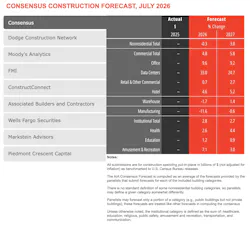
The winners include the commercial market (current forecast: 4.8% rise in 2026, 5.8% in 2027), driven largely by the rapid growth in data center activity, and the institutional building sector (2.8% growth in 2026, 2.7% in 2027), especially healthcare projects.
The biggest concern: the manufacturing sector (11.6% drop in 2026, 0.6% dip next year). "While the level of activity is expected to remain robust by historical standards, the declines represent a downshift following the massive infusion of public dollars from the CHIPS and Science Act and the Inflation Reduction Act. That pullback is being compounded by uncertainty over tariffs, which can make or break the decision to move forward with a multiyear capital project," according to the report.
AIA points to three primary factors impacting the U.S. economy: cyclical pressure, structural shifts, and policy.
"The cyclical pressure stems from high interest rates and persistent inflation, which have cooled consumer demand, tightened financing conditions, and led to an easing in the labor market. In that environment, developers are rethinking, delaying, or shelving projects.
"Meanwhile, structural shifts are reshaping the outlook across most building sectors. A rapidly aging population drives demand for health care and related institutional services, while lower immigration and slower labor force growth are adding to workforce constraints. These dynamics affect not only the cost and availability of labor but also the long-term outlook for housing and school buildings.
"The third influence is policy. Higher tariffs, increased immigration enforcement, and rising geopolitical risk have all added uncertainty to project planning."
For more on AIA's July 2026 Consensus Construction Forecast, view the full report.