10 design strategies that promote a holistic approach for student success
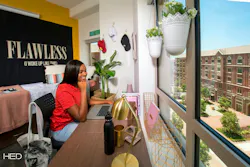
Student well-being has become a key sustainability priority for higher education, not only for the obvious human health benefits but also as a core component of institutional resilience. As a result, colleges and universities have invested heavily in counseling, wellness, and student support.
Yet the gap between how well institutions think they’ve responded to students’ needs and actual outcomes remains wide, especially in mental health. Nearly 70% of higher ed leaders say they’ve been effective at addressing students’ needs, but only 40% report student health has actually improved. Students seem to agree: only 39% say their institution is actively working to address their mental health/wellbeing needs.
One reason for this gap could be hiding in plain sight: the buildings themselves. Too often, quality programs get stuffed into legacy facilities that were not designed to support today’s students, making them invisible or difficult to access. Treating wellness as an afterthought or pigeonholing it into a specific department misses the mark. Instead, successful campuses incorporate it holistically across campus, embedding it into how students live, learn, and socialize every day.
Wellbeing as a Sustainability Metric
Students face compounding academic, financial, social, and mental stressors that directly affect their academic success and program completion. Meanwhile, college is a time when students cement habits they carry well into adulthood. Institutions have an opportunity to shape healthy patterns through environments that support continuous learning, exploration, connection and well-being—all of which ultimately benefit them in their careers and lives beyond the college experience.
While sustainability is most often measured in terms of energy efficiency or systems performance, student well-being is tied directly to academic outcomes and institutional sustainability. In fact, 35% of college students say they have considered leaving their program in the past six months, with roughly half citing emotional stress or mental health reasons.
There is a direct connection between student wellness and recruitment, retention, revenue, and long-term institutional performance. A built environment that embeds thoughtful, flexible, human-centric design can measurably enhance wellness and inclusion for students, as well as faculty, staff and other constituents.
Strategies in Practice: Designing for Built-In Wellness
Forward-thinking universities are now demanding effective design strategies that directly support student wellness. Here’s how student-centered sustainability is being implemented through ten intentional design and planning strategies:
Outdoor spaces. Access to nature is well established as supporting both mental and physical health. To align with its vision for integrative health, The University of California, Irvine (UCI) made the relationship between nature, health, and the built environment a top priority at its new Susan & Henry Samueli College of Health Sciences. With its central courtyard, rooftop gardens, and upper-level terraces adjacent to teaching labs, the design provides easy access to outdoor spaces for gathering, informal breaks, reflection, and meditation.

Biophilic elements. It’s a common misconception that classroom windows are distracting to students. The reality is that exposure to nature can be inspiring, boost attention and support cognitive function. When scenic views aren’t practical, bringing the outdoors in through biophilia and natural finishes can help students and staff stay grounded. At UCI, a two-story living wall in the lobby creates an inspiring entry and sense of community that feels congruent with the landscape. Complementary light fixtures resembling trees reinforce the connection to nature.
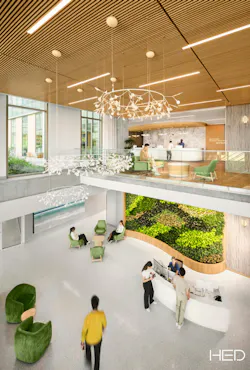
Strategic daylight management. Exposure to natural daylight has proven mood, sleep, mental health and cognitive performance benefits, but it can also pose challenges in building design. Excessive solar heating creates temperature dysregulation, and excessive light can produce uncomfortable brightness and glare. Strategic passive orientation and envelope design—such as the covered outdoor terraces and shading devices at UCI—can maximize daylight while controlling glare and heat to ensure comfort and efficiency.
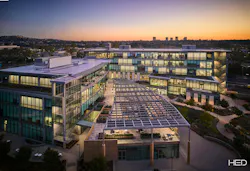
Circadian lighting. While pulling an all-nighter is common among students, over 27% of students say sleep difficulties impact their academic performance, and data show that overexposure to bright light can disrupt natural circadian rhythms. At UCI, designers used circadian lighting that automatically changes tone and intensity throughout the day, mimicking the natural progression of sunlight to support mental health, healing, rest, and recovery.
Irresistible stairs. Physical activity shouldn’t be confined to the student rec center. Incorporating movement naturally throughout the day is vital for well-being. While taking the stairs is a well-known health strategy, when they’re buried in an isolated, dark cavern at the end of the hall, it’s hardly appealing and may even feel unsafe. At the East Los Angeles Kinesiology and Wellness Center, active design strategies like “irresistible stairs” create highly visible, inviting opportunities for movement that double as social or gathering spaces. When stairs are featured prominently as a core design element and primary circulation route, taking the stairs becomes the default experience.
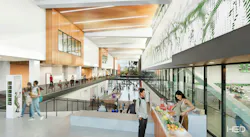
Universal accessibility and inclusive design. Beyond ADA compliance, ensuring equitable experiences and access for students of all abilities is essential. At Saddleback College’s Gateway Building, that includes careful acoustic management and minimally reflective materials to reduce sensory overload and excess stimuli. Foot traffic is also strategically directed as an awareness tool to showcase the student resources available, and access paths from multiple levels double as campus connectors.
Student-centered services. Fewer than half of students who drop out of college report being aware of academic advising and mental health support. Tucking these services into tiny portals in an endless hallway of doors perpetuates this accessibility problem. At Saddleback, the Gateway building solves this problem by offering a one-stop service center modeled after the Apple Genius Bar. Rather than sending students all over campus to get what they need, this approach provides convenient access in a welcoming atmosphere that mimics a high-end retail experience.
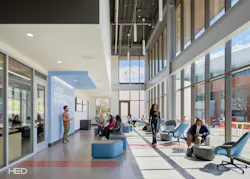
Inconspicuous safety. Campus safety and security are paramount, but students don’t want to feel like they’re in a fortress. There’s a fine line between feeling safe and feeling confined. Integrating security in a way that balances safety with hospitality avoids spaces that feel oppressive. At the Saddleback Gateway, student services are intentionally placed “on display” without physical barriers to improve accessibility, and administrative staff are readily available. This openness makes services more visible and approachable, encouraging students to use the resources available to them.
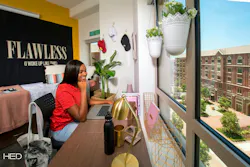
Calibrated community. Nearly two-thirds of students who consider dropping out of college say loneliness and isolation contribute to their decision. Designing spaces that provide incremental levels of engagement is essential for balancing the sense of belonging and autonomy students need. At the University of Southern California, The Village housing development, a variety of accommodations—single, double or triple suites—combined with a calibrated sense of community, allow students to feel connected to their roommates, suitemates, neighborhood, and campus at a level that feels right for them at any time.
Adaptable common spaces. Because individual needs for community, social interaction, and quiet time vary widely, providing a variety of spaces allows students to choose how they learn and engage. At the Fresno State Lynda and Stewart Resnick Student Union, modular common areas that can accommodate large gatherings, along with fixtures that can be moved together for small group work, balance privacy and socialization to support connection, collaboration and focused work.
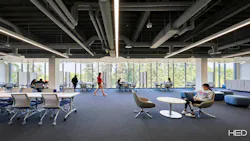
In today’s environment, higher ed can no longer afford to pigeonhole student wellness into specific programming, services, or departments. For future-ready campuses, it must be holistically integrated into the entire student experience—how they learn, live, socialize, rest, and recharge.
By designing facilities and infrastructure with student wellness as a central and intentional priority, institutions can better support student success, and ultimately their own retention, competitive positioning, and long-term building value.
About the Authors
Martha Ball, FAIA, LEED AP BD+C, is a Higher Education Sector Leader at HED, an integrated architecture & engineering company. She shapes academic, research, and student life environments that connect people and inspire learning. With experience across dozens of buildings and campuses, Martha leads complex, multidisciplinary projects that align institutional vision with integrated design solutions.
Michael Bulander, AIA, LEED AP BD+C, is a Higher Education Design Leader at HED, an integrated architecture & engineering company. He has experience working on a range of higher education projects with a focus on envisioning a well-integrated campus.