How employers are tackling the child-care crisis to support today’s workforce
Across the U.S., the childcare system shows clear signs of strain. Child Care Aware estimates that costs have increased nearly 220% since 1990, outpacing general inflation, while wages for child care workers stay near poverty levels.1
A study by the Center for American Progress, covering 22 states, finds that more than half of all Americans live in child care deserts where supply cannot meet demand.2 The impacts go beyond families; they influence the economy.
A Council for a Strong America, Ready Nation report found that breakdowns in childcare now cost U.S. businesses $122 billion in lost productivity each year.3 At the same time, employers compete for talent in a tight labor market where flexibility and family support matter more than ever. To meet that challenge, many companies are rethinking childcare not as a benefit but as infrastructure, a critical part of how people work, live, and thrive.
Rethinking childcare as a business strategy
The child-care crisis is often described as a “trilemma” where affordability, availability, and high-quality care rarely coexist. Yet some organizations are proving that integrated, employer-driven models can align all three.

Bright Horizons, a national provider of employer-sponsored childcare, partners with employers to develop and operate on-site and near-site centers. The company has also collaborated with Page, now Stantec on several workplace childcare projects.
Priya Krishnan, Chief Digital and Transformation Officer at Bright Horizons said, “For over 35 years, Bright Horizons has been committed to providing the highest quality early education and care to support working parents and their families. Employers are uniquely positioned to provide childcare solutions for their working parent employees.”
“For many companies, childcare is part of their workforce attraction and retention strategy,” continued Krishnan. “When companies invest in care, they’re positioning themselves as an employer of choice by investing in the stability, performance, and loyalty of their people.”
Research by Boston Consulting Group and Moms First found that when companies offer child-care benefits such as on-site or near-site centers, the investment can pay for itself. In one case, the return on investment reached 425%, driven by gains in retention and a reduction in absenteeism. Even a 1% improvement in employee retention was enough to cover program costs.4

Childcare benefits have become a differentiator in recruiting and retaining employees. If wages and salaries are similar, and you can provide these supports, it’s a differentiator. When parents know their children are well cared for, they stay longer, and that stability benefits everyone. Families build roots in these centers, and that sense of stability supports the entire organization.
Designing for care and connection
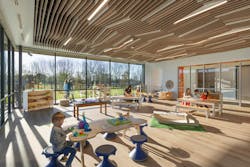
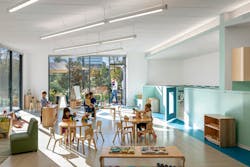
From the design side, Page, now Stantec collaborates closely with Bright Horizons to create centers that respond to the needs of children, parents, and educators. Our team tailors each center to the operator and the client workforce. We’re always learning from the many centers Bright Horizons has done and refining the best practices. The design isn’t static; it evolves as needs change.
Places like Walmart’s Home Office Little Squiggles childcare centers incorporate parent touchdown spaces that allow flexibility around pickup and drop-off times. If a parent has a meeting near pickup, they can take that meeting within the center instead of rushing. Those small design choices make a big difference for working parents.
Safety, comfort, and visibility emerged as key themes across the interview. Security is built into every center, from double-entry vestibules to directors’ offices with complete visibility to reception.
The design also supports educators, who are often described as “the third teacher” alongside the environment and the curriculum. Everything is developmentally appropriate. When teachers have the right tools and visibility, children thrive, and classrooms run more smoothly.
A long-term investment in quality
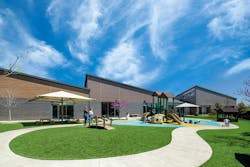
The physical environment reflects years of refinement. Color palettes have softened, and classrooms are designed for supervision without requiring teachers to turn their backs. Safety features, from vented diaper stations to rubberized playground surfaces, have reduced injuries. Even small design improvements have made centers safer and more supportive.

We’re not just repeating past designs. Every project builds on what we’ve learned to improve the environment for children, parents, and teachers. The data supports what practitioners have long observed: quality childcare delivers measurable returns. According to BCG, 88% of employers said childcare benefits boost productivity among working parents.4
Taking the crisis out of childcare
The childcare crisis did not appear overnight, and no single model will solve it. But companies are proving they can lead the way. By aligning design, operations, and policy and treating childcare as essential infrastructure, employers can support their working parent workforce and help turn a national problem into a shared solution.
From the architect’s desk to the executive boardroom, the message is the same: quality care is not a luxury, it’s an investment in people, performance, and the future.
Citations
1. Child Care of America. (September 2016). Child Care Deserts: Getting a Handle on Child Care Supply and Demand. [Newsletter].
2. Malik, R., & Hamm, K. (August 2017). Mapping America’s Child Care Deserts. Center for American Progress.
3. Bishop, S. (February 2023). $122 Billion: The Growing, Annual Cost of the Infant-Toddler Child Care Crisis. Council for a Strong America.
4. Kos, E., Clark, K., De Santis, N., Joseph, T. (March 2024). Childcare Benefits More Than Pay for Themselves at US Companies. Boston Consulting Group and Moms First.