Fire modeling for high risk, airtight facilities: Practical guidance for reliable CFD simulations in critical facilities
Simulating fires in airtight or mechanically ventilated compartments—such as those found in nuclear facilities, and critical infrastructure, and specialized industrial rooms—presents challenges not seen in typical buildings. These spaces are tightly sealed, have limited natural ventilation, and often rely on mechanical systems which interact with fire‑driven pressure changes.
For architects, engineers, and safety professionals, understanding how these conditions affect fire behavior is essential. Unlike open or well‑ventilated rooms—where simplified modeling assumptions often work—sealed compartments can behave very differently during a fire.
In practice, CFD fire simulations (often using Fire Dynamics Simulator, FDS) often rely on simplifying assumptions to reduce computational time and modeling efforts. Common shortcuts include:
- treating ventilation as fixed, even during a fire
- prescribing a fixed Heat Release Rate (HRR) instead of predicting fuel mass loss
- relying on default simulation setups
- using relatively coarse mesh resolutions
- modeling of fire extinction is often ignored
These assumptions might be acceptable in ordinary, well‑ventilated spaces, but in airtight compartments, they can lead to misleading results and false confidence of safety.
This article introduces some important parameters based on a study designed to evaluate how modeling assumptions affect fire predictions in an airtight environment. The goal is to offer practical guidance on how to balance accuracy with computational efficiency in such critical spaces.
Methodology
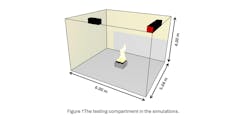
Fire simulations were run using FDS version 6.10.1 and compared with experimental data from the literature [1]. The test compartment was (see Figure 1):
- 6 m x 5 m x 4 m
- highly airtight
- mechanically ventilated at a low rate (Air Renewal Rate ARR = 8 h⁻¹).
(Note: The Air Renewal Rate, or ARR, describes how quickly the air in a compartment is replaced by the ventilation system. For example, an ARR of 8 h⁻¹ means the entire volume of air inside the room is refreshed eight times per hour.)
This low ventilation rate represents a more challenging scenario, where the fire decays and extinguishes early due to insufficient air supply.
Most simulations used the LES mode in FDS for better accuracy in this study. The default VLES mode was also tested for comparison.
Key Modeling Parameters
1. Ventilation Modeling
In many engineering models, ventilation is kept fixed and stable during the fire simulations. But in airtight compartments, fire‑driven pressure changes can significantly alter actual airflow.
This study compared:
- Fixed ventilation (simplified, commonly used assumption)
- Pressure involved ventilation modeling
Why this matters:
If the fire increases the pressure inside the room, inlet flow can drop dramatically, affecting oxygen supply and fire growth.
2. Fuel Mass Loss Rate (MLR) Modeling
Many engineering simulations prescribe a T-square fire curve with a fixed peak Heat Release Rate (HRR). However, in confined spaces, ventilation affects the burning rate notably. An alternative approach is to use the pyrolysis model available in FDS, which predicts the fuel MLR based on local oxygen levels and heat feedback from the fire.
This study compared:
- Prescribed fuel MLR (prescribed, and fixed value)
- Predicted fuel MLR (via pyrolysis models)
3. Simulation Mode (VLES vs. LES)
FDS offers different simulation modes, such as:
- Simple Very Large Eddy Simulation (SVLES)
- Very Large Eddy Simulation (VLES, default mode of FDS)
- Large Eddy Simulation (LES, more accurate but more expensive than the default mode)
- DNS (Direct Numerical Simulation, most computationally expensive)
Most engineering users stick with VLES by default.
This study compares the VLES and LES modes, and examines whether that default mode is sufficient in confined‑fire conditions.
Results and Discussions
Ventilation Modeling
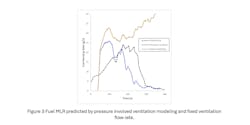
When a model assumes a fixed ventilation rate, it tends to predict a fire that grows continuously, without showing any decay. As the fire heats the compartment, the internal pressure rises and reduces the inflow of fresh air. This pressure‑driven drop in ventilation limits the fire’s growth and can cause the flame to weaken and extinguish. A fixed‑ventilation model ignores this effect and supplies more air than the fire would actually receive, leading to significant overprediction of fire growth and the absence of the decay and extinction phase (see Figure 3).
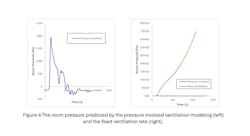
A further problem with fixed‑ventilation modeling is that it produces unrealistic compartment pressures. Because the model forces a constant airflow into the room—even as pressure should naturally restrict ventilation—the fire continues to grow, heating the compartment and driving the pressure to physically unrealistic levels. When pressure‑dependent ventilation is modeled correctly, the peak room pressure is around 2300 Pa (see Figure 4). Under a fixed ventilation rate, however, the predicted pressure can rise to nearly 6.9 times atmospheric pressure, which is unphysical.
These results demonstrate that pressure involved ventilation modeling is essential for accurately predicting fire behavior in tightly sealed or highly confined spaces.
Fuel Mass Loss Rate (MLR) Modeling
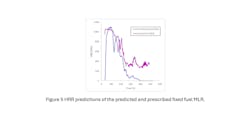
When dynamic ventilation modeling is used, the fire’s heat release rate (HRR) still follows a similar trend to the case where a fixed fuel mass‑loss‑rate (MLR) curve is applied (see Figure 5). This indicates that the fire is ultimately limited by the amount of oxygen entering the compartment, even when plenty of unburned fuel vapors are present.
However, the fixed fuel MLR modeling did not capture the early flame extinguishment, and the fire continues to burn at lower HRR (see Figure 5). Additionally, some unrealistic behaviors appear when a fixed fuel MLR is used. It is observed persistent “ghosting” flames—weak, floating flames that linger near the ventilation openings. In reality, the flame would extinguish once the oxygen level drops too low, but the simplified model is not able to capture this extinction process.
Simulation mode: VLES vs. LES
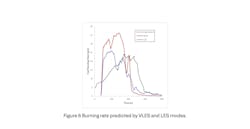
A comparison between the default VLES mode and the more detailed LES mode in FDS shows clear differences in how the fire’s burning behavior is predicted. In the peak and quasi‑steady burning phases, VLES deviates significantly from the experimental results, likely because its extinction model is more simplified. In practice, the choice of simulation mode can strongly influence the fire predictions. For example, VLES predicts an average fuel mass‑loss rate (in quasi-steady state) that is about 51% higher than the experiment, while LES stays within 5% of the measured values (see Figure 6). It is observed that the LES mode provides a much closer match to the actual burning behavior for confined compartment fires.
On the other hand, VLES mode does perform reasonably well in capturing the overall flame‑extinction trend. It also offers a 41% reduction in computational time, which can be useful in early‑stage analysis or screening studies.
However, for applications where accurate fire development is critical, using LES mode is likely essential to achieve more reliable predictions.
Recommendations and Conclusions
This study underscores how strongly modeling assumptions and numerical settings influence fire‑simulation outcomes in confined, mechanically ventilated compartments. Several key recommendations emerge:
- Use pressure involved ventilation modeling to capture pressure driven ventilation changes and the air supply affected fire behaviors.
- Be cautious with prescribed or fixed fuel mass loss rates, as they can lead to unrealistic fire predictions.
- Consider LES mode when accuracy is critical, as it provides more reliable predictions of fuel mass‑loss rate and heat release rate than VLES.
Modelers should be aware that relying on default simulation settings can produce results that deviate substantially from real fire and potentially give a false sense of safety. The findings aim to support better modeling practices for high‑risk facilities that are confined and mechanically ventilated, where accurate predictions are essential. This article also seeks to raise awareness among safety professionals involved in critical infrastructure about the importance of choosing appropriate modeling approaches.
References
1. H. Pretrel, S. Suard, L. Audouin, Experimental and numerical study of low frequency oscillatory behaviour of a large-scale hydrocarbon pool fire in a mechanically ventilated compartment, Fire Safety Journal. 83 (2016) 38-53. https://doi.org/10.1016/j.firesaf.2016.04.001