5 ways to expand a hospital vertically without disrupting care
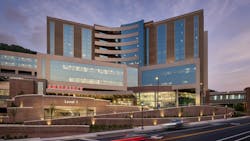
Urban hospital campuses are running out of space. Many are also running out of patience for expansions that add square footage but fail to improve how care is delivered day to day.
When Carilion Roanoke Memorial Hospital needed to expand emergency and cardiovascular services at its 700-bed flagship facility in Roanoke, Va., the system had one final development option: a steep, two-acre parcel with a 40-foot grade change, limited access points, and an existing emergency department (ED) that could not shut down.
Elsewhere on campus, expansion wasn’t realistic. Roads boxed in the north and west, and Mill Mountain’s steep terrain constrained the east. The project could not rely on horizontal growth or phased relocation. It had to work—operationally, clinically, and logistically—from day one.
ESa designed a vertical solution shaped by day-to-day operations, with the emergency department as the working base and complementary services above. The result is a 500,000-sf expansion that consolidates previously dispersed cardiovascular services, shortens staff travel distances, and improves coordination across care teams while keeping the ED fully operational throughout construction.
5 Ways to Expand a Hospital Vertically Without Disrupting Care
For healthcare leaders building up instead of out, the design challenge isn’t just where to put the square footage—it’s how care teams move, connect, and make decisions under pressure. Carilion’s tower shows what changes when operations are prioritized from the beginning.
Below are five practical principles that can help other health systems make vertical expansion work smoothly.
1. Start with operations, not square footage
The most common misstep in vertical healthcare projects is treating them as real estate problems rather than operational hurdles. Adding floors without rethinking adjacencies simply stacks inefficiencies.
At Carilion, the emergency department was intentionally designed as the foundation of the new tower—not just structurally, but functionally. Leadership used the expansion as an opportunity to reorganize care delivery, particularly for cardiovascular services that had been spread across the campus.
By placing intensive care units, step-down units, operating rooms, and cath labs directly above the ED, the team created a vertically integrated cardiovascular hub. This reduced transport distances, improved handoffs, and allowed care teams to work in closer proximity. It also freed up space elsewhere on campus, enabling support services and clinical units to backfill vacated areas.
Do this: Map patient, staff, and equipment movement before finalizing stacking diagrams.
Avoid this: Assuming that vertical proximity automatically improves efficiency.
2. Design the ED for specialization and surge, not just throughout
Emergency departments are no longer one-size-fits-all environments. Patient acuity, behavioral health needs, and infection control requirements demand more nuanced planning.
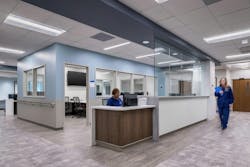
The new ED at Carilion is organized into dedicated zones for pediatrics, behavioral health, trauma, orthopedics, and infectious disease intake. CT scanners are located just steps from trauma rooms to speed diagnosis, and a results-waiting lounge supports patient flow without tying up treatment spaces.
This zoning approach improves efficiency under normal conditions while allowing the department to adapt during surges or public health emergencies.
Do this: Use zoning to align space with care pathways and acuity levels.
Avoid this: Over-reliance on generic exam room layouts that limit flexibility.
3. Treat vertical transport as a clinical system
In stacked hospitals, elevators become part of the care continuum.
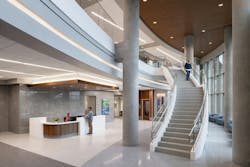
Carilion incorporated oversized elevators that provide direct vertical connections between helipads, trauma rooms, and critical care areas. Two helipads, one existing and one new, offer redundancy for emergency transport, while minimizing patient travel time during critical moments.
This level of coordination requires early collaboration between architects, clinicians, and engineering teams. Waiting to “solve elevators later” is a recipe for operational bottlenecks.
Do this: Plan vertical transport with the same rigor as clinical adjacencies.
Avoid this: Treating elevators as a downstream engineering problem.

4. Build flexibility into acuity and infrastructure from day one
Healthcare needs will change faster than most buildings can be renovated. In these projects, designing for flexibility is about risk management.
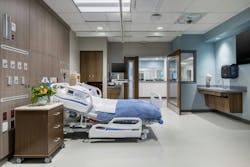
At Carilion, progressive care beds were designed to ICU standards, allowing units to flex as patient acuity changes. Units can also be converted to negative-pressure isolation, supporting infection control and pandemic readiness. Materials were selected for durability and hygiene, including integral sinks, solid surface products, and minimized seams in clinical flooring.
Three floors of the new tower are currently shelled, with infrastructure in place to support future buildout. This foresight accounted for the presence of helipads, mechanical systems, and elevator equipment, avoiding costly rework later.
Do this: Invest in infrastructure that supports future acuity shifts and expansion.
Avoid this: Designing spaces that only work for today’s census and case mix.
5. Align construction strategy with operational continuity
Building on an active urban hospital campus during a pandemic demands more than a standard construction playbook.
Construction partners Robins & Morton and Branch Builds navigated COVID-era supply chain challenges by purchasing materials early and using two off-site warehouses: one for storage and another for prefabrication of headwalls, mechanical racks, and electrical panels. This approach reduced on-site congestion, improved schedule reliability, and limited disruptions to hospital operations.
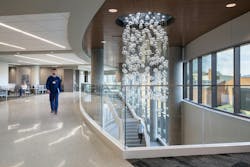
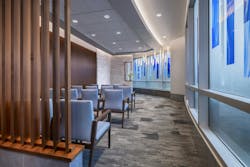
Just as importantly, staff wellbeing was addressed as part of the design. On the inpatient bed floors, the team incorporated dedicated respite spaces for staff. The wellness garden terrace on the seventh floor serves as the tower’s shared outdoor space for staff across departments.
Inside, most staff lounges and team workrooms were placed along exterior windows to bring in daylight and views of Mill Mountain and the Roanoke River. Even with patient rooms and public lobbies prioritized for window access, the design protected key stretches of exterior walls so staff could enjoy light and a view.
Do this: Coordinate construction logistics with hospital operations from the outset.
Avoid this: Assuming clinical teams can simply “work around” construction impacts.
Making vertical work on urban campuses
Carilion’s experience demonstrates that vertical expansion is not inherently efficient or inefficient. The difference lies in whether operations lead design decisions.
By using its final two-acre parcel strategically, ESa transformed Carilion from a constrained site into a high-performing, future-ready asset. The project shows that even on the most challenging urban campuses, it is possible to expand care, improve teamwork, and enhance the patient and staff experience without shutting down critical services.
When a campus can’t expand outward, every decision has to earn its footprint. The best vertical solutions start with care delivery and build from there.
Principal Sam Burnette, AIA, ACHA, EDAC, NCARB, and Clinical Operations/Design Specialist Emily Karbo, DNP, RN, EDAC, Associate AIA, design complex healthcare environments at ESa, a nationally recognized architecture and design firm with more than 60 years of experience in the sector.