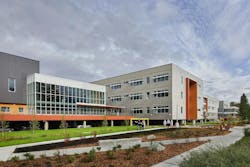
Flood-resistant Washington high school performs well in first big test
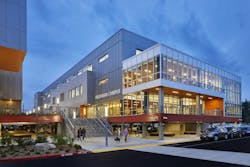
A new high school in Washington State designed to withstand flooding performed well in its first significant test, in December 2025. Mount Si High School, an elevated, resilience-focused campus operated as envisioned: floodwaters flowed safely beneath the school, sparing academic spaces from damage and preserving continuity for students and staff.
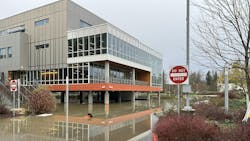
Mount Si High School’s 2019 redesign elevated the campus on robust plinths above the 100-year floodplain—six feet above historic levels, exceeding the three-foot code minimum.
The strategy worked as intended: water moved under the building through designed pathways, while learning environments remained dry. Limited water intrusion was contained to garage stairwells and elevator shafts serving the under-building parking, demonstrating that the system’s controlled flow and recovery approach was sound.
Elevated above the floodplain and parking area, the school creates a rare wealth of opportunities—educationally and experientially—in a progressive interpretation of future-oriented learning.
The primary goal was to create a student-centered environment by organizing the campus into small learning communities (SLCs). Defined as seven connected buildings, the large-scale facility integrates biophilic design principles and connections to nature to weave welcoming human scale spaces throughout the campus.
The 358,000 sf school was designed to evolve as pedagogies changed. Instead of a centralized regional high school typology, the design transforms the environment into a student-centered experience both in physical and educational terms.
Small Learning Communities, each 3-stories, include humanity classrooms, multiple pairs of science classrooms, open flexible space, small meeting rooms, and a teacher collaboration space. Students can spend most of their day in one part of the school, which improves familiarity and the chance to form peer-to-peer relationships.
Shared breakout areas are distributed through the Small Learning Communities, varying in scale and character to suit introverts or extroverts, with some connecting vertically across multiple floors. Blurring the lines between social and informal learning spaces encourages teachers and students to explore and find their ideal places for specific curriculum tasks.
Three separate commons allow students to gather and have lunch in a more personalized environment. Each invites dining on two floors, as well as outdoors, with engaging views of the school’s namesake mountain. The Career and Technical Education (CTE) area is adjacent to one of the large Commons to make it accessible and visible to all students. Shops and robotics classrooms are designed as a suite centered around a large collaboration and presentation space.
Cantilevered above the main entry with views to Rattlesnake Ridge, the library is given an interactive and interdisciplinary role. The full suite includes a maker space, video lab, green screen film room, distance learning classroom, and a large book and media area. With these tools, the library serves as a research center with multiple synergistic programs, or a town hall with space for meetings of 150 people after hours.
Owner and/or developer: Snoqulamie Valley School District
Design architect: NAC Architecture
Architect of record: NAC Architecture
MEP engineer: Metrix Engineers, LLC, NAC Engineering (electrical)
Structural engineer: Coughlin Porter Lundeen
General contractor/construction manager: Spee West Construction