Cornell University opens Computing and Information Science Building
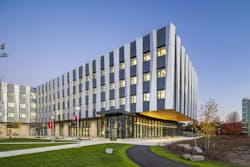
Cornell University recently opened the new 135,000-sf Computing and Information Science Building for the Ann S. Bowers College of Computing and Information Science. The new structure creates both a precinct and a destination for the university’s rapidly growing computing and information science programs.
Located at the southern gateway to the Ithaca, New York campus, the building shapes a precinct of continuous structures and open space.
The angled “L” configuration of the new building connects to the Bill and Melinda Gates Hall, completed in 2014 by Morphosis, forming an outdoor room for daily use.
The facility attracts students from multiple disciplines across the university. Its several entries and greenspace opening toward the adjacent Cornell Engineering quad make the building a compelling new presence on the campus.
A ribbon of faceted sculptural metal fins wrapping the upper research floors, designed with advanced digital modeling tools, gives the building its identity.
Four configurations of folded metal panels combine to create a wave-like pattern projecting changing shadows as the sun moves around the building. At the main entry end, a dramatic cantilever shields an overlook terrace adjacent to the indoor café inviting the campus in.
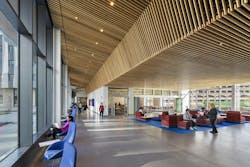
The ground floor includes a student “ramble” along the greenspace edge, providing places for individual and small group study, while the café, commons, large classrooms, and large builder labs encourage collaboration.
With its generous ceiling height and canopy of wood slats, the ground floor spaces are dynamic, warm, and welcoming.
The upper floors are dedicated to quiet research with offices and small computational labs. Conceived as a “skinny” building to avoid interior offices and labs, the workspaces all have generous daylight. Cross laminated timber ceilings in labs and offices bring warmth and floor identity to these spaces.
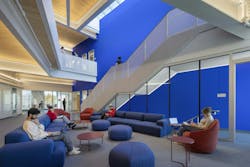
The two research wings of the building are joined by a suite of collaborative spaces on each floor where a continuous wall plane in vivid Yves Klein Blue and CLT wood ceilings lend dynamism and comfort.
Integrated sustainability systems include framing upper floors in steel with cross laminated timber floor and roof slabs for carbon reduction (the first CLT use at Cornell), a high-performance building envelope, chilled beams and radiant panels for energy conservation, and bioswales for stormwater management.
On the team:
Owner and/or developer: Cornell University
Design architect: Leers Weinzapfel Associates
Architect of record: Leers Weinzapfel Associates
MEP engineer: BVH Integrated Services, A Salas O’Brien Company
Structural engineer: Thornton Tomasetti
General contractor/construction manager: LeChase