6 projects named best in steel construction for 2026
Looking for innovation in 2026? We’ve got six places to start.
The 2026 IDEAS Awards, presented by the American Institute of Steel Construction and Building Design+Construction, are the steel industry’s highest design honor. This year’s winners all embody the innovation that’s driving our world forward—from a groundbreaking fire station at the forefront of sustainability to a field-applied cold-spray additive manufacturing technique that could change the future.
“American innovation—particularly design innovation—is built on a backbone of steel,” said AISC Director of Architecture Nima Balasubramanian, AIA, NOMA. “These cutting-edge projects represent the pinnacle of thoughtful design for a greener, more resilient future—and in some cases, they’ve been specifically designed for 100 years of service!”
Without further ado, here are six structures to know for 2026, presented in alphabetical order.
2026 IDEAS Award for Excellence in Sustainable Design and Construction
City of Boulder Fire Rescue, Station #3
Boulder, Colo.
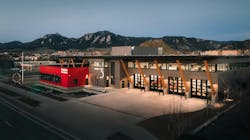
All American-made structural steel members are recycled, but this fire station took it one step further by directly reusing steel members from a deconstructed local hospital—absolutely minimizing emissions related to structural materials. It’s a first-of-its-kind project that literally uses the bones of the past to preserve the future.
Project team:
Owner: City of Boulder, Boulder, Colo.
Architect: Davis Partnership Architects, Denver
General contractor: Mark Young Construction, LLC, Frederick, Colo.
Structural engineer: KL&A Engineers & Builders, Golden, Colo.
Judge comment:
The engineers at KL&A have become leaders in developing the rules for deconstruction & reuse of steel through projects like this. Their methods are a model for future salvage and reuse in the U.S. The steel is visible. It celebrates the story in its construction, and the architect reduced embodied carbon by eliminating finishes that would otherwise cover it. It’s designed for longevity--100 yrs. Occupants can see whether the structure ever needs repair and fix it early. And, its function helps preserve the surrounding community.
—Bethany Whitehurst, SE, PE, Senior Structural Engineer, Clark Nexsen, A JMT Company
2026 IDEAS Award for Excellence in Constructability:
San Diego International Airport Terminal 1
San Diego
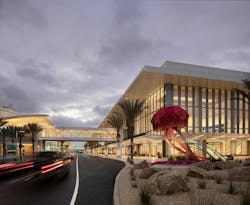
Serious collaboration between the architecture, structural design, and construction teams came in for a landing at this redevelopment—all while maintaining operations at the busiest single-runway airport in the country. Designs optimized for sustainability and a 100-year service life also contributed to $100 million in savings, while an innovative seismic system set a new precedent for large-scale construction with buckling-restrained braced frames (BRBs).
Project team:
Owner: San Diego County Regional Airport Authority, San Diego
Managing architectural firm: Gensler, San Diego
General contractor: Turner | FlatironDragados JV, San Diego
Prime structural engineer: Magnusson Klemencic Associates, Seattle
Additional structural engineer (substructure): Saiful Bouquet, Los Angeles
Civil and geotechnical engineer: Kleinfelder, San Diego
Civil engineer: Latitude 33, San Diego
Steel fabricator/detailer/erector: W&W | AFCO Steel, San Angelo, Texas *AISC full member; AISC-certified fabricator*
Additional detailer: Pro Draft, Inc., Surrey, B.C. *AISC associate member*
BRB supplier: Seismic Bracing Company, Salt Lake City
Judge comment:
Using preassembled modular bridges and roof trusses contributed to speedy and seamless installation. Having structural designers and the steel fabricator team up at the beginning of the project are what ensures innovative constructability. Designers addressing difficult connections in advance and the fabricator using programs such as Tekla helps to avoid any possible issues for rework or additional work in the field.
—Courtney Lilly, QA/QC Supervisor and certified welder, Southern New Jersey Steel
2026 IDEAS Award for Excellence in Adaptive Reuse:
TierPoint Tek Park High Density Environment Renovation
Breinigsville, Pa.
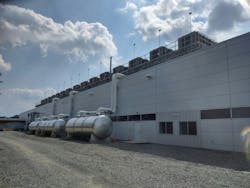
How do you build a three-story data center within the footprint of an existing building that can’t handle the new gravity and wind loads? You construct a new structure within and above the roof, of course! Reusing the existing roof and envelope provided a creative solution—and, of course, much-needed digital infrastructure.
Project team:
Owner: TierPoint, LLC, St. Louis
Architect: Miller Rosentel Associates, Inc., West Pittson, Pa.
General contractor: Ondra-Huyett Associates, Inc., Allentown, Pa.
Structural engineer: Beers Engineering LLC, Lehighton, Pa.
Steel fabricator: L. Liberato Steel Fabricating Co., Inc., Spring City, Pa. *AISC full member, AISC-certified fabricator*
Steel detailer: International Design Services, Inc., St. Louis *AISC associate member*
Electrical engineer: Design Management Group, Pittston, Pa.
Judge comment:
Structural steel played a critical role in repurposing this industrial building while delivering much-needed data center power to the region. The project team developed a simple yet elegant solution to accommodate the sensitive equipment and infrastructure: inserting a steel-framed mezzanine within the structure and a dunnage platform above the existing roof. The result serves as a model for data center developers looking to add capacity in urban and dense environments.
—David Barista, Editorial Director, Building Design+Construction
2026 IDEAS Award for Excellence in Architecture:
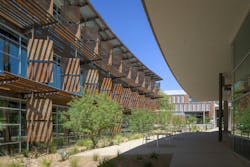
University of Arizona Andrew Weil Center for Integrative Medicine
Tucson, Ariz.
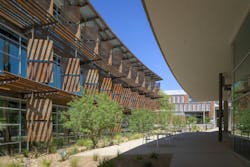
Steel unites environmental stewardship and flexibility to accommodate health-focused programming in light, open spaces.
Project team:
Owners: The University of Arizona Planning, Design & Construction, Tucson, Ariz.; The Andrew Weil Center for Integrative Medicine, Tucson, Ariz.
Architect: Line and Space, LLC, Tucson, Ariz.
General contractor: DPR Construction, Tucson, Ariz.
Structural engineer: Martin, White & Griffis Structural Engineers, Inc., Tucson, Ariz.
Steel fabricator, detailer, erector, and bender-roller: J.B. Steel, Tucson, Ariz. *AISC full member, AISC-certified fabricator*
Judge comment:
What impressed me about the project was that it's all steel, all exposed, and incredibly elegantly designed and detailed. It's not a project that hits you over the head with the architecture. It's not just one building, it's a conversation between multiple buildings. You're using structural steel that's exposed for low-rise structure. The facade is uncoated weathering steel, but it's used in a way to deal with shading. And the shading isn't just, okay, we're just gonna figure out how to shade the building. It has its own expressive qualities.
—Thomas Robinson, Principal, Lever Architecture
2026 IDEAS Award for Excellence in Engineering:
University of San Francisco Malloy Pavilion New Practice Gymnasium
San Francisco
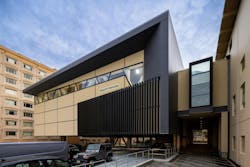
Some athletes look like they’re floating—and so does this athletic facility housing NCAA basketball and volleyball courts. The new building had to be seismically isolated from the existing structure garage below it. Thanks to some creative solutions, the 16,800-sq.-ft facility is a slam dunk!
Project team:
Owner: University of San Francisco, San Francisco
Architect: C + A Architects, Inc., Mill Valley, Calif.
General contractor: Cahill Contractors LLC, San Francisco
Structural engineer: ZFA Structural Engineers, San Francisco
Judge comment:
Due to the unique constraints of the site, the feasibility of this project was dependent on creative engineering solutions. Supporting more than half the structure on 3 columns limited impacts to the existing parking structure below. Fine tuning the lateral system by intentionally softening the east side of the building managed the torsional behavior of the structure. And the use of long-span perimeter trusses achieved the large open floor plans. All this delivered an elegant, “floating” gymnasium with minimal impacts to the surrounding structures.
—Paul Evans, SE, PE, Structural Design Specialist, Turner Construction Company
IDEAS | next Award:
Field deployment of cold spray additive manufacturing
University of Massachusetts Amherst, Massachusetts Institute of Technology, Massachusetts Department of Transportation
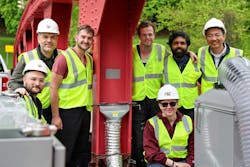
This year’s competition also included the inaugural IDEAS | next Award, presented not to a structure but to an idea that could change the future. And according to this year’s winner, that future could include additive steel manufacturing—in the field.
And, in fact, the technology is already out in the real world, thanks to a collaboration between The University of Massachusetts Amherst, the Massachusetts Institute of Technology, and the Massachusetts Department of Transportation. A research team created a digital patch for a damaged cross section in a bridge and developed a portable, field-ready cold spray system to complete the Great Barrington Cold Spray Demo Repair in a matter of hours, not days—turning the area’s “Red Bridge” into a living laboratory.
Judge comment:
Field deployment of cold spray additive manufacturing redefines steel preservation and restoration. This innovation not only provides a structurally efficient and sustainable alternative to conventional repairs but has the potential to open the doors to other game-changing applications for any localized member restoration, including lintel and crack repair, on-site modification of small details, or rapid repairs in access-limited conditions. This innovation embodies the IDEAS | next vision: bold, transformative, and beneficial to diverse structural steel applications.
—Melissa Gradecki, SE, PE, Senior Engineer - Innovation, American Institute of Steel Construction