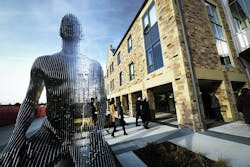
Sacred Heart University’s 15-acre student housing development features a Harry Potter-inspired dining hall
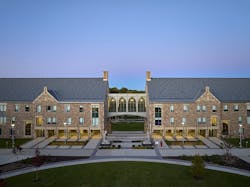
In Fairfield, Conn., Pioneer Village, a 15-acre development at Sacred Heart University (SHU), features a dining hall that playfully adapts the Great Hall of Hogwarts from the Harry Potter book and film series.
Founded in 1963, SHU, formerly a commuter school, became a fully residential college in the early 1990s. The university’s enrollment has grown from 4,000 students in 2014 to over 10,000 today, and incoming first-year numbers continue to increase yearly.
A Harry Potter–Inspired Dining Experience
Six new residence halls and the dining facility flank the development’s central quadrangle. In the Harry Potter-inspired dining hall, LED light fixtures, instead of Hogwarts’ candles, appear to float above the tables. The dining hall also offers flexible seating and outdoor terraces.
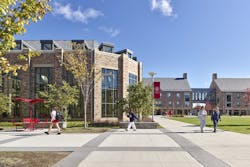
In addition to providing housing, Pioneer Village “redefines how students live, learn, and connect at the University,” according to a statement from the project’s architect, The S/L/A/M Collaborative (SLAM).
“This isn’t just a collection of dorms. It is the new heart of the campus, and a village unto itself,” Rick Herzer, Managing Principal, Design at SLAM, said in the statement.
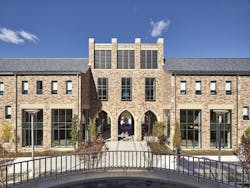
The development’s design combines collegiate Gothic and modern influences. A material palette of brick, stone, and prefinished metal panels aims to echo the architectural language of the original campus core while also indicating a forward-looking identity. Amphitheater steps lead from the new development to the existing Chapel Quad.
Tall gables, punched window openings, and carefully scaled facades create a residential quality for the site. The design also emphasizes natural light with strategic orientation and fenestration.
“Every brick, every pane of glass had to contribute to a sense of home,” Herzer said.
Student Housing Designed for Connection
Upper-class students reside in fully outfitted four- and five-bedroom apartments, and under-class students have four-bedroom suites with shared lounges and study spaces. Each floor includes integrated technology zones, collaborative workspaces, laundry, and community kitchens.
Designed with sustainability in mind, the development plan focuses on pedestrian movement, greenspace preservation, and responsible stormwater management, along with high-efficiency systems and long-lasting materials.
On the project team: The S/L/A/M Collaborative (design architect and architect of record), Consulting Engineering Services (CES) and H.F. Lenz (MEP engineer), OECIS, Inc. (structural engineer), Consigli Construction Company and Turner Construction (general contractor).