Nation's first multi-user silicon carbide lab opens at Univ. of Arkansas
The National Multi-User Silicon Carbide Research and Fabrication Laboratory (MUSiC Fabrication Lab) recently opened at the University of Arkansas Fayetteville. The new facility was designed to support advanced research in silicon carbide (SiC), a critical material for next-generation energy, transportation, and semiconductor technologies.
The facility was backed by the Mid-Scale Research Infrastructure program of the U.S. National Science Foundation with funding through the U.S. Army Research Laboratory. The single-story structure has a footprint of 22,000 sf and houses clean rooms to support laboratory research and fabrication of semiconductors, offices, building support spaces, and core/shell space for future development. A state-of-the-art eight-bay cleanroom will be expandable to add one additional bay in a subsequent phase.
The building’s architecture is organized around a continuous band of glazing that reveals the highly technical work taking place inside while bringing daylight deep into the interior. The transparency highlights the cleanrooms and creates a visual connection between research spaces and circulation areas. Exposed structural elements reinforce the building’s industrial character, expressing function and purpose while supporting a straightforward, efficient form.
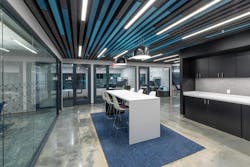
The interior design draws inspiration from the molecular structure of silicon carbide, which bonds in a tetrahedral form. This concept is subtly expressed through geometry, finishes, and abstracted patterns that reference the material from which the chips are made. The material palette reflects the varied hues of silicon carbide, particularly its iridescent qualities when impurities are present. Black, grey, blue, teal, and purple tones appear across finishes in the office areas.
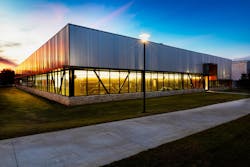
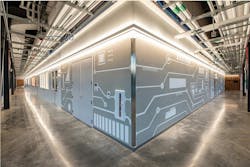
To bring visual interest to the long corridors that circulate around the cleanrooms, a large custom graphic was introduced. Scaled and abstracted, the graphic evokes the pattern of a microchip and creates a sense of movement as occupants move through the space. Insulated metal panels (IMPs) comprise the exterior envelope, along with the glass facade that wraps around the two public-facing sides of the building.
An isolated concrete slab helps protect the most sensitive equipment in cleanroom bays from vibration. A special consultant was brought in before the project to measure micro-vibrations in the area. Detections registered trains and planes and interstate traffic from miles away. The design required an isolated, thickened area of slab on void forms tied to structural piers on bedrock.
The MUSiC Lab is dedicated to advancing silicon carbide research through hands-on prototyping, proof-of-principle demonstrations, and device design. The facility supports work across energy, transportation, data centers, and aerospace applications, providing researchers with the specialized environments required for fabrication and testing.
Owner and/or developer: University of Arkansas
Design architect: DLR Group | Tsoi Kobus Design
Architect of record: WDD Architects
MEP engineer: Vanderweil Engineers
Structural engineer: Martin / Martin Consulting Engineers
General contractor/construction manager: Whiting-Turner Contracting Company