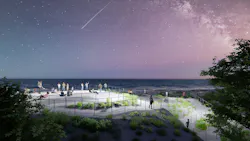
A geological park in Taiwan to add tourist facilities that echo the surrounding rock formations
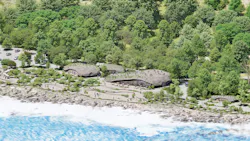
Although it’s one of Taiwan’s best-known geological parks, Jialeshui has had limited tourist infrastructure. A new project aims to change that by adding rock-like tourist facilities and infrastructure to Jialeshui, known for sandstone formations shaped by winds and waves over thousands of years.
The Pingtung County Government recently selected the design proposal, Nature Rocks, by MVRDV, an architectural firm based in Rotterdam, the Netherlands, and HWC Architects, a Taiwanese firm.
Inspired by the area’s iconic rock formations, Nature Rocks intends to improve the site’s tourism infrastructure while also respecting the natural environment. The project will create small-scale buildings, including a central visitor center and three lookout points, as well as new pathways and public spaces—all within the existing built footprint to avoid disrupting the landscape.
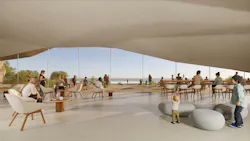
Rock-Inspired Visitor Facilities Designed to Blend with Nature
The three sculptural concrete buildings echo the rock formations and blend into the surrounding environment. Over time, moss and small plants will grow over the buildings’ surfaces, taking root in the concrete.
The largest building includes the welcome center, a café, and a souvenir shop, and the building’s roof doubles as a viewing terrace. A second building offers spaces for exhibitions and environmental education, and the third contains restrooms.
Located in the southernmost part of Taiwan, Jialeshui features sculptural rock formations that resemble animals and have monikers such as Rabbit Rock, Toad Rock, and Seal Rock. A single road between the forest and the rocky shoreline has been shared by shuttle buses, pedestrians, and cyclists. Pavilions and kiosks along the road have been damaged by seawater over time.
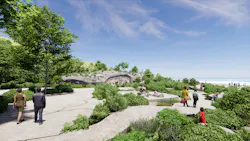
Reimagining Coastal Access at Taiwan’s Southernmost Geological Park
MVRDV’s plan will replace and improve the old infrastructure. Taking inspiration from the layered coastline, the design breaks up the existing straight road and reconceives pathways as rocky, naturalistic landscape connecting the forest and the coastline.
The transformed road features stops such as a stone viewing deck and a sea lookout point, their outdated structures replaced with viewpoints, kiosks, and other facilities.
“What you see today at Jialeshui shows a clear boundary between the natural and the artificial. In turn, this artificial trail separates nature from itself, separating forest from coastline,” MVRDV founding partner Winy Maas said in a statement. “In our design, the artificial elements take the shape of the surrounding nature, like natural extensions of the site rather than foreign objects.”
Cracks in the site’s pavement will provide passive drainage and protective buffers, helping to manage stormwater and reduce damage from typhoons and flooding. The cracks also support biodiversity by allowing greenery to grow and creating passages for small animals to travel between the forest and shoreline.