3 upcoming data center projects for 2026
This month, Building Design+Construction editors are looking at the future of data center design. We reached out to our readers' firms for data centers under construction or completed within the past 18 months. Here are three that caught our eye.
Top 3 Data Center Projects for 2026
--
727 Grand Avenue
Los Angeles, Calif.
Submitted by: OFFICEUNTITLED
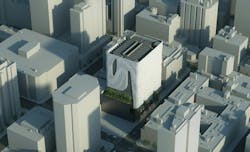
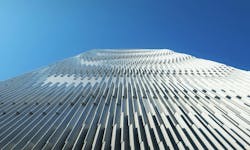
727 Grand, a proposal for a downtown Los Angeles data center, introduces a distinctive design that transforms the building into an architectural landmark. The focal point of the building is a dynamic facade that defines the building's essence.
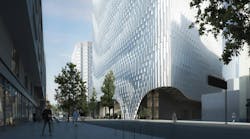
Unlike conventional structures, the entirety of the building—apart from glass-framed cutouts along its frontage—will be windowless. This programmatic requirement enhances security for the data suite floors while safeguarding the privacy of nearby residential buildings.
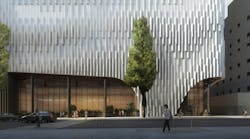
To avoid a monolithic appearance incongruent with the vibrant vision for Downtown Los Angeles, a creative panel system is employed. The panels are designed with a sequence of triangular profiles that transition from smaller to larger angles, breaking up the building's length and scale.
This playful facade, characterized by its interplay of light, shadow, reflectivity, and form, undergoes constant transformation throughout the day and year. Striking a delicate balance between solidity and ephemerality, it acts as a soft veil enveloping the entire building. At the ground floor, this veil lifts, revealing the active program within, seamlessly integrating with street level.
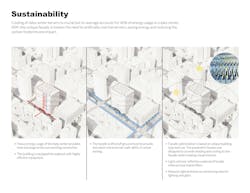
The distinctive parametric facade also serves a dual purpose by providing shading and cooling to reduce energy consumption. The use of light-colored, reflective material further minimizes the heat island effect, decreasing the reliance on artificial server cooling—a factor that typically constitutes 40% of energy usage in traditional data centers.
Additionally, the building's design includes features to minimize exterior lighting, further mitigating light pollution in the downtown area.
Want to learn more about what's trending in data center design and construction? Check out our top 10 trends article below:
The Heptagon
Sudair, Saudi Arabia
Submitted by: Interstitial Systems
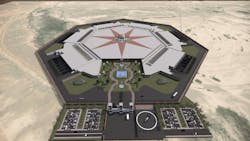
The mission of The Heptagon was to design a state-of the-art 150 MW, TIER 3+, 6-building, data center campus near Sudair, about 75 km NW of Riyadh, in the Kingdom of Saudi Arabia—slated for construction in 2026.
"What stands out immediately is the design’s inherent efficiency. By optimizing airflow and distribution, it significantly reduces operational overhead—savings that translate directly into cost advantages we can pass on to our clients," said Mohammad Huwaidi, CTO, Quantum Technologies.
What The Heptagon offers is a non-traditional take on the simple "box-styled" data center.
"The Heptagon model provides the flexibility to evolve with client needs, particularly as more organizations begin transitioning toward liquid cooling solutions. This adaptability ensures that our infrastructure remains relevant, future-proof, and capable of supporting next-generation computing demands without requiring disruptive reconstruction," Huwaidi continues.
A central focus of the design is the distribution of air, power, piping, and cabling, which Interstitial Systems argues is the single greatest determinant of a data center’s efficiency, adaptability, and lifecycle cost.
Conventional solutions—whether single-level raised floors or on-slab “flooded room” configurations—suffer from inflexibility, airflow turbulence, poor cooling efficiency, and high operational waste. To overcome these systemic shortcomings, the project uses an Interstitial Pod system: a dual-plenum, multi-level service distribution approach that separates mechanical equipment, electrical systems, and air paths.
This allows the campus to support variable rack densities, N+1 redundancy, and a smooth transition from air cooling to hybrid liquid cooling, while significantly improving energy performance and usable cabinet count per square foot.
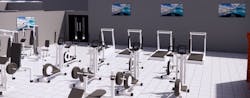
At the campus scale, the design organizes six 25-MW pods around a shared heptagonal atrium that eliminates duplicated support spaces and cuts land requirements by more than half compared to traditional multi-building layouts. The atrium also introduces employee- and community-oriented amenities—such as dining, fitness, childcare, health services, and gathering spaces—uncommon in remote hyperscale data centers.
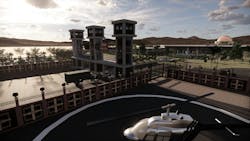
Low-profile architecture, extensive landscaping, closed-loop cooling, minimized generator noise, and reduced infrastructure sprawl aim to mitigate common community objections related to water use, noise, environmental impact, and visual massing. Constructed as a modular system, the campus supports phased deployment and simplifies construction while remaining upgradeable to 50 MW per pod without disruptive overhauls.
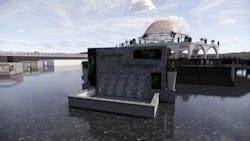
Prime Data Centers DFW01-02
Dallas, Texas
Submitted by: AO
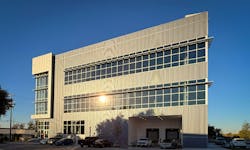
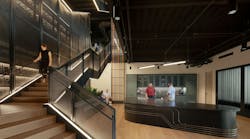
AO is leading the architectural vision for Prime Data Centers’ DFW01-02 facility—a 12MW, three-story mission-critical development in the heart of Dallas, Texas. Spanning roughly 100,000 sf, the project delivers a highly coordinated, AI-ready data center designed for operational resilience, efficiency, and long-term scalability.
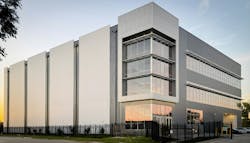
AO’s design reflects Prime’s values of precision and performance, expressed through a material palette of deep navy, teal, graphite, and warm neutrals. Premium finishes—matte black stainless steel, ash veneer, charcoal porcelain, and backlit glass—reinforce a modern identity rooted in trust and technological clarity.
The building program organizes two large hyperscale data halls on Levels 2 and 3, with a secure first floor housing the lobby, security operations center, conference spaces, logistics areas, and critical MEP rooms.
Site planning integrates generator yards, switchgear, rooftop mechanical systems, and service pathways to ensure safe access and maintainability.
AO delivered the core and shell package and is now advancing the buildout phase to bring DFW01-02 to initial operational capacity. The result is a purpose-built, high-density facility that sets a new standard for Prime’s growth in North Texas—a balance of technical rigor and thoughtful architectural design.
Want more project roundups? Check out these articles below:

About the Author
 BD+C Staff
BD+C Staff
The Building Design+Construction editors bring you all things related to the AEC market, from the latest design tools to green building trends.
BD+C editors include David Barista, Editorial Director; John Caulfield, Senior Editor; and Quinn Purcell, Managing Editor.