Prefab and modular gain traction in student housing construction

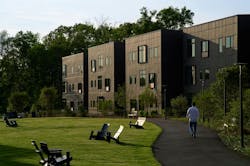
Prefabricated assemblies and modules are all the rage in student housing, both on and off campus.
Prefabricated load-bearing structures offer a “creative Type II-B solution” at lower cost than concrete construction but with more density than Type III wood frame construction, says Lou Campero, Vice President, JE Dunn Construction.
Since 2016, Findorff has operated an offsite prefabrication shop in Madison, Wis., to build cabinets, wall panels, framing, and trusses to optimize production and on-site crew sizes during critical construction periods. “Prefabrication streamlines workflows off-site and helps deliver high-quality components ready for quick installation, which has a positive impact on the schedule,” says Findorff Vice President Luke Hutchins.
Juneau Construction has been using prefabricated skin assemblies from Sto and Southern Wall Systems to close in projects quickly for fast dry-in, which is crucial in the often hot and muggy Southeast states where it does most of its work. “Prefab’s the key to getting inside the units faster,” says Jake Landreneau, Juneau’s Vice President for Innovation & Technology.
At the University of California Riverside’s North District Phase 2, McCarthy Construction is using prefabricated cold-form steel panels manufactured near Tijuana, Mexico, to build 429 apartment-style units. The seven-story, 1,568-bed structure, set to open this summer, has seven different floor plans. “We’re doing a floor a day,” says Tim M. Stevens, AIA, LEED AP, Principal, Campus Environments, SCB (architect). Also on the team: DCI Engineers (SE), KPFF Los Angeles (CE), and Interface Engineering (MEP).
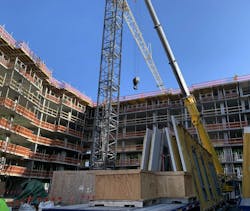
Design-build partners SCB and Sundt Construction specified prefab facade assemblies—complete with windows and insulation––for 241 two-, three-, and four-bedroom apartments at Cal Poly Humboldt, in Arcata, 280 miles north of San Francisco. “With the remoteness of the campus and the limited supply of skilled trades, prefab was the only way it could have been done,” says Stevens. Clark Pacific is the precast subcontractor.
New South Construction and Metromont Precast Building Solutions teamed up on a load-bearing precast system for Gateway 737, a 940-bed residence near the University of South Carolina, Columbia. “It’s a sandwich panel with insulation and concrete, so we didn’t have to worry about waterproofing details or the furring on the interior side: you just paint it,” says Donny Kim, AIA, LEED AP, Associate Principal, Director of Student Housing, Cooper Carry (architect). “The structure was precast all the way through, even the floor slabs. It was the only system that would meet the schedule.”
For Theory Ithaca, a 373-unit residence targeting graduate students at Cornell University, Cooper Carry (architect, interior designer) and Purcell Construction (CM) went with prefabricated metal stud panels. The $116 million, seven-story, 518-bed residence and 238-space parking deck are scheduled to open in 2027.
Andres (GC) took a fresh approach to the construction of the 300-space garage for a 953-bed “five-over-two” edifice for LV Collective and Culpepper Realty near Texas A&M University, College Station.
“Usually the garage is cast-in-place concrete, but we made it precast and wrapped the concrete podium around it,” says Cody Whittle, Andres’s Vice President of Operations. “The precast garage made the pro forma work, and we got the most volume possible in the wood-frame residential portion without going over the 85-foot height limit.”
Prefabricated metal wall systems were employed in the 1,800-bed first phase of the University of South Carolina’s Campus Village. “The walls went up incredibly fast,” says WDG Managing Principal Bob Keane, AIA, NCARB. Greystar and the university development foundation are codeveloping the 18-acre site, which will grow to eight buildings (3,750 beds)` plus a 25,000-sf dining commons and seven-level garage.
Keane thinks that prefab modules—whole residential units—will be the next big thing in student housing. He points to Greystar’s modular construction subsidiary, known as Modern Living Systems. in Knox, Pa., which has been manufacturing apartment modules since 2023. “I toured the factory and some of the apartment projects they’ve done, and it blew my mind,” says Keane. “The UK’s been doing this for years, and now the building codes in the U.S. are slowly catching up.”
A word of caution, however. Work closely with the prefab manufacturer, perhaps via design assist. “You have to start in design development,” says Cooper Carry’s Kim. “It’s a painful process, but you have get it right the first time, because with prefab, it’s very difficult to fix errors or make changes later.”
MORE CONSTRUCTION/DESIGN INNOVATIONS
“We’re putting operable windows and Juliette balconies in our off-campus housing, to make it feel more high-end,” says Juneau’s Landreneau. “We’re getting away from 3x4 double-hung windows, going for 500-pound, 8x10 window walls for lots more fenestration.”
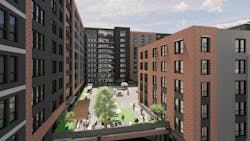
Niles Bolton Associates has been using hybrid light-gauge framing in place of cast-in-place concrete to cut construction time and foundation costs on off-campus housing. “There’s also greater flexibility in layouts that comes with eliminating large concrete columns,” says Mohamed A. Mohsen, AIA, LEED AP, Principal.
Suffolk Design, the contractor’s in-house design-management team, trims costs on projects like UMass Amherst’s 823-bed Fieldstone project by bringing together design, estimating, and construction expertise to resolve design and constructability questions early. “That reduces change orders and delays and promotes smoother project delivery,” says Jeff Gouveia, President of Executive Operations, Suffolk.
Sasaki used its proprietary Dashi tool for scenario planning on the University of Connecticut’s LEED-NC Gold Connecticut Hall, a 652-bed residence and 500-seat dining hall. “Dashi helps us directly connect the capital phasing and debt with what’s happening on campus,” says Carla Ceruzzi, AIA, LEED AP, Associate Principal. Sasaki (architect, interior and landscape designer), Newman Architects (AOR), and KBE Building Corporation (design-builder) completed the 279,000-sf work in 2024.
As for thin-shell construction, experts differ on its efficacy. Jonathan Delcambre, AIA, LEED AP, Gensler’s Residential Practice Leader, says, “It’s more competitive cost-wise than typical construction methods and helps reduce costs on drywall, metal studs, and exterior metals.” But JE Dunn’s Campero says that, while he knows of some developers who have considered thin-shell concrete for student housing, so far “these designs have not shown to be more cost-effective than concrete frame or light gauge metal structures.”
GETTING THE GOODS, POST-PANDEMIC
Supply chain problems have not disappeared now that Covid is more or less under control. For a fast-track 800-bed, $150 million residence at the Colorado School of Mines designed by Anderson Mason Dale Architects and Mithun, “We’re buying domestic to navigate this tariff situation and the delivery of goods,” says Kyle Wegner, The Weitz Company’s General Manager of Supply Chain.
On the 28-unit, 110-bed Renfrow Hall at Iowa’s Grinnell College, Weitz ordered electrical gear—transformers, switch gears, and generators— 90 weeks in advance to ensure on-time delivery from the manufacturers.
For Honors Village, a four-tower, $161 million, 1,415-bed complex at the University of Florida, Weitz (design-builder) secured furniture, bedding, and fabrics and stored them in nearby warehouses ahead of the August 2024 move-in. “This was a first for us,” says Wegner. “We worked with one manufacturer for 150 consecutive days to get the goods to the job site on time.”
GREATER STUDENT DEMAND FOR ECO-FRIENDLY HOUSING
Going the extra mile on sustainable design can appeal to today’s environmentally conscious student renters. “Green roofs, solar panels, all-electric buildings, EV chargers, and smart thermostats—these are all a draw for many students,” says Ben Austin, LEED AP BD+C, WELL AP, Sustainability Manager, Findorff.
Paul Graves, PE, Fitwel Ambassador, Principal, CMTA Consulting Engineers, says, “I’ve been on campus tours where the student tour guides talk very enthusiastically about IAQ and biophilia and occupant wellness. Sustainability brings buy-in from students.”
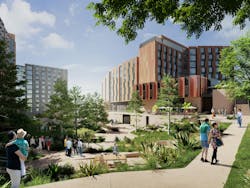
Some college towns are rewarding developers for sustainability. In Ann Arbor, home of the University of Michigan, “You can get 30% more height above code (180 feet) if you cover the roof 60% with PVs,” says WDG’s Keane.
Findorff is building Five Corners, a 15-story, 376-unit, all-electric residence near the University of Michigan for Core Spaces and Schenk Realty. It will have rooftop PVs, a compost room, and EV charging spaces. DLR Group and J Bradley Moore and Associates are the architects.
Hensel Phelps, electrical contractor Helix Electric, and HMC Architects went all-electric on UC San Diego's $537 million, 2,444-bed Ridge Walk North Living and Learning Neighborhood.
“There was a lot of early planning and focus on the electrical design and capacity, to make key project decisions to support the fast schedule,” says Lindsey Sielaff, LEED AP BD+C, Operations Manager, Hensel Phelps. “We knew there would be delays in getting generators, transformers, and other electrical equipment, so we ordered everything a year and a half ahead,” says Sielaff. LEED Gold is targeted.
CMTA Consulting Engineers deployed energy-saving water-to-water heat pumps in the corridors of the West Woods and Jamestown East Halls—1,205 beds in all—at the College of William & Mary, Williamsburg, Va. “The facility staff can change the filters and perform other maintenance without having to go into the students’ rooms,” says CMTA’s Graves.
CMTA also specified DOAS systems to bump ventilation up by 90% and keep CO2 under 1000 ppm in residential areas. “We know that improving IAQ can benefit student performance,” says Graves.
AI? MASS TIMBER? MAYBE DOWN THE ROAD
Remember what BIM was like 20 years ago? Lots of talk, not much action? That’s the case for artificial intelligence today. “We use AI mostly for design iteration, as a rapid way to study facade approaches and building character, but we don’t see it coming yet to produce construction documents,” says SCB’s Stevens.
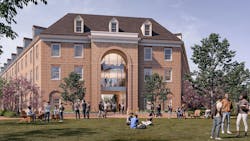
Powers Brown Architecture, master planner and architect for a 15-story residence at the University of Houston, is using AI as a design assist tool for quick sketches and massing models. “On some projects it’s helped us compress the exterior design phase by testing out ideas quickly,” says Ben Mahala, AIA, Principal/Executive Vice President.
“AI allows us to test sites very quickly for things like elevation studies, massing capacity, and solar impact,” says Mithun Partner Lynn McBride, AIA, LEED AP BC+C.
Suffolk applies its proprietary AI-powered predictive analytics tool to forecast possible construction exposures before they impact schedules or budgets, says Gouveia. Juneau’s 12-member VDC staff is using AI schedule tracking to provide “reality capture” for job sites. “It makes for more empowered decisions,” says Juneau’s Landreneau.
Much like AI, mass timber is having a tough slog getting adopted for college housing. “I’ve used it in nonresidential university projects, but mass timber has never penciled out for student housing, not even for a canopy,” says Cooper Carry’s Donny Kim.
Matt Post, AIA, Associate Principal, OZ Architecture, is more sanguine about mass timber. “The IBC codes are becoming more accommodating as more projects are tested and we have a better understanding of acoustic performance and fire assemblies in mass timber,” he says.
Schools in Canada and the U.S. Northwest have embraced structural engineered wood. Diamond Schmitt Architects used cross-laminated and glulam timber structure on a 320-bed residence at Humber Polytechnic, near Toronto. “The five-story residence is encapsulated mass timber construction above a concrete academic building,” says David Dow, OAA, FRAIC, Principal. Kalesnikoff was the CLT/glulam supplier/fabricator; Bryte Designs, the mass timber erector.
Mass timber components will be applied this fall at Oregon State University when Turner Construction (CMAR) starts building an eight-story, 346-unit, 656-bed residence designed by Mithun and Rowell Brokaw. Five-ply cross-laminated timber decks, supported by glulam beams and columns, will span over the rooms and bathroom pods. In the hallways, five-ply CLT will be point-supported on the columns, enabling it to span in both directions and eliminating the need for corridor beams.
KPFF Consulting Engineers (SE/CE), NClose (enclosure), PAE (MP/FP), Samata (electrical), Reyes Engineering (lighting), ABD Engineering (acoustics), and Jensen Hughes (codes, ADA) are participating in the enterprise.
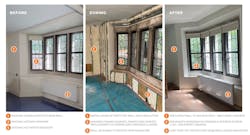
Wellesley Reconstruction by Finegold Alexander Architects
When renovating “dorms” at older institutions, “You have to study all the options and do the stuff that makes sense,” says Rebecca L. Berry, AIA, LEED AP, NCARB, Principal, President, Director of Sustainability, Finegold Alexander Architects. “These colleges don’t have nine-figure budgets to work with.”
Finegold Alexander and Suffolk conducted such a review to create a road map for the $12 million renovation of Wellesley College’s Severance Hall, a 103-room, 173-bed brick residence built in 1926. Among the strategies employed:
- Use energy modeling and life cycle analysis to get the biggest bang for the college’s buck. The team found that insulating the walls would save 38% on energy costs and installing interior storm windows would save 25%. However, “We didn’t do the roofs because stripping the slate and adding new insulation would only have produced 12% energy savings, at very high cost,” says Berry.
- Make the commonsense fixes. What Berry calls “small interventions” like LED lamps and high-efficiency appliances made sense. But to keep energy usage in check, none of the living units were air-conditioned, only select common areas.
- Shoot for cost-effective fixes that improve livability. Bathrooms are high priority at a women’s college like Wellesley (which now admits transgender and nonbinary persons). “We upgraded the showers and made the bathrooms more efficient,” says Berry. But the college flunked the idea of reconfiguring units into suites. “They wanted to keep the traditional Wellesley residential hall look,” says Berry.
- Make the effort to search for innovative products and systems. “The interior storm windows that we used cost about one-fourth of what replacements for the original beautiful leaded windows would have run,” says Berry.
Passive House Comes to the Fore
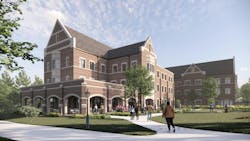
Carleton University’s new 450-bed Rideau House, in Ottawa, Ont., will showcase passive house design. “We put a lot of focus on insulation, window-to-wall ratio, and hot water efficiency,” says Diamond Schmitt Architects’ Principal Nigel Tai, OAA, CPHD, LEED AP. The units have a system that captures the heat from the showers and warms the incoming water to save energy.
Also on the team: KWC Architects (associate architect), RJC Engineers (SE), Stantec (CE, infrastructure), Smith + Andersen (MEP), Footprint (LEED consultant), Lashley + Associates (landscape), and M. Sullivan & Son (GC).
Passive house certification was top priority for the recently opened, 130-bed residence at Catawba College, Salisbury, N.C., designed by Page. The three-story Collegiate Gothic structure’s R-53 roof insulation, R-30 walls, and triple-pane windows will trim heat load by 44% and cooling load by 75%, yielding an EUI of 31.2 kBtu/sf/year.
Page’s Justin Shultz, PhD, BEMP, says he learns something new from every passive house project. “At Catawba, our analyses showed that using stainless steel was more effective than galvanized steel in dealing with thermal bridging,” he says.
Princeton University Meadows Apartments, a 379-unit P3 formed by American Campus Communities and Mithun, houses 604 graduate students. Passive House certification was achieved through the use of high R-value insulation (roof: R-60; walls: R-29; slab: R4-14), ERVs that recover 80% of energy from exhausted air, and triple-glazed windows.
The three 40-foot-high structures are PV-ready, but installing solar panels would have sunk ACC’s cost-per-foot target. “Meadows Apartments came in at 35% less cost than other recently completed on-campus residences locally and nationally,” says Mithun Partner Brendan Connolly, FAIA, LEED AP.