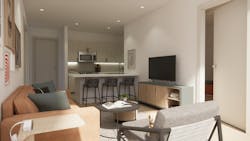
Location, user experience key factors in off-campus student housing success
Off-campus construction has slowed, with new deliveries projected to fall below 30,000 beds this year and next, says Gregg Logan, Managing Principal with real estate consulting firm RCLCO.
To be competitive, off-campus housing must be walkable, bikeable, or immediately adjacent to public transit, says Patrick Fleming, Vice President, Commercial Group, JE Dunn Construction. But vacant lots near campuses are drying up, says Cooper Carry’s Donny Kim, AIA, LEED AP, Associate Principal, Director of Student Housing. “I’ve heard at conferences that developers are going a bit farther out due to the lack of sites immediately near the campus,” he says.
As a result, “in many markets, particularly in dense urban areas, off-campus student housing has become increasingly unaffordable,” says Suffolk’s Jeff Gouveia, President of Executive Operations.
Even if you can find a close-to-campus parcel, “Neighborhood relationships need to be carefully managed,” says David P. Manfredi, FAIA, LEED AP, CEO and Founding Principal, Elkus Manfredi Architects.

That’s because city officials and their constituencies sometimes have a love-hate relationship with off-campus housing, says Ben Kasdan, FAIA, LEED AP, NCARB, Design Director, KTGY. “In San Francisco, they see purpose-built student housing as competing with the development of family housing, but they’re glad if it gets students out of private homes near campus.”
Some mid-size college towns where student enrollment is up—Ann Arbor, Mich.; West Lafayette, Ind.; College Park, Md.—are embracing density and verticality because local officials would prefer to concentrate students near the campus rather than in established residential neighborhoods, says Bob Keane, AIA, NCARB, Managing Principal, WDG.
GETTING HARDER TO GET ENTITLEMENTS
Adding to the affordability problem is the increasingly complex and time-consuming entitlement process, says Mohamed A. Mohsen, AIA, LEED AP, Principal, Niles Bolton Associates. “You’re negotiating with everybody—neighborhood groups, city staff, the planning commission, design review, the city council,” he says.
To get entitlements for the Mark Mansfield, an eight-story, 738-bed residence surrounded by the University of Connecticut, Newman Architects worked with town officials in Mansfield, Conn. “The site was zoned for multifamily and every unit will have a kitchen and laundry,” says Newman’s Dov Feinmesser, AIA, LEED AP BD+C, Associate Principal, Director of Sustainability. “We got some more density by pursuing Energy Star certification and including a cafe that will be open to the public, even though it’ll be mostly for students.”
To make off-campus rentals more affordable, AEC teams are maximizing plate sizes on smaller sites and “getting aggressive” with tighter building layouts, says Mohsen. That can mean smaller courtyards, compressed floor-to-floor heights to gain another floor, and reduced parking ratios to make way for more beds.

“Ten years ago, purpose-built housing had to have bed/bath equity and luxurious amenities like lazy rivers, and costs just got way out of whack,” says KTGY’s Kasdan. “Now, it’s keep the must-have amenities—fitness centers, study areas, social lounges—but cut unit size and go from four-bedroom, four-bath layouts to four-bedroom, two-bath with four sinks in the vanity.”
USER EXPERIENCE: ANOTHER CRUCIAL INGREDIENT
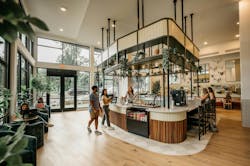
In the face of these constraints, hospitality-centered delivery must remain the focus for off-campus residences, says Matt Post, AIA, Associate Principal, OZ Architecture. “You have to pay attention to the user experience, both interior and exterior, with elevated finishes and a cafe, so that as you enter the property it’s more of a hotel atmosphere, not a dorm.”
Mohsen says there’s been a noticeable push toward amenities that bring people together, not just spaces that look good on a leasing tour. That means creating “environments that invite real interaction”: a courtyard with seating that encourages conversation, shared kitchens where residents can cook in groups, and flexible common areas that can host anything from study sessions to movie nights.
The goal, says Mohsen, is to build in moments that help residents feel they belong to a community. “When those spaces resonate, they shape the resident culture and support the broader living experience,” he says.
Among the more popular amenities Mohsen is seeing in off-campus housing these days:
- Flexible study and co-working spaces: quiet pods, collaboration hubs, and virtual learning environments
- “Outdoor activation”: courtyards, roof terraces, and street-level plazas accessible to the public
- Automated, temperature-controlled package lockers for secure food and parcel deliveries
- Ride share areas connected to resident amenities
What’s less popular off campus, says Mohsen, are oversized units and over-the-top amenities that fail to encourage social interaction; amenity spaces that can’t be reconfigured to accommodate students' ever-evolving needs and activities; and car-centric complexes close to campus. Also out: gaming rooms, golf simulators, and tanning beds.
CUSTOM-BUILT FURNITURE LETS YOU DITCH THE CATALOGS
At some off-campus housing complexes, “The amenities are incredible, but the living units can be disappointing,” says John Kassing, Senior Vice President at interior design firm Mary Cook Associates (MCA).
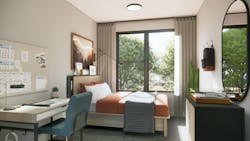
“The problem,” says Kassing, “is that most designers rely on catalogs for furniture, but catalog furniture isn’t designed with the actual space in mind. You’ll see beds with built-in storage where you can’t open the drawers because they’re too close to a desk, or media consoles with no enclosed storage, leaving cords and clutter out in the open.”
For Aperture at UCF—two five-story buildings (204 units, 680 beds) near the University of Central Florida—MCA created “personas” of hypothetical UCF students—by age, gender, psychographic influences, career goals, why they chose UCF—and designed one-of-a-kind furniture that would meet their needs and fit well in the living spaces.
“We made the headboard with a six-inch-wide ledge so they can lean their posters and artwork on top without having to damage the walls,” says Kassing. The living room has a two-tier nested coffee table, the smaller portion suitable for seating.
The furniture is being manufactured by custom fabricator Morgan Li and will be shipped to Orlando ahead of Aperture at UCF’s August opening. The property, a joint venture between Toll Brothers Campus Living and the Davis Companies, is 100% leased.