Hotels are becoming the favored places for retailers and consumer products to bolster their brands
Companies are always looking for ways to extend their brands to new customers. That’s particularly true of retail and consumer brands at a time when the drawing power of physical stores has been diluted by the proliferation of online options that accounted for $349.9 billion in sales in 2016, a 15.6% increase over 2015 and representing 11.7% of total retail sales last year (excluding items not normally purchased online, like fuel and cars), according to Commerce Department estimates.
But it still came as something of a surprise when the Wall Street Journal reported last September that West Elm—William Sonoma’s fastest-growing brand, with 89 home furnishing stores in the U.S. and four in Canada—was launching a chain of boutique hotels, the first of which is scheduled to open on Cass Avenue in Midtown Detroit in late 2018. Other announced locations for West Elm Hotels include Minneapolis, Charlotte, Indianapolis, and Savannah.
Brooklyn, N.Y.-based West Elm, which already supplies products to the hospitality sector, is the latest company to view hotels as natural extensions of their names. The trendsetter may have been luxury jeweler Bulgari, which opened its first hotel in Milan in 2004, and has since opened sites in London and Bali, with new branded hotels scheduled to open in Shanghai, Beijing, and Dubai this year, and in Moscow in 2018.
Several other well-known brands—including Versace, Baccarat, and Virgin—have pasted their names onto hotels, often as an avenue for showcasing their products. In 2014, Tommy Hilfiger paid $56.6 million to acquire the Raleigh Hotel in Miami Beach, which it plans to convert to a members-only club with 88 rooms. This month, New York City’s Landmark Preservation Commission gave the go-ahead to furniture and home furnishings retailer Restoration Hardware to convert a 130-year-old building in the city’s Meatpacking District to a 14-room concept hotel, trademarked under the name RH Guesthouse, near one of its stores. (Anderson Architects is this project’s architect.)
And Shinola, which markets watches and handbags, is working with Dan Gilbert’s investment arm Bedrock Real Estate and the design firm Gachot Studios to convert a building in downtown Detroit that originally housed a hardware store into a 130-room hotel that’s scheduled to open in 2018. (Gachot did not return phone calls requesting comment about this hotel’s design.)
Retail and product brand expansion into hotels, explains Conde Nast Traveler, lets companies cut out the middleman and market themselves directly to aspirational hotel patrons. “Design brands flowing into the hotel business is an opportunity for devotees to live the lifestyles the companies espouse,” the magazine wrote.
Peter Fowler, West Elm’s Vice President of Hospitality and Workspace, told Forbes that opening hotels is part of his company’s broader growth strategy: “How we move from a $1 billion brand to a $2 billion brand.” Fowler also told US News and World Report that 80% of the furniture and décor in West Elm’s hotels will be custom-made and inspired by the cities in which they open. “There’s a huge shift that’s happening, as we see work-life, travel, and leisure blending and merging, and the needs really molding together,” he said.
So far, exclusive partnerships prevail
This trend is still relatively new, and so far has presented limited opportunities for AEC firms, as many of these projects involve management companies and design firms with which the brands appear to have long-term relationships.
For example, Bulgari Hotels & Resorts is a partnership between Bulgari S.p.A and Marriott International. In response to emailed questions from BD+C, Bulgari said that its hotels are managed under standards set forth in a license contract it has with Marriott’s luxury division. And since 2004, Bulgari has used Antonio Citterio Patricia Viel + Partners as its exclusive architect and designer for its hotels. “They have been able to interpret our vision of luxury as an expression of superior Italian craftsmanship by creating a luxurious, refined environment,” Bulgari stated. It added that the hotels’ architectural design “relies on extensive use of rich materials and finishes, and residential furniture from Italy’s leading brands.”

A rendering of 55 Ganvevoort Street, a landmark building in New York City that Restoration Hardware plans to convert into a boutique hotel that would be near one of its furniture and home furnishings outlets. Image: Courtesy of Anderson Architects.
Some attempts by consumer and retail brands to expand into hotels have also taken a while to get off the ground. The renovation of Tommy Hilfiger’s Raleigh Hotel, for one, was supposed to start in 2015, and then 2016, but has yet to begin. (Florencia Weinschelbaum, AIA, Senior Project Manager at Touzet Studio in Miami, the architectural firm overseeing this renovation, at presstime had not responded to BD+C’s request for comment about this project and its design parameters.)
Still, Tommy Hilfiger and its development partner, the Turkish conglomerate Dogus Group, are reportedly scouting other hotel locations in Los Angeles, Aspen, London, and New York.
And then there’s Equinox, the upscale fitness center chain, which recently launched a luxury hospitality brand and intends to open its first fitness-oriented hotel in New York City’s Hudson Yards development in 2018, and a second hotel in Los Angeles in 2019. Travel + Leisure magazine reports that Equinox eventually wants to match its hotel count with its number of gym locations, currently 77.
To lead that effort, Equinox this month hired Niki Leonidakis, the former CEO of Two Roads Hospitality and a 30-plus year industry vet, as CEO of Equinox Fitness Clubs. Leondakis provided some insight into her thinking about hotel branding and design during a recent roundtable discussion, conducted by USA Today. “Hotel design is an expectation, not a differentiator,” she said. “So we don’t approach design from a ‘Let’s create a cool design’; we approach design from a ‘this is the brand, this is the brand promise, this is the target customer, and this is how we want to feel.’ ”
However, Equinox’s brand expansion into hotels is occurring at a moment when fitness equipment appears to be the least used hotel amenity. A new study on selecting hotel amenities—conducted by Cornell University School of Hotel Administration and based on research from 33 hotels across six brands managed by an unidentified global company—found that while 46% of hotel guests intend to work out during their stay, only 22% actually use the hotel gym.
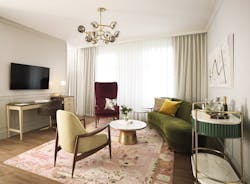
Eighty percent of West Elm Hotels' furniture and decor will be custom-made and inspired by the cities where the hotels open. The hotels will also have a “strong design ethos,” says Jim Brett, West Elm's president. Image: West Elm Hotels
Connecting with customers and communities
To expand its brand into hotels, West Elm is working with DDK, a hotel management firm with more than 60 years in hospitality and investment experience. In an interview with BD+C, Fowler said that DDK will be the exclusive operator of its hotels, which it is developing with local partners.West Elm is open to new construction or renovating existing properties, and while each property will vary in size, the hotels will target between 100 and 250 rooms.
Jim Brett, West Elm's president, has stated that his company’s branded hotels will be distinguished by “a strong design ethos.” Fowler wasn’t at liberty to divulge which architects and designers West Elm is working with for its hotels. He did say, though, that its design’s mission is to “create a network of individual hotels that combines consistency of quality with an experience that reflects the local community in design [and] programming.”
West Elm’s hotels will target travelers of all ages—which, in itself, would make them different from the Millennial-obsessed boutique venues that other hoteliers have opened. The goal, said Fowler is to “deepen” West Elm’s “connection” with its customers and communities. “Our entry into the hotel industry is a natural next step … and an opportunity to continue building a brand that doesn’t oversaturate the retail market.”