Planning and designing shared workspaces that empower physician faculty
This blog post was authored by Swapna Sathyan, MBA, Principal and Consulting Director, Blue Cottage of CannonDesign; and Chris Lambert, LEED AP, Consulting Principal, Blue Cottage of CannonDesign.
Faculty—many of whom are practicing physicians—navigate the complexities of meeting the responsibilities of this tripartite mission. The work is both important and fulfilling, and the work environment to support faculty must adapt to address the needs of these distinct users.
These coalescing factors put unique pressure on academic medical centers as the ways physicians care for patients and spend their time on campus are changing. Whereas traditionally hundreds to several thousand physicians might have been assigned private offices—today's workforce necessitates new models that seize new opportunities around technology, wellness, and cross-disciplinary collaboration.
As CannonDesign and Blue Cottage of CannonDesign work with academic medical centers, there is an emerging shift toward shared workspaces in lieu of private offices. Beyond responding to the current and future needs of faculty members, these thoughtfully designed environments also help open space for patient care and research.
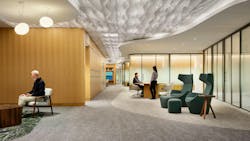
It’s never easy challenging long-held norms that touch culture, tradition and identity as much as academic medical center workplaces, but it is becoming a necessary conversation. In fact, our clients such as the University of Colorado Anschutz, Penn Medicine and Northwestern Medicine have made the leap—and are seeing positive results:
- Northwestern Medicine’s Faculty Office Center operates on a membership basis and has seen extensive faculty members move from private offices to join the center. Shortly after opening in February 2025, Northwestern has decreased dedicated physician offices significantly with resoundingly enthusiastic feedback.
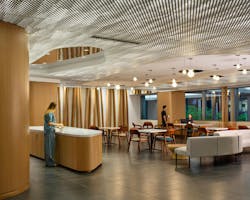
- The University of Colorado (CU) Anschutz Medical Campus opened the HUB in 2019 with an initial membership of 120 faculty. Now, the current membership sits at 860, and CU Anschutz has opened two similar spaces (together called the Clubs) to accommodate demand.
- Penn Medicine has applied a similar model expanding their Future of Work strategy across their real estate portfolio. The shared faculty space in their Clifton Center for Medical Breakthroughs is in close proximity to clinical areas and serves faculty from various departments.
Each of these institutions has advanced successful shared workspaces solutions in part because we gathered direct feedback from faculty on the amenities and opportunities that matter most to them. We’ve then translated that feedback into highly responsive spaces that can adapt as needs and technologies evolve.

Here’s a look at four distinct ways these shared workspaces drive value for faculty and health systems alike:
1. Wellness
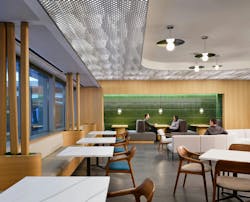
These centers can offer impactful benefits to faculty members with a range of amenities that matter to them while supporting different work styles. In most cases, shared physician workspaces feature reservable private offices and meeting rooms along with open lounge spaces for more casual breaks.
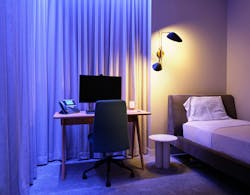
Additionally, shared workspaces can be more easily infused with amenities including meditation rooms, workout equipment, showers, white coat cleaning services, custom food options, lactation rooms, nap pods, and much more. In some instances, these spaces even model hotel-like concierge services such as notary services and Amazon lockers that help clinicians balance personal and professional demands.
Centralizing and introducing these services in shared physician workspaces makes them more accessible, equipping them to better deal with their own health, wellness, and work-life balance.
2. Team Medicine
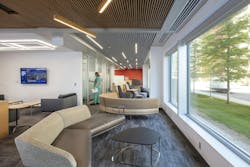
Academic medical centers often care for patients with complex medical issues where physicians from multiple specialties collaborate to provide optimal care. Having shared workspaces where it is easy for groups of varying sizes to meet up on campus makes this cross-disciplinary teamwork easier and more likely to occur as opposed to across multiple private offices.
Using real estate resources efficiently also enables institutions to provide specialized conferencing technology that allow for telehealth visits or hybrid collaboration in interdisciplinary meetings.
Shared physician workspaces can more easily infuse accessible state-of-the-art technology that makes both physicians individual and teamwork more efficient.
3. Clinical Proximity
Traditional private offices have typically been physically distant from patient care spaces, in administrative buildings, or other off-campus buildings. If a faculty member only has a short break, it may be difficult for them to get back to their office.
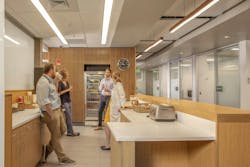
Faculty centers that are located a main clinical building or adjacent to main patient care spaces create convenient spaces for faculty to accomplish productive work in the precious minutes between other responsibilities.
4. Financial Performance
By rethinking the paradigm, individual offices can be replaced by purpose-built faculty centers, allowing academic medical centers to devote more area to patient care, diagnostic and treatment space or research labs, and those overhead costs are concentrated to one space for hundreds of faculty members.
While discussions about moving away from private offices can feel difficult when they remain theoretical, these shared faculty centers show that when faculty feedback and input is actively gathered, thoughtfully implemented and experienced in practice, the result can both support physicians and unlock significant cost and space savings for the institution.
With the ability to provide not only critical private workspaces but also amenities and services in a centralized space, these faculty centers offer much more to physicians in the long run when it comes to cultivating wellness and productivity outside of patient care.
About the Author
CannonDesign
CannonDesign’s Insights is a place for the global design firm to share thoughts and news related to their current efforts to help transform businesses, educational models and health paradigms. The firm engages diverse perspectives and expertise to deliver proven, innovative solutions to our most important partners, our clients. Our global network of more than a thousand professionals enable us to create design solutions to the greatest challenges facing our clients and society. Follow us on Facebook, Instagram, LinkedIn, and Twitter.