Quantum leap: Tackling the challenges for quantum computing facilities
This blog post was authored by David Clensy, Copywriter, Buro Happold.
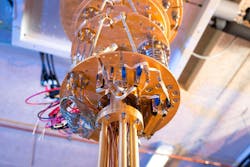
Quantum computing represents a revolutionary leap in technology, promising to solve complex problems that are currently intractable for classical computers. By leveraging the principles of quantum mechanics, quantum computers can process vast amounts of data simultaneously, offering unprecedented computational power. Creating buildings for housing quantum computers presents interesting challenges for design teams, with engineers and architects working closely with the computing experts to fully understand the requirements of the cutting-edge equipment.
One of the primary concerns is maintaining an environment with extremely low temperatures, often close to absolute zero, to ensure the stability of quantum bits (qubits). This requires advanced cryogenic systems. Additionally, quantum computers are highly sensitive to electromagnetic interference and vibrations, necessitating specialised vibration-damping structures. The need for precise environmental controls into a functional and efficient facility demands innovative design solutions.
Quantum computing will have significant implications for various fields, including cryptography, material science, and artificial intelligence, potentially leading to breakthroughs in drug discovery, optimisation problems, and secure communication. As research and development continue to advance, quantum computing holds the potential to transform industries and drive innovation in ways we are only beginning to imagine.
Unlocking the potential
Buro Happold’s teams around the world are at the forefront of shaping this new specialism, working on quantum computing facilities from the U.S. to the Netherlands. Hubrecht Van Ginneken, a partner and director based in our office in Rotterdam, led the Buro Happold project team working on new quantum computing facilities for QuTech, an innovative, mission-driven research institute that works on radically new technologies with world-changing potential.
Our building services (MEP) experts delivered highly bespoke infrastructure systems for these specialist, highly sensitive scientific facilities. The institute believes this technology will be a game changer in many social and economic sectors, including health, agriculture, climate, and safety.
"Quantum computing requires a quantum effect, which only appears in very cold conditions around 10 millikelvin (mK)," Hubrecht Van Ginneken explains. "Achieving and maintaining 10 millikelvin requires sophisticated cryogenic technology, as it’s far colder than anything found naturally in the universe.
"Our role is to integrate this technology with the built environment. To put 10mK into context—it’s an incredibly low temperature, just a fraction above absolute zero, which is 0 Kelvin (-273.15C). For comparison, the coldest natural temperature ever recorded on Earth is around -89.2C, and even the coldest known places in space, like the Boomerang Nebula, are only about 1 Kelvin. This extreme cold is necessary for quantum computing to minimise thermal noise and maintain the delicate state of qubits.
"Running this kind of highly specialist cooling system requires a lot of electricity and a lot of cooling water," Hubrecht adds. "From an MEP point of view, that’s the most complicated aspect of this type of building."
Sustainability in quantum computing
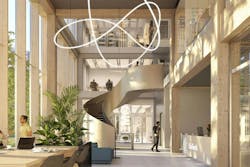
Universities and progressive technology companies—the organisations currently leading quantum computing development—also tend to be the leaders when it comes to delivering sustainability goals. In Delft, the University has an aspiration to be carbon neutral across its campus by 2030. By the same year, it intends the campus to be truly “circular”—in terms of waste and material flows—and climate adaptive, with infrastructure in place to allow it to deal with weather and heat extremes. This context had to inform the wider design for the new building, with some element of balance created to counteract the specialist laser and cryo laboratories where, by necessity, spaces are energy intensive.
"In terms of electrical intensity, there’s no way around it," Hubrecht says. "The quantum computer set-up requires a certain high amount of electricity. A consequence of this is that the client needs to purchase green electricity. In terms of cooling water, at Delft they have created a separate hot and cold network where they try to make it as optimised as possible, and also reuse some of the hot and cold energy between the different buildings."
Chris McClean is a partner at Buro Happold based in Los Angeles, leading on this sector. He believes the sustainability concerns around enabling quantum computing need to be taken in context with the potential benefits the new technology could deliver—not least to tackling climate change.
"You need to ask yourself, per piece of science achieved, could it be more energy efficient in the long run?"
Dealing with uncertainty
McClean says during the current NISQ-era (Noisy Intermediate-Scale Quantum) some organisations are utilising quantum computing technology to demonstrate quantum use cases, such as logistics optimisation, whilst others are focusing on developing more powerful QPUs (quantum processing units) with increasing qubit count and fault tolerance to enable future applications such as quantum chemistry. Our support is proving critical to helping clients understand the built environment requirements for the technology. Given the evolving nature of the research, our approach to developing built environment solutions has to be highly flexible and adaptable to their evolving needs. This means working more closely than ever with the client-side experts who will be using the equipment to understand their needs, with a consciousness for factoring in the levels of uncertainty that come with engaging in such experimental technologies.
"It is evolving and nothing is cast in stone," he says. "There is a lot of research going on. There are a number of quantum processor modalities—superconducting, photonic etc.—being developed by multiple organisations. They are all still quite different and things evolve pretty radically year-on-year. It’s an iterative loop. As a bit of new science evolves, what we do on the buildings side possibly needs to change to accommodate it.
"We work with clients to make the infrastructure as flexible as possible to accommodate the near-term future needs, while balancing the adaptability at a certain point to minimise costs.
"Our role is to address the complexity of emerging technologies, their energy and cooling demands, and to develop resilient and sustainable built asset solutions to enable this ground-breaking and exciting new technology. Getting this right will unlock the full potential and realise enormous benefits for society as a whole."
It’s an iterative loop. As a bit of new science evolves, what we do on the buildings side possibly needs to change to accommodate it.
- Chris McClean, Partner, Buro Happold
Richard Walder, a Buro Happold partner who leads our UK science and technology portfolio, says: "It is proceeding at pace. In terms of commercialisation and outputs, it may still be at a very early stage. But it’s changing fast, and in the UK we have places like the National Quantum Computing Centre in Oxfordshire, which is going to be a good catalyst for development.
"Everyone’s feeling that, although it doesn’t have all the answers at the moment, it’s certainly on the right trajectory and there’s plenty of excitement in the market for it."
Graham Kean, Buro Happold’s chief development officer, adds: "One of the things that Buro Happold has always been good at, is dealing with complexity. The challenges we’re facing with quantum computing are very different from some of the complex challenges we have traditionally faced in the past, but the design processes and technical skills to find the solutions are in our DNA and we relish a challenge!
"I am convinced that by working collaboratively with our technology partners, research universities and architecture colleagues we will deliver an operating environment that is sustainable, agile, inspiring, and able to adapt to meet future needs of quantum technology."
Read more about what quantum computing might mean for the future evolution of laboratory spaces.
About the Author
Buro Happold
Buro Happold is an international, integrated engineering consultancy. Operating in over 35 locations worldwide, with over 100 partners and over 3,000 employees, for over 45 years we have built a world-class reputation for delivering creative, value led solutions for an ever-challenging world. Always driven by their guiding principles of mutual respect and working collaboratively with clients, Buro Happold values sustainability and equity above all else; creating better outcomes for clients and communities. www.burohappold.com