The 'Big Five' strategies to going greener
This blog post was authored by Lauren Park, AIA, LEED AP BD+C, WELL AP, Senior Associate and Sustainability Specialist, GWWO.
Building sustainability is dynamic. Easily quantifiable metrics, such as energy and water usage, are intertwined with the more nuanced qualities of beauty and occupants' delight.
A truly sustainable building takes a holistic approach to balance the needs of the users, budget, and environment. Let’s dive into five facets of sustainability that have a large influence on a building’s environmental impact: operational carbon, embodied carbon, recyclability, carbon sequestration, and passive design.
1. Operational Carbon: What We Do Everyday
Operational carbon is the carbon omitted during the day-to-day use of the building: the heating, air conditioning, ventilation, equipment that uses power or fuel, and lighting. The key to reducing operational carbon is metering and monitoring usage to influence impactful reductions in energy usage. For example, traditionally, a building’s heating and cooling system turns on hours before the first users arrive. The building operator wants the building to have time to warm up or cool down to limit early morning discomfort and complaints. Thanks to more efficient heating and cooling systems paired with thermally-tight exterior walls, doors, and windows, buildings need less time to reach occupied temperature set points. Optimizing scheduling with informed, responsive start times and multiple building zones can ensure heating and cooling is best serving users and not wasting energy on unoccupied spaces.
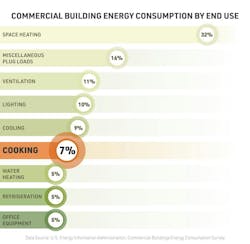
As heating and cooling systems become more efficient, sources of smaller energy use now have a larger relative impact on the overall energy demands of the building. In commercial buildings, food service operations often account for about seven percent of the building’s energy usage - almost as much as its cooling systems! Choosing electric induction cooking equipment instead of gas cooking equipment will result in increased efficiency. As a bonus benefit, indoor air quality will improve without the gas burners.
2. Embodied Carbon: What We Did Already
Embodied carbon is the total amount of carbon dioxide equivalent (CO2 e) emitted during extraction, manufacturing, transport, and disposal of building materials. Renovating an existing building is an excellent strategy to reduce the overall embodied carbon of a project, as compared to new construction. Retaining existing foundations and structural systems, which are carbon-intensive elements, dramatically lessens embodied carbon over building these as new construction. Smart materials selection is the key to reducing a project’s embodied carbon. Let these questions guide you:
- What is the material made of? Does it require an intensive manufacturing process?
- Where is the material harvested or fabricated? Will it travel +100 miles to the project site?
- How long will it last? Can it have 25+ years of useful life?
- Can the material be recycled once it has reached the end of its useful life?
Select materials free from volatile organic compounds (VOC's), formaldehyde, and other toxins, which contribute to healthy interior air quality. Material durability is also a key part of embodied carbon analysis; there is a high financial and environmental impact of material disposal and replacement.
3. Recyclability: What We Can Do
Many building materials are not easily recycled or are being recycled improperly. Prioritize material manufacturers that offer take-back programs. For example, seek out manufacturers that will accept old carpeting and recycle it into padding for their new flooring products.
Manufacturers understand the chemical composition of their products and can get the best value of the recycled material, thus limiting the amount of virgin material in their new products. Recycling eliminates landfill dumping fees, lessens the waste in landfills, and decreases the overall embodied carbon of the material.

4. Carbon Sequestration: What The Plants Do
Landscape carbon sequestration is the absorption and storage of carbon by trees and shrubs. Plantings do an amazing job of sequestering carbon! It’s a valuable design exercise to calculate the current carbon sequestration of your site’s landscape and compare it to the potential sequestration power of the new landscape design. Strive to improve the site’s carbon sequestration potential by maximizing planted areas and with the appropriate selection of plant materials.
For example, rhododendron shrubs are carbon sequestration powerhouses; they perform photosynthesis year-round. Heritage Museums and Gardens undertook an onsite initiative to track the carbon sequestration of their 100-acre campus with impactful results. Learn more about the Heritage Museums and Gardens in the article Reducing Carbon Emissions in Complex Environment.
5. Passive Simplicity: Something Easy to Do
Planting deciduous trees and shrubs is a natural, simple passive design investment. Deciduous plants’ leaves provide cooling shade to buildings in the summer while their bare branches enable radiant, warming rays to reach the building in the winter. Their light-filtering and patterning adds beauty and interest both externally and internally. Remember that the landscape is such an important part of the project’s sustainability story.
A holistic approach to sustainability offers the highest impact. Sustainable building design is developed through an unwavering desire to support the needs of the user, budget, and environment. Let efficiency, simplicity, and durability guide you in your sustainable building journey.
About the Author
GWWO
At GWWO, we are architects, thinkers, wonderers, creators, partners, collaborators, debaters, and questioners. It is in this spirit—and based on our desire to engage, share, and discuss—that we blog. Our intent is to bring you news from the industry and our cultural and educational markets, to discuss our point of view, to pose thought-provoking questions, and to engage in discussion with our readers. We invite your suggestions, questions, and comments and look forward to an open and lively dialogue. Visit our blog site, and follow us on Facebook and LinkedIn.