Battery safety requirements and implications for the built environment: 2027 International Fire Code update
The increasing use of lithium-ion battery-powered products has created novel fire-protection and design challenges for designers, facility operators, and authorities having jurisdiction (AHJs) across multiple sectors.
This article highlights the key changes in the upcoming 2027 International Fire Code (IFC) related to battery safety and their implications for building design, fire protection, facility operations, and permitting.
The 2024 IFC introduced the first dedicated requirements for the storage of lithium-ion and lithium-metal batteries in Section 320 and added separate provisions for powered micromobility devices in Section 322 under the general requirements in Chapter 3.
Before the 2024 edition, the IFC primarily addressed batteries installed as part of energy storage systems (ESS) under Chapter 12. It did not provide a dedicated framework for the storage of idle lithium-ion or lithium-metal batteries that were not part of an ESS.
While many jurisdictions are still working toward adoption of the 2024 IFC, the 2027 edition is expected to introduce several meaningful changes in how the code addresses batteries, battery-related operations, and battery-powered equipment.
The 2027 IFC Framework
In the forthcoming 2027 IFC, most 2024 storage provisions are carried forward, though reorganized and refined. The more important change is that battery safety is no longer addressed mainly as a storage or micromobility issue.
The new Chapter 43, “Batteries and Battery-Powered Equipment and Devices,” covers a much wider range of activities and equipment found in many facilities. The chapter is divided into requirements for:
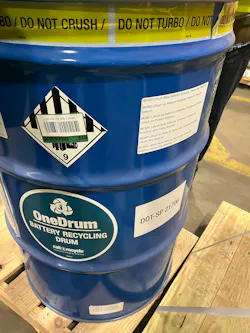
- battery research, testing, manufacturing orrecycling
- battery storage
- battery-powered equipment and devices
- portable power packs
- other battery types
Installed stationary, mobile, and portable energy storage systems remain under IFC Section 1207. A facility could contain stored batteries, battery-powered forklifts, robotic equipment, portable power packs, and an installed energy storage system, with different code provisions applying to each condition.
The 2024 International Building Code (IBC) identifies lithium-ion or lithium-metal battery testing, research, and development as Group B; manufacturing of batteries, energy storage systems, or equipment and vehicles containing these batteries as Group F-1; and battery storage and repair garages for battery-powered vehicles as Group S-1.
For owners and designers, the practical point is that a facility should not be reviewed only based on its battery inventory. Each battery-related activity and type of equipment should be identified because different building and fire code requirements may apply to each usage area.
From the 2024 IFC Section 320 to Chapter 43 in the 2027 Edition
The following discussion breaks down the major proposed Chapter 43 sections and highlights the major changes from the past editions.
Section 4302 – Lithium-Ion and Lithium Metal Battery Research, Testing, Manufacturing or Recycling
Section 4302 establishes requirements for facilities where lithium-ion or lithium-metal batteries are developed, tested, manufactured, repaired, refurbished, dismantled, or recycled. A fire safety plan and a technical opinion and report are required. The report must evaluate hazards, such as:
- combustible dust
- flammable liquids and gases
- formation and aging
- destructive testing
- high-piled storage
- damaged or recalled batteries
- firefighting access
- flying debris
- suppression system's basis of design.
Automatic sprinkler and fire detection systems are also required. Some of these operations require 2-hour fire-resistance-rated separation from the remainder of the building. This includes areas where batteries of more than 2 kWh capacity are charged or tested, or undergo formation or aging, as well as areas involving any quantity of destructive testing or recycling.
Section 4304 - Battery-Powered Equipment and Devices
Section 4304 expands the scope of the 2024 micromobility provisions to include battery-powered industrial trucks, industrial equipment, automated mobile platforms, robotic equipment, and appliances. Equipment with a battery capacity below 200 watt-hours is generally exempted.
These provisions can affect warehouses, manufacturing buildings, retail facilities, laboratories, repair operations, and other occupancies where battery-powered equipment is charged or used.
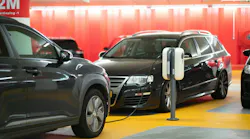
The fire area containing the indoor charging location must be protected by an automatic sprinkler system. The charging location must also have a fire alarm system using smoke detection, thermal imaging, or radiant energy-sensing fire detection. The charging area must have enough permanent electrical receptacles to allow each charger to connect directly to a receptacle.
Extension cords and relocatable power taps are prohibited. An 18-inch separation is also required between the locations of batteries on each powered micromobility device, industrial truck, piece of equipment, robot, or appliance during charging.
Section 4305 - Portable Power Packs
Section 4305 directs portable power packs with an energy capacity of 1 kWh or greater to new Section 1209, under the Energy Systems Chapter 12. Portable power packs with capacities from 1 kWh through 20 kWh must be listed and labeled in accordance with UL 2743 and used according to their listing and the manufacturer’s instructions. Units exceeding 20 kWh are regulated as energy storage systems under Section 1207. This provides a clearer path for large portable or wheeled power units that do not fit neatly within the traditional stationary ESS requirements.
Section 4306 - Other Battery Chemistries
Section 4306 applies where more than 15 cubic feet of batteries other than lithium-ion or lithium-metal batteries are stored within a fire area. The requirements address
- rack stability
- seismic design
- vehicle-impact protection
- approved charging equipment
- electrolyte spill control
- warning signs
Where charging can produce flammable gases, the mechanical exhaust system must limit the maximum concentration of flammable gas to 25 percent of the lower flammable limit within the total volume of the room or area during the worst-case simultaneous charging condition.
To accommodate the changes, Section 309, powered industrial trucks and equipment, is clarified to apply to fuel-powered industrial trucks and equipment only. The older battery-charging provisions are removed from Section 309, while battery-powered equipment is regulated by Section 4304. This avoids having two sets of charging requirements apply to the same forklift or piece of equipment and reduces the potential for conflicting code interpretations.
Section 4303 - Battery Storage
Under Section 4303, battery storage provisions are mostly carried over from 2024. One change adds an exception for lithium-ion batteries rated at 300 watt-hours or less and lithium-metal batteries containing 25 grams or less when in use, staged for use after charging, or charging for use with equipment.
Chapter 43 also provides more detail on limited indoor collection and waste storage aligned with NFPA 855, Standard for the Installation of Stationary Energy Storage Systems. It requires technical reports for outdoor storage arrangements, which is an addition to the requirements in the IFC 2024 edition. Many 2024 IFC storage requirements were based on concepts in Chapter 14 of the 2023 edition of NFPA 855.
For indoor storage, the early-release 2027 IFC still requires air-aspirating smoke detection, radiant energy-sensing fire detection, or both. By comparison, Section 14.3.2.1.2 of the 2026 edition of NFPA 855 permits smoke detection, thermal-imaging detection, or radiant energy-sensing fire detection installed in accordance with NFPA 72, National Fire Alarm and Signaling Code. The early-release 2027 IFC language did not incorporate that broader NFPA 855 language.
For a new facility or an existing design, the practical message is that the battery inventory is only one part of the code review. The design team also needs to identify what will be charged, tested, repaired, returned, or recycled within the building.
Partnering with an Expert
Although the final 2027 IFC may contain editorial changes, the overall direction of Chapter 43 is expected to remain. Facilities that store, use, charge, test, repair, manufacture, or recycle batteries should expect a broader and more coordinated assessment than under previous editions. Early involvement of an experienced fire protection engineer is therefore important, since waiting until permit review could result in significant redesign, additional revisions, and project delays.
A fire protection engineer can evaluate these connected requirements, assess the hazards associated with the specific battery chemistry and operation, and develop practical design and operational measures. Addressing these issues early helps integrate battery safety into the overall building design and can avoid significant redesign, additional revisions, and project delays during permit review.
About the Author
Saleel Anthrathodiyil, PE, CFPS, MIfireE, PMSFPE, is a Team Lead of Fire Protection Engineering at Telgian Engineering & Consulting (TEC). Anthrathodiyil has extensive experience in smoke control design, fire and egress modeling, hazardous materials analysis, and regulatory code consulting. He specializes in performance-based fire engineering, NFPA/IBC code interpretation, and third-party inspections and testing. His experience offers a strong track record of effective collaboration with AHJ’s, clear communication, timely approvals, and reduced project risk. Saleel can be reached at [email protected].