Turning a façade into a power source
This blog post was authored by Robert McClure, AIA, NCARB, Principal and Design Director, Stantec; Alison Ledwith, AIA, WELL AP, LEED AP BD+C, Senior Associate and Senior Design Architect, Stantec; and Mo Elsayed, Senior Associate and Senior Building Performance Analyst, Stantec.
When George Mason University advanced plans for a net-zero campus, one priority stood out: A visual display of their campus’s innovative approach towards responsible, high-performance design.
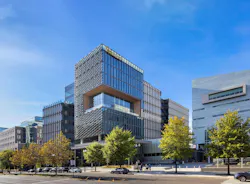
The university partnered with the architects and designers at Stantec to bring this vision to life. While George Mason University was developing its broader net-zero strategy, Stantec was tasked with designing a photovoltaic (PV) system for Fuse, a revolutionary innovation hub in Arlington, Va.
Fuse as a hub for lightbulb moments
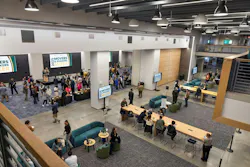
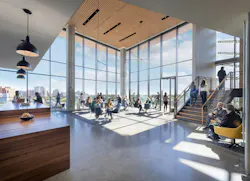
Fuse is roughly divided into thirds, with academic spaces, private industry partners, and shared innovation and convening areas. Together, these spaces support education, recreation, retail, and laboratories, creating an innovative environment that includes laboratories, robotics, AR/VR, simulation, and more.
George Mason University envisioned a fully activated building where students could wake up, go to school, go to work, and participate in evening activities all within the building and its immediate vicinity.
Robert McClure, principal and design director who led the project for Stantec, described the effort as “Intentional design that would encourage collisions amongst the people in the building.” McClure envisioned a building where coincidental or unexpected connections occur between occupants, visitors, students, entrepreneurs, scientists, and more. “It’s like a jar with a bunch of lightning bugs in it,” said McClure.
Visible energy, from the street
From the beginning, George Mason University knew it wanted Fuse to project a clear external identity that set it apart from its peers. They wanted passers-by to quickly associate Fuse with innovation and climate-responsive design. With this guidance, Stantec designers saw an opportunity to rethink the traditional design of photovoltaic fins.
Photovoltaic fins are classified as building-integrated photovoltaics (BIPV), where solar energy capture is embedded directly into a building as architectural elements. These elements combine energy generation with shading and aesthetic design. For convenience reasons, photovoltaic fins are often arranged horizontally or vertically. While these rectilinear designs can effectively capture sunlight, they can also limit overall light capture. While these rectilinear designs can effectively capture sunlight, they can also limit overall light capture because neither horizontal nor vertical fins follow the sun's path throughout the day.
A new angle
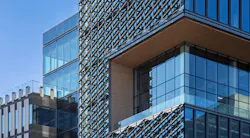
In an effort to embrace a refined approach, Stantec moved away from conventional horizontal fins and introduced an unexpected solution: an array of diagonal fins that trace the perimeter and line the entire façade of Fuse.
Using a parametric optimization workflow, Stantec developed and refined the PV fin façade as a high-performance unitized curtainwall system. The goal was to balance four competing objectives: increasing daylight penetration, reducing glare, preserving clear outward views, and maximizing the capture of on-site solar energy.
Through iterative analysis, the team generated and tested multiple fin geometries, panel densities, and cantilever configurations. Each option was evaluated with Radiance-based daylight studies alongside PV performance analysis to understand how changes in angle, spacing, depth, and coverage affected visual comfort, façade transparency, self-shading, and energy yield. This approach transformed the façade into a multi-functional environmental filter rather than a fixed shading device, maintaining views to the exterior while improving solar control and capturing substantial renewable energy. Across the configurations studied, annual PV output increased to approximately 62 megawatt-hours (MWh).
This innovative diagonal design met the owner’s goal for a visible display of ingenuity and effectively maximized photovoltaic capture year-round.
Because they’re angled, diagonal PV panels can capture sunlight for more of the day, not just when the sun is low, as with vertical panels. As the sun’s position shifts with the seasons, the diagonal orientation continues to capture peak sunlight year-round. Throughout the day, this configuration allows the fins to capture sunlight over a longer time window. An added benefit, and one often overlooked, is the reduction of fin-on-fin shading, which commonly limits the performance of vertical fin systems.
Designing with detail
While the diagonal photovoltaic fins were a design success on their own, designers from Stantec also focused on strengthening the overall aesthetic of their photovoltaic system. The system was conceived not as an applied technology, but as a core architectural gesture, one that merges environmental performance with façade expression. Its angled geometry adds depth, movement, and texture to the building envelope, creating a visually compelling composition that responds to changing light conditions throughout the day. The result is a façade strategy that is both visually striking and rigorously high-performing.
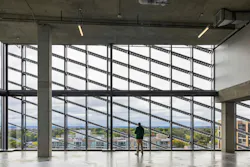
Special attention was paid to system wiring, so all the cables were fully hidden from view. Cable management along the diagonal PV fins ties each module together, allowing wiring to return only at the floor line. Control boxes and home-run wiring were integrated into the floor line and architectural cover and hidden in plain sight, allowing occupants to perceive the electrical systems as a natural extension of the floor rather than an obstruction of their view.
Performance by the numbers
Multiple studies were completed to maximize the number of photovoltaic panels and optimize the system’s diagonal orientation. Using specialized software, the Stantec team generated and evaluated over 300 iterations, testing multiple variations to find the right balance of overall panels, fin angles, tilt, cell count, and depth to balance energy output, panel quantity, and views. The best configuration included about 500 panels, producing roughly 62,000 kilowatt-hours (kWh) annually, with fin orientation at approximately -36° pitch and 17° roll for south-facing fins.
A visible step forward
With the success of Fuse’s diagonal photovoltaic façade, George Mason University and Stantec have demonstrated how integrated design can transform renewable energy into a defining architectural feature. The diagonal photovoltaic system at Fuse exemplifies a new approach to building design that visibly communicates performance, innovation, and sustainability through the integration of parametric design, advanced simulation, and architectural clarity. As research expands to include rooftop photovoltaics, solar-covered parking, and other on-site energy strategies, Fuse continues to serve as a catalyst in the university’s broader goal of achieving a net-zero campus.
About the Author
Stantec
Published by global design firm Stantec, this eclectic blog features viewpoints, insights, and explanations from Stantec architects, engineers, and designers, on a range of issues impacting the fabric of our communities. Our contributors share their thoughts about design trends, emerging technologies, vexing challenges, and inspired solutions. For more blog posts, visit our Ideas page. Follow us on Facebook, Instagram, LinkedIn, and Twitter, and YouTube.